





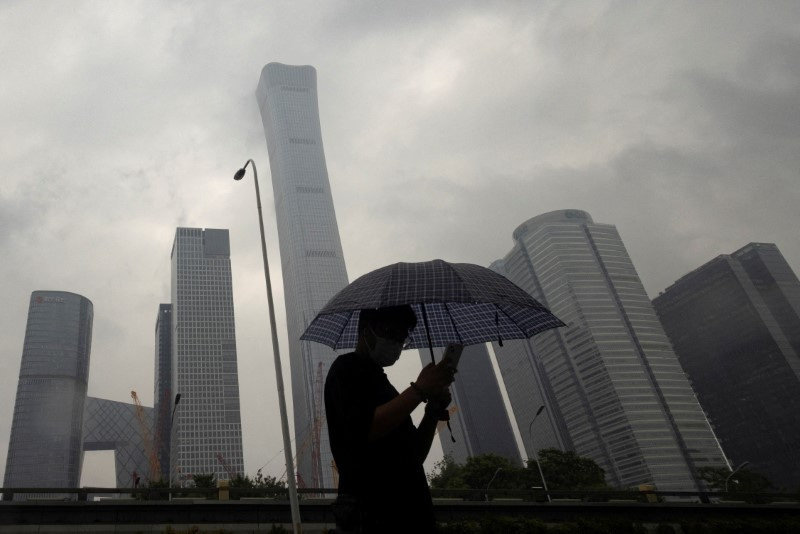
© Reuters. A person walks within the Central Business District on a wet day, in Beijing, China, July 12, 2023. REUTERS/Thomas Peter/File Photo
By Kevin Yao
BEIJING (Reuters) – China’s financial system possible perked up barely within the fourth quarter, enabling the federal government to hit its development goal after the earlier 12 months’s miss, however the outlook for 2024 stays shaky amid a protracted property hunch and weak client confidence.
Data on Wednesday (0200 GMT) is anticipated to indicate gross home product (GDP) grew 5.3% in October-December from a 12 months earlier, quickening from the 4.9 tempo within the third quarter, in response to a Reuters ballot.
But on a quarterly foundation, the financial system is forecast to develop 1.0% within the fourth quarter, slowing from a 1.3% tempo in July-September, underlining the weak momentum regardless of a raft of coverage steps.
For 2023, the financial system possible expanded 5.2%, partly helped by the earlier 12 months’s low-base impact which was marked by COVID-19 lockdowns.
The financial system grew simply 3% in 2022 attributable to strict COVID curbs, badly lacking the official goal.
Confounding most analysts’ expectations, the world’s second-largest financial system has struggled to mount a powerful and sustainable post-COVID pandemic bounce, burdened by a protracted property disaster, weak client and enterprise confidence, mounting native authorities money owed, and weak international development.
Beijing set a development goal of round 5% in 2023 and coverage insiders anticipate it to take care of an identical aim for this 12 months.
Analysts polled by Reuters anticipated development to gradual to 4.6% in 2024, and ease additional to 4.5% in 2025, which can increase the warmth on policymakers to unveil extra stimulus to revive confidence and journey out the property hunch.
Recent information prompt the financial system was beginning 2024 on shaky footing, with persistent deflationary pressures and a slight pick-up in exports unlikely to kindle a fast turnaround in lacklustre manufacturing facility exercise. December financial institution lending was additionally weak.
“Attention will be on the year-end data to be released on Wednesday,” stated Matthew Ryan, head of market technique at international monetary providers agency Ebury. “GDP growth is particularly worth watching, as it could set the tone for sentiment toward China in 2024.”
Investor disappointment with China’s performance last year pushed the yuan currency to a 16-year low at one point. The market capitalisation of stocks listed in Shanghai and Shenzhen fell by a cumulative $258 billion during 2023 and Hong Kong-listed shares lost $592 billion.
MORE EASING STILL SEE ON THE CARDS
Separate data on December activity, to be released alongside GDP data on Wednesday, is expected to show factory output growth steadied while consumption growth slowed and investment remained tepid.
Retail sales, a key gauge of consumption, are forecast to grow 8.0% in December from a year earlier, slowing from a 10.1% rise in November. Factory output is seen growing 6.6% in December year-on-year, matching November’s rise.
The People’s Bank of China (PBOC) has pledged to step up policy support for the economy this year and promote a rebound in prices.
On Monday, the PBOC left the medium-term policy rate unchanged, defying market expectations for a cut as pressure on the yuan currency continued to limit the scope of monetary easing.
Analysts polled by Reuters expected the central bank to cut the one-year loan prime rate (LPR) — the benchmark lending rate — by 10 basis points (bps) in the first quarter.
“Despite the shock, we proceed to anticipate the PBOC to ultimately ship two rounds of coverage price cuts and one RRR reduce in H1 2024, given the continuing financial dip and the fading of pent-up demand for consumption, which we anticipate to speed up following the Chinese New Year holidays in February,” Ting Lu, chief China economist at Nomura, stated in a observe.
The authorities, which in October unveiled 1 trillion yuan ($139.22 billion) in sovereign bonds to fund funding initiatives, is more likely to press forward with extra fiscal spending to drive development, analysts stated.
($1 = 7.1829 renminbi)