






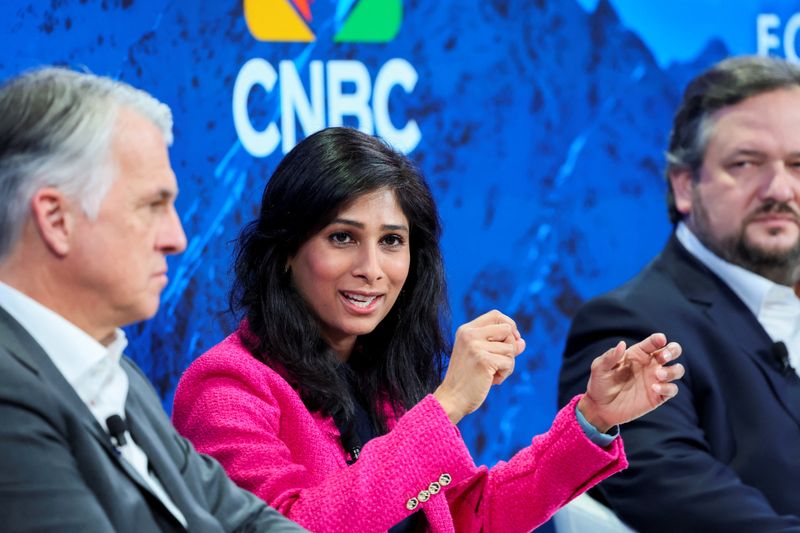
© Reuters. FILE PHOTO: Sergio P. Ermotti, Group CEO of UBS, Gita Gopinath, First Deputy Managing Director of International Monetary Fund (IMF) and Slawomir Krupa, CEO of Societe Generale attend the 54th annual assembly of the World Economic Forum in Davos, Switzerlan
2/2
By Leika Kihara
TOKYO (Reuters) -The Bank of Japan can keep away from upending international markets with its coverage shift by shifting steadily when elevating rates of interest and offering clear communication alongside the best way, International Monetary Fund First Deputy Managing Director Gita Gopinath stated on Friday.
Japan’s output hole will keep closed into subsequent 12 months and this 12 months’s annual wage negotiations will produce wage development larger than final 12 months, permitting the central financial institution to finish its yield curve management (YCC) and large asset-buying programme, she stated.
Ending its detrimental rate of interest coverage in place since 2016, a transfer markets anticipate may occur by April, may even doubtless be easy as there’s a clear recognition by traders that inflation-adjusted actual borrowing prices will stay very low, Gopinath stated.
But additional hikes within the short-term coverage fee must be gradual and delivered in the middle of a number of years, she stated.
“Regardless of whether you do the first increase in two months or three months, the main point is to raise (rates) slowly, over a few years,” she instructed Reuters in an interview.
“As long as the BOJ moves gradually, which is what they have signaled that they will do, and provides the right communication to go along with it, that should not have very large spillovers to the rest of the world,” she stated.
As a part of efforts to reflate development and sustainably obtain its 2% inflation goal, the BOJ guides short-term rates of interest at -0.1%, caps long-term bond yields round zero beneath YCC, and buys large quantities of property to pump cash into the financial system.
But with inflation having exceeded 2% for nicely over a 12 months, the BOJ has been laying the groundwork for exiting its advanced stimulus programme, with a Reuters ballot tipping April because the doubtless timeframe for ending detrimental charges.
Gopinath stated it was additionally essential to maintain Japan’s monetary system steady when exiting simple insurance policies, together with by guaranteeing that minimal liquidity necessities can be found not only for large banks however their smaller counterparts.
She stated there was uncertainty across the stage at which Japan’s rate of interest could be deemed impartial, although some estimates by the IMF recommended the nominal fee could be between 1-2% if it had been at a impartial stage.
Given uncertainty over the financial outlook, the quantity and tempo of short-term fee hikes must be data-dependent, she stated.
“The point of moving gradually, is to get the confidence about incoming data, and making sure that you don’t move prematurely” and set off draw back dangers, she stated.




