




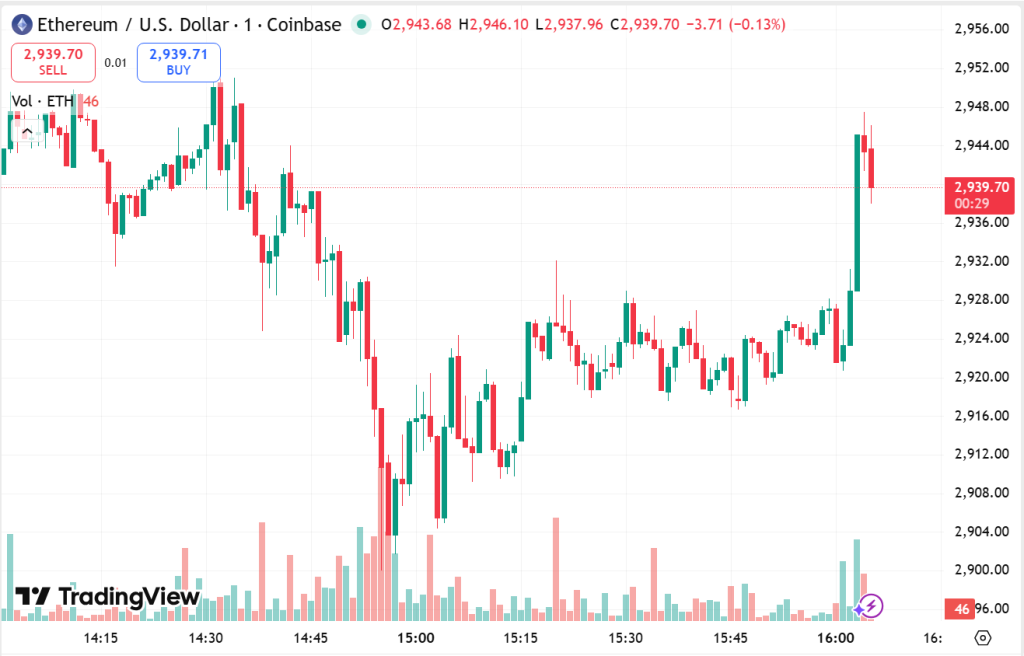
Ethereum is undergoing a silent supply shock. While retail speculation has evaporated, institutional players have absorbed nearly 11% of the circulating supply, repurposing the asset as yield-bearing infrastructure rather than a trading vehicle.
Key Data: Corporate treasuries and spot ETFs now control 10.72% of all ETH, according to data from Strategic ETH Reserve.
ETH is trading at $2,939 (-4.13%), decoupling from the “retail buzz” that drove previous cycles.
The Supply Squeeze
The liquidity drain is quite noticeable as Ethereum reserves on centralized exchanges have plummeted to 10.5%, a record low and a 43% drop since July.
Unlike previous accumulations, this capital isn’t just sitting in whale wallets idly. It’s being locked into staking contracts and treasury vaults.
- The Buyer: U.S. spot Ethereum ETFs have netted approximately $12.4 billion in year-to-date inflows, with BlackRock’s iShares Ethereum Trust (ETHA) leading the charge.
- The Catalyst: BlackRock filed for a staking-enabled ETH trust earlier this month, indicating intent to capture the network’s native yield, effectively treating ETH as a digital bond.
BREAKING:
Blackrock’s iShares just filed for a staked Ethereum ETF. Bullish for $ETH
pic.twitter.com/7DHuXANW4R — Ash Crypto (@AshCrypto) December 8, 2025


Infrastructure, Not Speculation
The value proposition has shifted from “ultrasound money” to settlement plumbing.
“Current prices remain above Citi’s activity-based estimates, likely reflecting ‘buying pressure and exuberance around new use cases such as tokenization and stablecoins,’” according to Citi analyst Alex Saunders in a note seen by Reuters.
Data from RWA.xyz confirms this thesis: Ethereum now secures $12.5 billion in tokenized real-world assets (RWAs). Simultaneously, the network settles $1.6 trillion in monthly stablecoin volume, cementing its role as the financial layer for digitized dollars.
The Outlook and Institutional Take
The disconnect between price action and on-chain metrics is stark. While NFT sales are down 87% from 2021 highs, the structural absorption of ETH continues.
A Binance Square post argued that ETH’s valuation could shift from a deflation narrative toward an ecosystem/infrastructure narrative as stablecoin and L2 usage grow. Separately, Binance Research has pointed out that rising staking participation reduces liquid ETH supply, which can amplify price sensitivity during demand spikes.
Forget the chart for a moment. The real story is the reclassification of ETH in institutional portfolios. It’s no longer a high-beta tech play; it’s being structured as a yield-bearing instrument (approx. 3-4% APR).
The BlackRock staking filing is the “green light” for risk-averse allocators to capture that yield. Expect liquidity to remain thin on exchanges as custodians move assets into cold storage staking solutions, making a “supply shock” squeeze a mathematical inevitability if flows accelerate.
The post Institutions Corner 11% of ETH Supply as Exchange Balances Hit Record Lows appeared first on Cryptonews.