




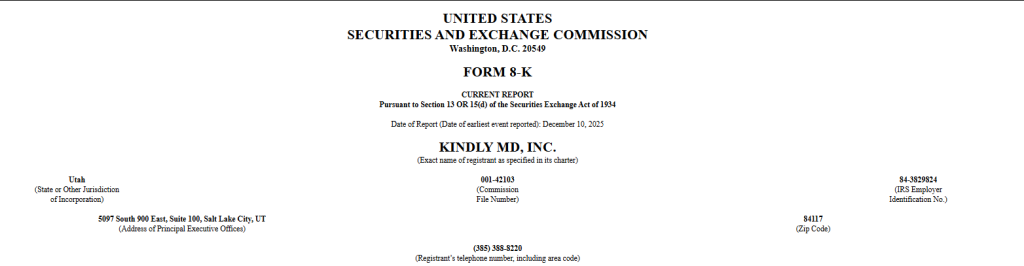
KindlyMD Inc., a healthcare and Bitcoin treasury company, is facing the risk of being delisted from the Nasdaq after its share price remained below the exchange’s minimum bid requirement for an extended period.
In a Form 8-K filing dated Dec. 12, the company disclosed that it had received a notice from Nasdaq’s Listing Qualifications Department after its common stock closed below $1 for 30 consecutive trading days, placing it out of compliance with Nasdaq Listing Rule 5450(a)(1).
KindlyMD’s shares, which trade under the ticker NAKA, are currently priced at $0.38. The stock is down nearly 5% on the day, has fallen more than 30% over the past month, and is down over 73% year to date.
KindlyMD Faces June 2026 Deadline to Recover Stock Price
Under Nasdaq rules, KindlyMD has 180 calendar days, or until June 8, 2026, to regain compliance by maintaining a closing bid price of at least $1 for a minimum of 10 consecutive trading days.


KindlyMD’s current situation marks a steep reversal from earlier optimism surrounding its Bitcoin strategy.
In May, the company merged with Nakamoto, a Bitcoin-focused public entity, in one of the first known cases of a healthcare firm formally adopting Bitcoin as a core treasury asset.
@KindlyMD merges with Bitcoin-native Nakamoto to launch the first-ever Bitcoin-backed healthcare company. #Bitcoin #treasury #Metaplanethttps://t.co/Gw5h56BP70 — Cryptonews.com (@cryptonews) May 13, 2025


The combined entity retained the KindlyMD name, with Nakamoto operating as a wholly owned subsidiary, and raised more than $700 million through a mix of private placements and convertible debt to fund Bitcoin purchases.
That strategy accelerated in August, when KindlyMD acquired 5,764 Bitcoin in a single transaction, spending approximately $679 million at an average price above $118,000 per coin.
According to CoinGecko data, the company now holds Bitcoin valued at about $502.6 million, placing it around 32nd among public Bitcoin treasury holders, down from 26th three months earlier.

At current prices, the position carries an unrealized loss of roughly $176 million, or about 26%.
Bitcoin itself is trading near $87,000, up modestly on the week, but many publicly listed companies holding crypto on their balance sheets have seen their stocks fall faster than the underlying assets.
The Bitcoin Treasury Trade Isn’t One-Size-Fits-All: KindlyMD vs. Strategy
KindlyMD’s financial filings reflect the strain of its rapid transformation. In its third-quarter report, the company posted revenue of $0.4 million from its healthcare operations, while operating expenses climbed to $10.8 million, driven largely by costs tied to its Bitcoin strategy.
The company reported a net loss of $86 million for the quarter, including non-cash charges linked to the Nakamoto merger and unrealized digital asset losses.
Notably, the company said the Nasdaq’s notice has no immediate impact on its listing and that its shares will continue trading on the Nasdaq Global Market during the compliance period.
If it fails to recover, the company may seek to transfer to the Nasdaq Capital Market or pursue a reverse stock split, though it cautioned that there is no assurance either step would be successful.
The situation differs from Strategy Inc., formerly MicroStrategy, which is facing uncertainty tied to index eligibility rather than exchange rules.
Strategy’s spot @MicroStrategy in major indexes is now at risk, with JPMorgan warning that a removal from MSCI USA or the Nasdaq 100 could spark billions in outflows.#Strategy #CryptoStocks https://t.co/ozDjakVUm7 — Cryptonews.com (@cryptonews) November 21, 2025

MSCI began reviewing its index methodology in October 2025, triggering a sharp sell-off in MSTR shares.
The company has formally submitted its 12-page letter to MSCI opposing the proposal.
While the stock later stabilized after retaining its Nasdaq 100 position, the risk remains, with a delisting potentially triggering billions in forced passive fund sales.
MSCI is expected to issue a final decision in January 2026.
Notably, across the market, digital asset treasury stocks have broadly underperformed their underlying holdings in recent months.

Data shows that in November, inflows into DATS were only $1.32 billion in inflows, their lowest level of the year, showing a cooling of investor appetite as volatility and regulatory uncertainty persist.
The post KindlyMD Bitcoin Treasury Faces Nasdaq Delisting As It Plunges Below $1 — Can It Survive Like MSTR? appeared first on Cryptonews.