


On October 18, Tools for Humanity’s World network launched its “World ID for Banking and Finance” suite, with Sam Altman’s firm partnering with Wall Street banks including VanEck, Pantera Capital, and Bain Capital, to counter AI-driven deepfakes via a new integration with Zoom. But behind the glossy enterprise rollout lies a deeply interconnected corporate web designed to turn human biology into institutional liquidity.
As World ID markets itself to global financial institutions as an essential infrastructure layer, uncomfortable questions are mounting over how this biometric database was built, who financed it, and whether everyday retail participants are merely fuel for a highly lucrative financial illusion. While World pitches its “Proof of Human” cryptographic architecture as a high-minded defense against AI impersonation, critics note the network was built by offering crypto incentives to financially vulnerable people willing to submit to Orb verification.
The pitch sounds timely. Deepfakes threaten financial security, while autonomous AI agents are beginning to transact and communicate on people’s behalf. Yet World is selling trust through a network built partly by offering crypto incentives to people willing to submit to Orb verification.
Now, the commercial opportunity is emerging, justifying the bargain struck with those early participants.
Track WLD Market Movements: Trade Worldcoin on Bybit (New Users Eligible for Share of $1,000 USDT Airdrop)
Worldcoin Human ID Expansion Revives the Orb Exploitation Debate
World’s latest announcement presents Proof of Human as essential infrastructure for an AI-heavy internet. Its system can establish that someone is a unique human, confirm their presence, or verify selected attributes. World says its cryptographic architecture can provide these assurances without exposing unnecessary personal information.
That is a legitimate use case. The problem is how the network was built and whether people understood what they were joining.
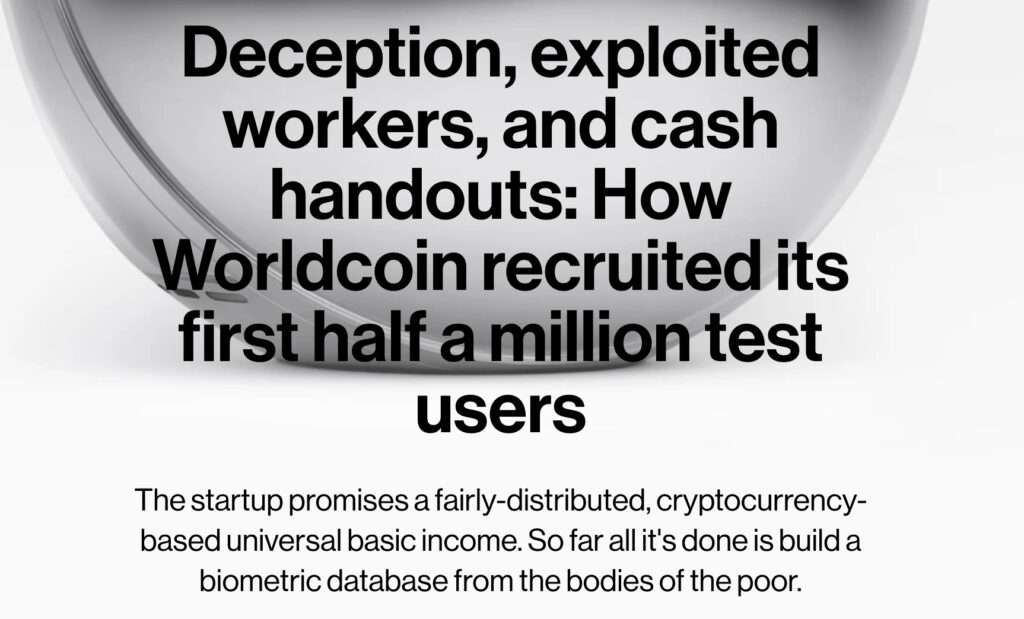
A 2022 investigation by MIT Technology Review documented Worldcoin recruitment practices across several countries, including Kenya and Indonesia. Participants described receiving cryptocurrency, cash, or gifts for signing up, raising fundamental questions about informed consent when financial incentives are offered to people with limited resources.
Reddit discussions in r/degoogle and project forums highlight a related problem. A person who accepts a token incentive is not necessarily an informed, retained user who understands the product.
Anecdotes from the community suggest many of the claimed 18 million verified humans registered primarily to receive rewards, creating a vast disparity between registered biometrics and active user engagement.


Is Wall Street Enterprise Laundering World’s Extracted Data?
This disconnect exposes a darker reality as World targets legacy finance: global banking giants are now actively attempting to buy “trust” built on a foundation of asymmetric economic warfare.
Critics argue that by integrating World ID, these initial design partners are effectively laundering an ecosystem built on the backs of unconsenting, low-income individuals.
By outsourcing their identity security to Worldcoin, institutions like Bain Capital and VanEck Funds are legitimizing a system that commodifies and exploits data from the Global South, purchasing an enterprise verification network whose foundational database was harvested by offering pocket-change crypto incentives to financially vulnerable populations.
This is not a theoretical ethical debate; it is a matter of documented legal record:
- Judicial Condemnation in Kenya: The High Court of Nairobi ruled in Republic v Tools for Humanity Corporation that Worldcoin’s operations violated the nation’s Data Protection Act, citing unlawful data transfers and invalid consent obtained via cryptocurrency inducement. This ultimately forced the Office of the Data Protection Commissioner (ODPC) to order the permanent deletion of biometric data harvested from over 350,000 citizens.
- Supreme Court Pushback in Chile: The Supreme Court of Chile similarly ruled that Worldcoin violated constitutional data protection rights, highlighting a severe lack of safeguards and insufficient mechanisms for verifying informed consent.
For a banking sector bound by strict international compliance, anti-money laundering frameworks, and consumer protection laws, turning a blind eye to the toxic regulatory history of this biometric pipeline represents a profound failure of corporate due diligence.
It signals that as long as the corporate utility is polished, legacy finance has no issue consuming enterprise architecture built on data extraction that sovereign courts have explicitly ordered to be scrubbed and destroyed.
The Hidden Architecture: Is Distribution as a Financial Illusion in World?
While the project frames its current push into banking as a natural evolution of identity infrastructure, market observers point to a deeply interconnected corporate web designed to scale the network through mass retail entertainment.
This institutional roadmap exposes the cold, transactional calculus behind the project’s vision. Public market vehicles like Eightco Holdings (NASDAQ: ORBS), backed heavily by institutional investors like Bitmine Immersion (NYSE: BMNR), have accumulated significant treasuries of WLD, alongside massive private-market equity positions in Sam Altman’s OpenAI and Jimmy Donaldson’s Beast Industries (MrBeast).
By treating human identity as mere fuel for an interconnected corporate ecosystem, Worldcoin relies on institutional vehicles like $ORBS and massive distribution partners like MrBeast to passively onboard millions of everyday people into an Ethereum-based Layer-2 network.
Critics argue this model hollows out the authentic definition of “proof of humanity,” reducing it to a clever onboarding mechanism designed to inflate token utility, effectively selling exploited biometric data to Wall Street to drive liquidity upward to large financial backers.
Earn $50 and Enter $300K Prize Draw on EdgeX
Sam Altman and Worldcoin Token Unlocks Leave Holders With Another Unanswered Question
Source – TradingView, WLDUSTD)
World’s expansion also arrives as WLD struggles to sustain its price. WLD bounced to $0.547 on October 17 before falling to $0.478 the following day. Open interest declined 5.1% over 24 hours, while funding turned negative, pointing to weakening short-term market sentiment.
Token supply adds another complication. DeFiLlama lists 10 billion WLD as the maximum supply and approximately 3.819 billion as circulating on October 19, with 58.19% of tokens unlocked. Our analysts estimate 1.02 billion WLD in releases over the following 12 months, worth around $500 million at today’s price.
For sure, unlocks do not automatically mean immediate selling, but investors must weigh potential dilution against evidence of sustainable demand. A banking integration is not proof that enterprise revenue will accrue to WLD holders, nor does a growing verified-human count guarantee meaningful token utility.
That is the uncomfortable bargain at the center of Worldcoin’s expansion. Participants exchanged time, attention, and biometric verification for incentives, while token investors financed a vision whose long-term economics remain uncertain.
World may yet build useful identity infrastructure for the AI era. But if its next chapter depends on banks paying for trust, it must demonstrate more than impressive registration numbers and ambitious partnerships.
It must explain the product clearly, protect participants meaningfully, and show how the economic benefits reach beyond the companies building the network.
Otherwise, World risks turning proof of humanity into proof of a much older problem: the people who supply the raw material do not necessarily share in the value created from it. Should Sam Altman and Worldcoin give their answer?
Discover: The Best Token Presales
The post Sam Altman’s Worldcoin: How VanEck, MrBeast, and Wall Street Capitalize on Exploited Biometrics appeared first on Cryptonews.