



BitMine Immersion Technologies chairman Tom Lee put a $22,000 Ethereum target on the table at a Miami event this week, with ETH trading at $2,280.70, a nearly 10x call from current levels.
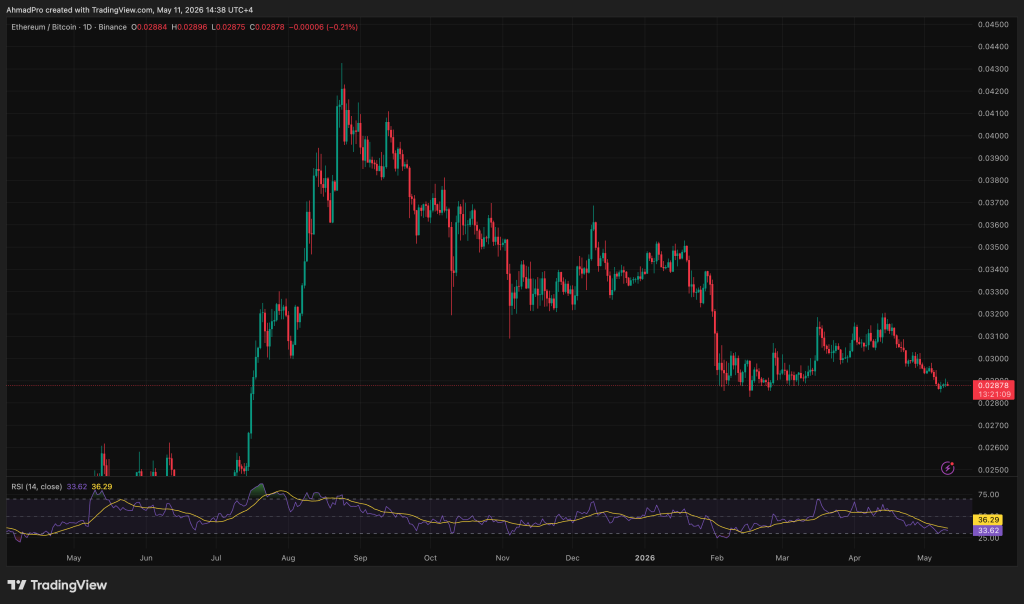
The mechanism is a two-part thesis: ETH/BTC ratio reversion toward historical averages applied against a $250,000 Bitcoin fair value assumption, layered with a structural demand argument that AI agents will require on-chain settlement infrastructure that legacy banking cannot provide.
That combination, Lee argued publicly and on stage, makes Ethereum cheap right now.
The tension in the call is real. Every condition in that chain has to cooperate simultaneously. Bitcoin has to reach $250,000.
The ETH/BTC ratio has to recover toward its 2021 peak of 0.087 from its current 0.03. And AI-driven blockchain adoption has to materialize at a scale the market has not yet priced.
What follows is an examination of whether the data supports any of those assumptions – and which one is doing the heaviest lifting.
Discover: The best pre-launch token sales
The Math Behind the $22,000 Target Is Specific – and Demanding
Lee’s ratio math is straightforward. The ETH/BTC long-term average sits near 0.048. The 2021 cycle peak hit 0.087.
Applied to a $250,000 Bitcoin price Lee’s stated fair value, those ratios produce ETH targets of roughly $12,000 and $21,750, respectively.
The $22,000 figure is essentially the bull case of the bull case: peak ratio, peak BTC assumption, both arriving at the same time.
The AI-blockchain demand component is where Lee diverges from a pure ratio trade. His argument: AI agents operating autonomously in the global economy will need a payment layer that functions 24/7 without correspondent banking dependencies.
Ethereum’s uninterrupted uptime record and decentralized validator set make it the default candidate. Lee also cited stablecoin transaction volumes surpassing Visa’s annual throughput, a claim that holds up. Ethereum-based stablecoin volumes (USDC, USDT, DAI combined) ran approximately $220 trillion annualized in 2025, against Visa’s $12.2 trillion.
That data point is not speculative.
On supply, Lee’s position at BitMine adds direct context. The firm holds more than 4% of all circulating Ethereum and generates over $300 million annually from staking rewards, which places Lee’s bullish thesis in direct financial proximity to his institution’s balance sheet.
That conflict of interest is worth naming. It does not make the thesis wrong. It does mean the assumptions deserve scrutiny.
Discover: The best crypto to diversify your portfolio with
Where Ethereum Price Trades Now and What the Chart Needs to Do
ETH is sitting at $2,330 on the daily chart, and the macro picture here is a coin that peaked near $4,900 in August and has been in a downtrend for the better part of a year, shedding over 60% before finding a floor around $1,750 in February.
The recovery since that low has been the most sustained positive price action since the downtrend began, with price grinding higher lows from February through May and now sitting in the $2,300 to $2,400 zone which is a critical area.


That $2,400 level is where the February breakdown accelerated from, making it the first major overhead supply zone that needs to flip before any meaningful recovery can develop, and price has been churning just below it for weeks without a clean break.
A daily close above $2,400 held over multiple sessions opens $2,800 first, then $3,000 and $3,400 as the next resistance clusters from the November and December distribution.
On the downside, $2,000 is the immediate floor that has held on every dip since March, and $1,750 is the absolute line that cannot break without the entire base structure collapsing.
The longer ETH spends consolidating below $2,400 without breaking down, the more pressure builds for an eventual resolution to the upside, but until that break happens, this remains a recovery inside a longer downtrend and not yet a confirmed reversal.
Discover: The best crypto to diversify your portfolio with
The post Tom Lee Floats $22,000 Ethereum Target: What Has to Be True? appeared first on Cryptonews.