



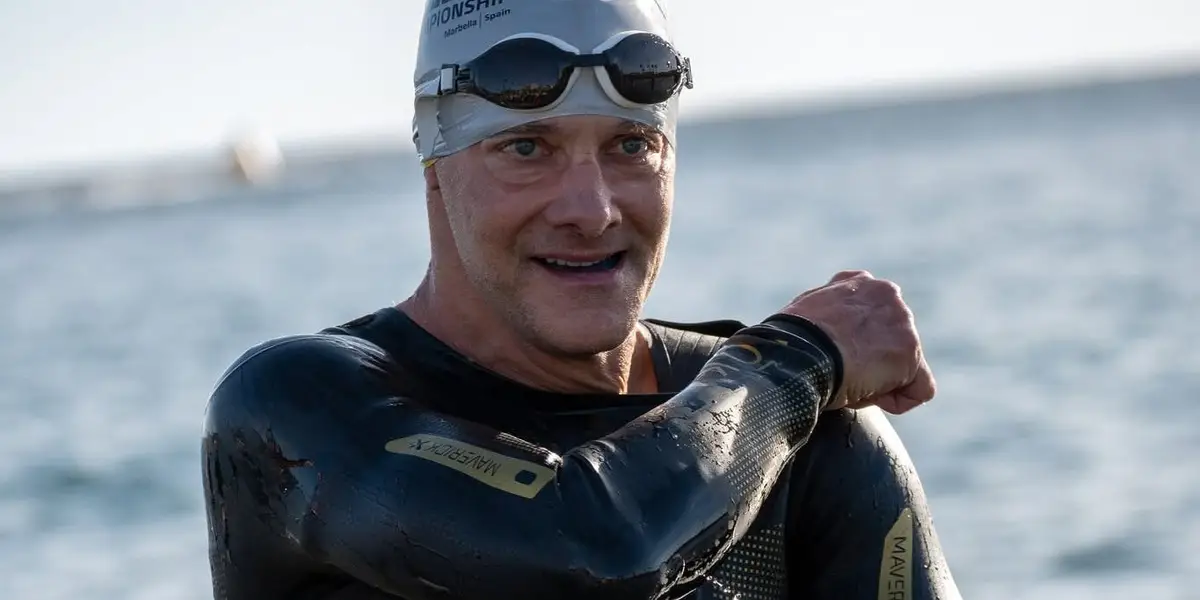
For a triathlete with a rigorous training schedule, Ken Fine’s introduction to fitness was a little more happenstance.
“I was the type of kid who would, instead of walking to school, run just because I wanted to,” Fine, 58, told Business Insider. The CEO of Affinity, an AI-first private capital CRM, or customer management system, eventually went from challenging his friends to races to competing in track and field events throughout his youth, including his time in the Navy.
He later discovered triathlons in his early 40s, when he first learned to swim in his community pool. Spending time with triathletes encouraged him to sign up for his first; he’s now done about 40 triathlons of varying lengths, including 140.6-mile Ironman races.

Ben Chrisman/Ben Chrisman
When he first transitioned from running to triathlons (which involve running, biking, and swimming) in 2012, he was an investor. Because “triathlons are longer, more complex and more challenging to execute well,” he said, training strengthened his growth mindset. Over the years, he held CEO positions at Symphony Commerce, Heap, and, since 2024, Affinity.
While training for Ironmans requires a lot of energy and planning that would presumably make it challenging to simultaneously lead a company, Fine sees a “strong connection” between his fitness routine and career success.
“The characteristics that are required and behaviors to be successful in the athletic portion of my life are very similar to the behaviors and skills you need to be successful as an executive,” he said.
Fine shared the three reasons he believes his fitness routine has helped his career.
A boon for his brain — and overall health
Leah Fine
Cardiovascular workouts like running, biking, and swimming are linked to increased focus, improved mood, better sleep, lower stress, and reduced chances of cognitive decline as you age — all of which can boost work performance. Plenty of successful business leaders also boast intensive exercise routines, from hours-long bike rides to rucking workouts.
Additionally, Fine said that fitting in training around his work schedule means he’s had to make other healthy choices, such as winding down every day.
Want more Business Insider in your news feed?
Add BI in Google so our reporting is easier to find when you’re searching for what matters.
“When I was in my 20s, I worked till 2 a.m., 3 a.m. in the morning, a lot of what you would probably call ‘tech heroics,’ all-nighters and working through all day on the weekends,” he said. “I wasn’t taking as good care of myself.”
Now, he has a steady sleep routine and boundaries around his time. Around 7:30 p.m., he and his wife shut down their devices and talk together before Fine sits outside to do breathwork to de-stress. That way, he can get up between 4:30 a.m. and 5:30 a.m. for his workouts.
It all ties into his overall health, which leads to fewer disruptions in his day-to-day work responsibilities.
“My foundation of health — which also includes diet, sleep, stress management — enables me to handle the pressure and demands of my job while maintaining calm, creativity, and positive engagement with my team,” he said, noting that he feels physically and mentally stronger now than he did 20 years ago.
Getting good at developing a plan
Leah Fine
Every Sunday, Fine sits down and maps out his weekly workouts around his work, family, and other obligations. “I find if you don’t have a plan, then the likelihood that you execute well is lower,” he said. “You have to get very good at the process of developing a strategy” — a particularly crucial skill for business leaders.
Training also helped him manage unpredictability better, whether in his work or personal life. In 2022, Fine was diagnosed with kidney cancer and had a successful surgery to remove the tumor. Six months later, he was due to compete in the World Triathlon Championships Grand Final in Abu Dhabi, and couldn’t move his slot to the next year. He decided to compete anyway.
Two months before the race, he created a plan where he slowly eased back into regular walking and short biking intervals. He also learned to deal with post-surgery inflammation that caused him back pain. A week before the race, he injured his Achilles tendon, took a full break from running, and flew across the world.
“I had the best race of my life,” he said. When his Achilles started to act up toward the end, he simply strategized more: “I have to concentrate on every step. I can’t twist my ankle. I can’t hit the curb. I can’t land on a stone because if anything goes wrong, I probably won’t be able to keep going.” He said it was one of his strongest race times ever.
Becoming a pro at failure
Leah Fine
As a business leader, Fine is no stranger to setbacks.
“COVID is uncontrollable, the SaaSpocalypse is uncontrollable, AI obviously is another example we’re living through today,” he said.
Training for triathlons especially taught him how to deal with sudden changes. Once, he participated in a half-Ironman during a hurricane — the race was never canceled because the organizers thought the rain would be short-lived. It never stopped.
“I bring this to work, and I talk to my teammates about it: hold yourself accountable to control the controllables,” he said. “I couldn’t control the weather, couldn’t control the rain, couldn’t control the wind, but I could control how I handled my bike. I could control how I managed the stress. I could control my willingness to still persevere in that event and not drop out.”
He also said it’s important to debrief every time, even when things go really well. “I’ve never had the perfect race yet,” he said. “Even the races I would list as my very, very, best, I look at and I can identify things that I think I could have done better on that day.”