
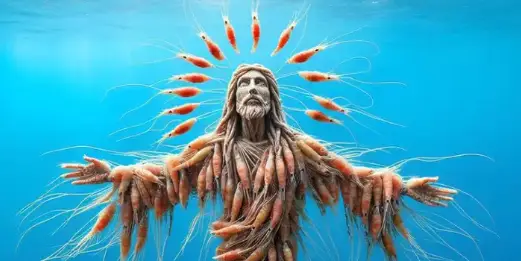
There was a time, not so long ago, when AI-generated content was very easy to spot. It was surreal, ridiculous — like Jesus made out of Shrimp.
We’re in a new time now, and AI slop looks so good, it’s hard to tell from the real thing. I’ve been fooled by it. You probably have, too, even if you don’t think you have. For example, this extremely realistic video of Nicolás Maduro doing TikTok dances in prison with Diddy. You know it’s AI only because it’s improbable, not because the video quality is poor.
So in a post-slop world, what comes next? What does our future look like with AI?
One person who would know something about both is Instagram head Adam Mosseri, who posted a prediction to Threads: He says AI images, text, and videos will get more and more realistic, and it’ll become harder to separate them from what’s real — including on the platform he oversees.
(That’s already happening to some extent: Long are the days when it was easy to spot a “Shrimp Jesus”-like AI-generated picture.)

Every time Katie publishes a story, you’ll get an alert straight to your inbox!
Stay connected to Katie and get more of their work as it publishes.
What I appreciate about Mosseri’s memo is that he seems optimistic about what probably sounds like a bad thing to most people. Admitting his platform will be filled with AI-generated content meant to fool people — for funsies or profit — should, theoretically, be taking an L. But he sees this as a problem that can be solved (on Instagram, at least) at the product level:
As for Instagram, we’re going to have to evolve in a number of ways, and fast. We need to build the best creative tools, AI-driven and traditional, for creators so that they can compete with content fully created by AI. We need to label AI-generated content clearly, and work with manufacturers to verify authenticity at capture—fingerprinting real media, not just chasing fake. We need to surface credibility signals about who’s posting so people can decide who to trust.
His other point is that people will naturally gravitate toward human-produced content because that’s what will become trendy: authentic, less polished, intimate, real.
“Authenticity is fast becoming a scarce resource, which will in turn drive more demand for creator content, not less,” he writes. Which is certainly a hopeful message if your job is to run a platform for creator content and you’re trying to reassure creators (and advertisers) that they should continue to post authentic content to your platform.
I think he’s generally right. The idea that human-created content will become more premium amid a flood of machine-created content seems to be the prevailing wisdom.
ChatGPT might help with the chores, too?
Another optimistic prognostication comes from OpenAI’s chief economist, Aaron “Ronnie” Chatterji, who told the Financial Times that he believes AI will help free us from mundane household chores.
Look, I love the sound of that as much as anyone, but I’m skeptical. Sure, someone is working on a robot that folds clothes, but it seems like it’ll be a long time before that’s a real thing for most of us. And it’s hard to imagine automation doing the chores I really hate, like scrubbing toilets or sorting through the piles of papers and junk that accumulate on countertops daily. And I am highly, highly skeptical of a robot helping with childcare.
Humans to the rescue
Meanwhile, Ben Thompson of Stratechery also seems to fall into the “humans rock!” side of things, which I find much more appealing as a human.
He wrote about a Substack essay that had been going viral among a subset of influential people who care about economics and AI. The essay suggested that once AI and automation make it so that humans no longer have to work, income inequality will actually be far worse.
But Thompson thinks that even if there’s an exponentially bigger gap between the haves and have-nots in the year 2126 (which doesn’t sound great on paper), we will still value and prize human labor precisely because it is human. He writes:
Consider the most base example: sex. I have no doubt that there will be human-like robots with which you can have sex; I also have even stronger conviction that the overwhelming preference of humans will be to have sex with other humans. And that, by extension, means that all of the courtship and status games that go into finding a lover will persist, and that that itself will be an entire economy all its own. One will not impress a partner with commodity robot-generated goods, no matter how objectively perfect they might be: true value will come from uniqueness and imperfections that are downstream from a human.
I like the sound of this! It’s quite self-serving to me, a human who creates something (writing words) that I suppose could be done by AI, but you would probably hate and not want to pay for if it were. And also as a human being who would like to keep the species going for another few generations, I suppose. I like to think this is hope rather than cope.