





subscribers. Become an Insider
and start reading now.
Have an account? .
- 2025 marked 25 years of nonstop human presence on the International Space Station.
- Photos shared by NASA show what life looked like 250 miles above Earth this year.
- Astronauts photographed the northern lights, hurricanes, lightning, rivers, and city streets.
In the 25 years since the first permanent crew docked at the International Space Station, fewer than 300 people have experienced what life is like there, 250 miles above Earth.
The rest of us can only imagine it.
So, for NASA astronauts like Don Pettit, taking photographs of our planet while aboard the ISS is a way to share the experience with people on the ground.
“It’s a labor of love,” Pettit said of his photography in an interview from space in December 2024. “That’s what astronauts spend a lot of their off-duty time doing: doing imagery, collecting the photographs that go with the memories to tell the story of what it’s like up here.”
In 2025, NASA shared thousands of photographs of Earth taken by its astronauts from the International Space Station.
The powerful images captured weather events from above, including deadly hurricanes and lightning strikes. Others showed the pinks and greens of the northern lights and what sunrises look like from space.
While there are challenges in taking photos from the ISS — the multiple layers of windows, for example, cause reflections that need to be overcome — there are benefits as well.
Large camera setups, like Pettit’s 800-millimeter telephoto lens and solar filter, would be cumbersome in a place with gravity.
“There are things we can do up here that would make many photographers envious when they’re mounting their heavy gear on stout tripods,” Pettit said.
Take a look at some of the most awe-inspiring images of Earth taken by astronauts aboard the International Space Station in 2025.
This year, 25 astronauts lived at the ISS to conduct research and complete maintenance. They also took thousands of photos.


NASA
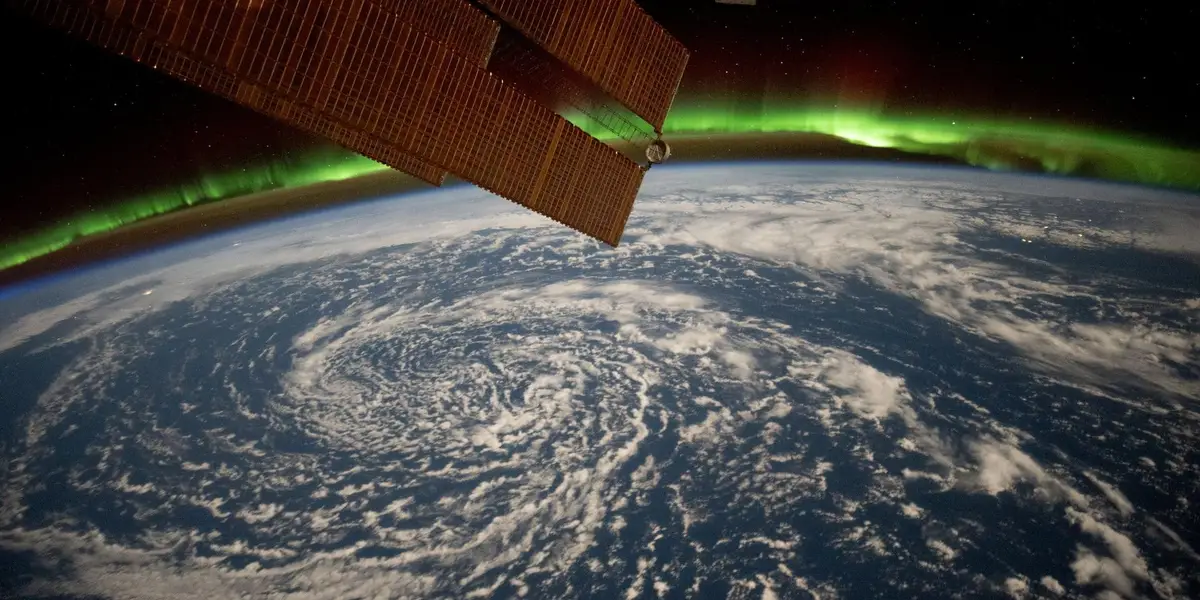
From 250 miles above Earth, they witnessed jaw-dropping sights, such as the northern lights stretching across the horizon.
NASA
Astronaut Don Pettit captured the Milky Way behind Earth’s atmospheric glow.

NASA/Don Pettit
“Photographs help complete the story of what it means for human beings to expand into space and expand into this frontier,” Pettit said.

NASA/JAXA
This long-exposure photo by astronaut Nichole Ayers shows mesmerizing, illuminated arcs of star trails.
NASA/Nichole Ayers
Using a handheld camera, Ayers also captured neon northern lights above the Indian Ocean.

NASA/Nichole Ayers
Her image of lightning above Milan looks like something out of a movie.
NASA/Nichole Ayers
“I’m still amazed by every sunrise and every sunset that I get to see,” Ayers told Denver7. “I try to take as many pictures as I can so that we can share it with you all.”

NASA
Their views are incomprehensible to us on Earth. Here, they saw an orbital sunset — the last rays of the sun as the ISS slipped into Earth’s shadow.
NASA
Some of the views are far more recognizable, such as the (upside-down) boot of Italy next to the island of Sicily.
NASA
Another unmistakable sight: Dubai’s manmade islands in the Persian Gulf.
NASA
The sands of the Sahara Desert in Libya were seen behind an extending robotic arm in August.
NASA
Another photo looks down on Mount Damavand. At more than 18,000 feet, it’s the highest peak in Iran and the highest volcano in Asia.
NASA
Also visible from space is the Manicouagan crater, caused by a 3-mile-wide asteroid that crashed into what is now Quebec 214 million years ago.
NASA
The lights of the Nile River, leading to Cairo, were captured as the ISS orbited 259 miles above Earth in July.
NASA
The river was also visible by day, as the ISS soared above the Mediterranean Sea.

NASA
An image shows the British Isles, upside down and brightly lit, with the northern coast of France in the background.
NASA
Astronauts also captured multiple scenes across the US, from Phoenix…
NASA
… and the San Francisco Bay Area …

NASA/Nichole Ayers
… to the fields of Kansas.
NASA
The Florida peninsula was captured in the early hours of a March morning …
NASA
… and during the day. Here, the tip of Florida is visible between Cuba and the Bahamas.
NASA
Astronauts were witnesses to disasters that wreaked havoc on American communities, such as the Los Angeles wildfires in January.

NASA/Don Pettit
Impending disasters were also visible from space, such as Typhoon Halong, which inflicted devastation on Western Alaska in October.
NASA
They saw Hurricane Melissa, one of the most powerful Atlantic hurricanes on record, before it battered the Caribbean.
NASA
Cyclone Alfred lurked near the coast of Queensland, Australia, several days before it crossed the mainland.
NASA
Pettit said witnessing life-changing events with such a wide field of view “really changes the perspective of what you see.”
NASA
The incredible photos add to the more than 7 million images that astronauts have sent back from the ISS since the first crew docked in 2000.
NASA
The photos are valuable for monitoring changes on Earth and for aiding in disaster response.
NASA
In November, NASA celebrated 25 years of “continuous human presence” aboard the ISS. Operations are scheduled to end around 2030.
NASA
For now, astronauts’ front-row seat to Earth gives us a new perspective on life on our planet.
NASA




