


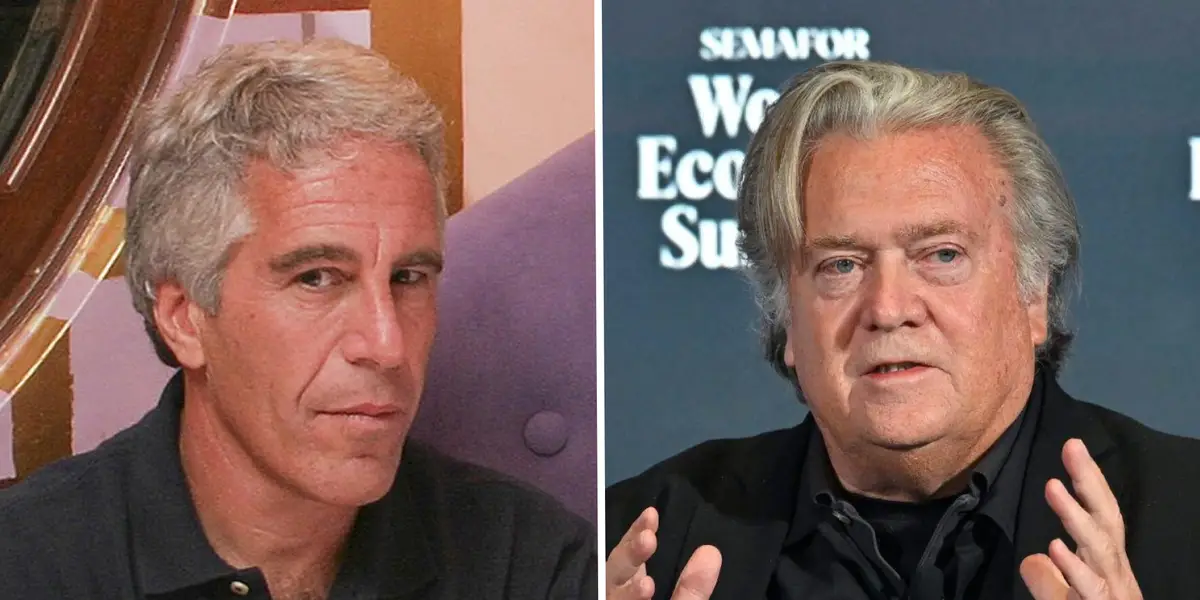
It has been over six years since Steve Bannon filmed what he said were 15 hours of interviews with Jeffrey Epstein.
Fewer than 30 seconds have seen the light of day.
Though he possesses exclusive footage of the final weeks of the life of the well-connected pedophile — who remains one of the most potent political topics on the planet — Bannon has kept his footage under wraps.
A cache of emails and text messages made public by the House Oversight Committee may help explain why: Epstein and Bannon discussed using an obscure legal maneuver that would technically make Bannon part of Epstein’s legal defense team.
In the communications, which the House Oversight Committee obtained by subpoenaing Epstein’s estate, Bannon and Epstein discuss forging a Kovel agreement — a type of legal arrangement that extends attorney-client privilege to non-lawyers. That agreement could protect the footage from public release under the shield of attorney-client confidentiality.
“We need to talk about kovel. Letter and black bag.” Epstein texted Bannon while discussing filming. “As in a kovel agreement re accounting and finance. Legal privleged.”
Attorneys typically use Kovel agreements when they need the expertise of non-lawyers to assist them with legal work.
An attorney working on a financial fraud case might use a Kovel letter to retain a forensic accountant to help unpack complex financial records. That agreement, between the attorney and the accountant, would protect the accountant’s work product under attorney-client privilege so the opposing side’s lawyers can’t obtain it in discovery.
“I don’t want someone to say, ‘You waive the privilege by disclosing that to a third party,'” explained Bruce Green, a legal ethics professor at Fordham Law School. “So I make the accountant part of my team the way my paralegal is part of the team.”
Kovel agreements can also be used for public relations professionals. In a text message conversation, Epstein suggested just such an arrangement between Bannon and his longtime personal attorney, Darren Indyke.
Epstein said Indyke would pay for the videos and have “final control” over the work product, while Bannon would make money on whatever they ultimately produced.
“here is what I think will work legally,” Epstein told Bannon in a series of text messages in April 2019, as the two began discussing the videos. “I pay direct costs of filming. As Darren is the contractor for legal service prep . It gets paid by Darren. He has final control as it is his work product.”
“I have no interest whatsoever in making money here,” Epstein continued. “Zero . You deserve whatever it brings . As it is our cost , no return on it.”
Bannon responded with “K” and asked if they could film that weekend.
A ‘documentary’ to improve Epstein’s reputation
Bannon didn’t respond to requests for comment for this story. He has not responded to Business Insider’s requests for comment about his relationship with Epstein for about four years. At a political conference in July, Bannon told a fan that he would release the “documentary” as a five-part series “early next year.”
Bannon hasn’t released any footage since The New York Post posted a trailer in 2021, nor has he discussed the project on his daily political podcast, “War Room.” A person close to Bannon said they haven’t seen any indication that the footage is being edited.
Mark Epstein said Bannon told him in a meeting months after his brother Jeffrey’s death that he couldn’t see the footage because it was “witness preparation” and protected under attorney-client confidentiality.
“He said he had 16 hours of tapes,” Mark Epstein told Business Insider. “He said they were in his vault and they were protected under attorney-client privilege. I don’t how, because he’s not an attorney. But anyhow, that’s what he told me.”
House Oversight Committee
The emails and text messages made public by the House Oversight Committee show Bannon and Epstein communicating as early as February 2018, several months after Bannon stopped working as President Donald Trump’s White House advisor in his first term. The two continued their relationship at least up until Epstein’s arrest on sex-trafficking charges in July 2019.
In that time period, Epstein was dealing with a swarm of civil litigation from women who had accused him of sexual abuse, as well as a new criminal investigation from Manhattan federal prosecutors following a November 2018 Miami Herald investigation about his conduct.
Bannon — who had led Breitbart News and written and directed nine documentaries — described the media coverage as a “sophisticated op” against Epstein.
The 2019 text messages show Bannon and Epstein discussing a project that would burnish Epstein’s reputation by introducing the public to other facets of his life, like his views on politics, finance, and science.
Epstein and Bannon talked about which of the financier’s impressive acquaintances could appear in the program, including academic Noam Chomsky and Nobel Prize-winning molecular biologist James Watson.
Epstein said in his usual typo-strewn writing style that Bannon’s goal would be “to himanize the monster.”
House Oversight Committee
Bannon suggested focusing on a narrative of redemption.
“we must counter ‘rapist who traffics in female children to be raped by worlds most powerful , richest men’— that can’t be redeemed,” Bannon told Epstein.
“Can’t redeem unredeemable — you are a lot of things-which we will show– but you are NOT that,” Bannon said in another text.
It’s not clear whether Indyke and Bannon ultimately signed a Kovel letter before Epstein’s arrest and death. Epstein talked about Bannon needing to sign a “letter” for Indyke for “the engagement for litigation services” as late as June 2019. Around the same time, Bannon urged Epstein to finalize the terms so that he could assemble a film crew.
“Can we make this deal today so I can pull my crew off other stuff they are working on and get this thing done — we are burning daylight,” Bannon texted Epstein.
“YEs. Do you have a lawyer . ? we need to document past and future, all needs surgical care,” Epstein replied.
For a Kovel agreement to be done properly, Indyke would have needed to hire Bannon to assist on the lawyer’s work for Epstein, according to Green. Work between a client and a public relations professional can’t be shielded by a Kovel agreement just because a lawyer is involved, Green said.
“Half the time or more, when the client hires a PR person and uses the lawyer to try to create a Kovel theory, it doesn’t work,” Green said. “Because the court looks at it and says, ‘This isn’t really designed to assist the lawyer — it’s designed to assist the client.'”
As the co-execitor of Epstein’s estate, Indyke has the power to waive attorney-client confidentiality on the dead financier’s behalf.
Daniel Weiner, an attorney representing Indyke and Richard Kahn, the other estate co-executor, declined to comment on whether the Kovel agreement existed.
In May of 2019, while discussing communications between “darren” and a member of Bannon’s team, Epstein indicated they had worked out at least some kind of agreement.
“You and i are perfect. All under privlege,” Epstein wrote.