


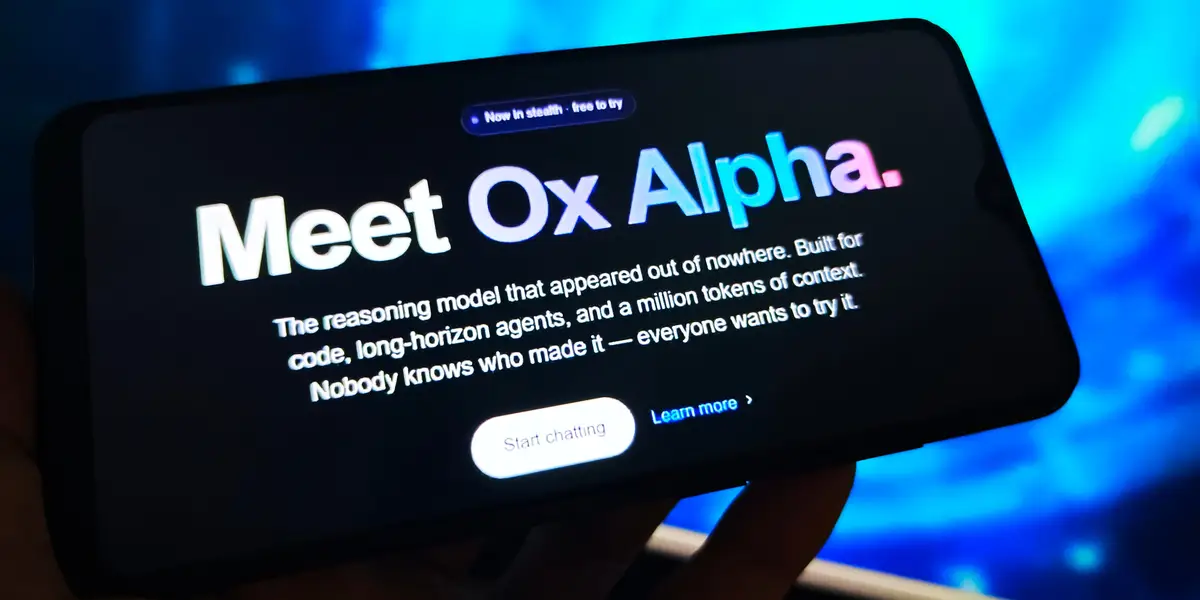
Chinese tech company Z.ai says it was behind the mysterious free AI model, Ox Alpha, that generated buzz for its performance.
In a blog post published on Wednesday, Z.ai said Ox Alpha was an anonymous preview of its new GLM-5.3-Flash model, tested on OpenRouter and OpenCode to gather user feedback before its release.
The company said it has made the model’s weights publicly available on the platform Hugging Face, allowing developers to download, modify, and build on it.
Z.ai said the model is multimodal, meaning it can work with text, images, and video, and has a context window of up to 1 million tokens.
Last week, Ox Alpha became a subject of intense online speculation after developers began testing it.
OpenRouter, a platform for accessing AI tools, described Ox Alpha as a reasoning model for coding, sustained agentic work, and production workloads.
Ox Alpha was also offered free for a week with “near unlimited usage,” according to OpenCode, an open-source AI coding agent. OpenCode said the provider had capacity for 100 trillion tokens per day.
The model won early praise from prominent tech figures. Stripe CEO Patrick Collison wrote on X that it was “very impressive.”
Bloomberg earlier reported that Z.ai had confirmed it was behind Ox Alpha.
Some developers had already identified Z.ai as one of the leading possibilities. Wccftech, an online tech publication, reported similarities between Ox Alpha’s tokenizer behavior and responses and Z.ai’s GLM models.
The company had previously tested a GLM model anonymously under the name Pony Alpha.
The model’s name generated another potential clue. Chinese social-media users linked “Ox” to “Niu Lai,” which translates to “Here Comes the Ox,” a low-budget Chinese animated film that became a viral meme this summer. Users on Weibo began referring to the AI model by the film’s name and speculating that it had Chinese origins.
Some analysts suggested technical signals could instead point to Microsoft’s MAI family, while Reddit users noted that Ox Alpha was willing to discuss politically sensitive topics that Chinese-made chatbots tend to avoid.
Z.ai did not immediately respond to Business Insider’s request for comments.