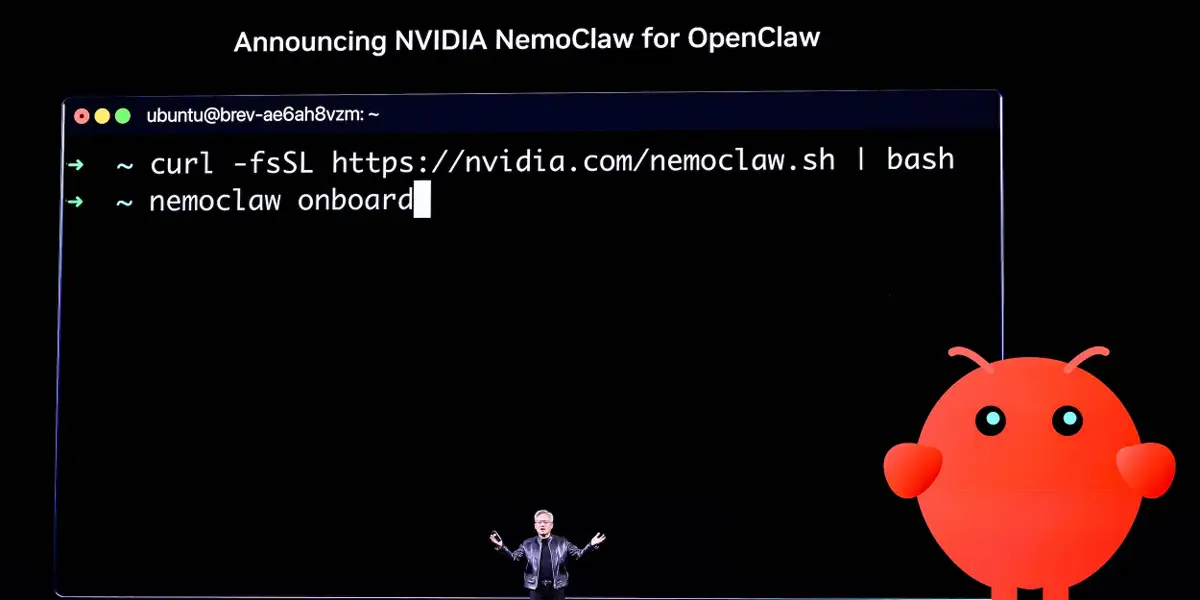
Nvidia CEO Jensen Huang says companies can’t ignore the OpenClaw moment.
“Every company in the world today needs to have an OpenClaw strategy, an agentic system strategy,” Huang said during Nvidia’s 2026 GTC conference in San Jose on Monday. “This is the new computer.”
Huang offered deep praise for OpenClaw, previously known as Clawdbot and Moltbot, an open-source AI agent that has taken Silicon Valley by storm. Though OpenAI lured away OpenClaw creator Peter Steinberger, the service will live on as an open-source project.
“OpenClaw has made it possible for us to create personal agents,” he said. “The implication is incredible.”
Huang said that OpenClaw “gave the industry exactly what it needed at exactly the time.”
Every time Brent D. Griffiths publishes a story, you’ll get an alert straight to your inbox!
Stay connected to Brent D. Griffiths and get more of their work as it publishes.
OpenClaw will do for AI what Windows did for personal computing, Huang said. He also compared OpenClaw to other influential technologies, such as the Linux operating system, the Kubernetes cloud project, and HTML.
“It made it possible for the entire industry to grab onto this open-source stack and go do something with it,” Huang said.
Huang said there’s one big caveat about using OpenClaw that Nvidia has been working to address: security. Nvidia announced its spin on OpenClaw, called NemoClaw, which allows users to add privacy and security controls to their AI agents, or “claws.”
“It has a network guardrail, it has a privacy router, and as a result, we could protect and keep the claws from executing inside our company, and do it safely,” Huang said.
Nvidia is promoting NemoClaw at its conference by hosting a “build-a-claw” event where attendees can develop their own custom-made AI agent.
“OpenClaw brings people closer to AI and helps create a world where everyone has their own agents,” Steinberger said in a statement released by Nvidia. “With Nvidia and the broader ecosystem, we’re building the claws and guardrails that let anyone create powerful, secure AI assistants.”
Huang made a host of other announcements at Nvidia GTC on Monday, including a new inference system that incorporates technology from Groq, an AI chip startup with which Nvidia made a $20 billion deal. He also projected $1 trillion in demand for its Blackwell and Rubin AI chips through 2027.