


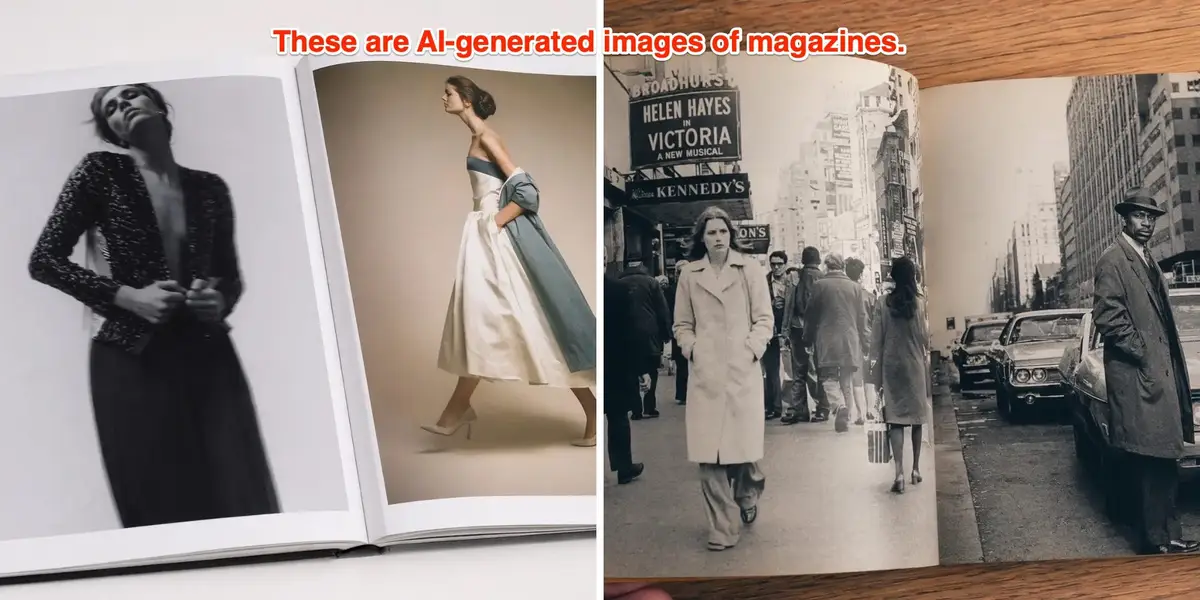
OpenAI wants you to know how good its latest image generator is —and it has a few fake screenshots and pictures of pictures to prove it.
On Tuesday, OpenAI announced ChatGPT Images 2.0, a new image model that it says has “thinking capabilities,” which includes the ability to crawl the internet and “double check” its own output.
Some of the examples are made to look like fake screenshots or of a person thumbing through a magazine, further blurring the lines between what’s real and fake as AI-generated images and videos continue to proliferate on the internet
In teasing the release, OpenAI shared an AI-generated picture on X that mimics a desktop screenshot of a Google Chrome tab on a Mac. The fake screenshot shows a tab opened to ChatGPT’s website, talking about Tuesday’s livestream of the new model.
“The team really cooked on this one,” OpenAI CEO Sam Altman said during the livestream.
OpenAI said in a press release that Images 2.0 can also generate pictures from prompts in multiple languages, including Japanese, Korean, Chinese, Hindi, and Bengali.
In samples provided by OpenAI, the model created realistic advertisements, a photo of what appears to be a physical magazine, and multiple pages of manga.
Courtesy OpenAI
A spokesperson for OpenAI said the company does not intend to copy or reproduce specific artwork and that the images are generated from patterns it has learned.
Outside mimicry, the model allowed for some creative twists on real-life celebrities and images, like an 1980s glam version of legendary investor Warren Buffett and a blueprint of a Business Insider editor’s dinner.
Chris Kaye/BI
The spokesperson added that OpenAI prevents copying styles of individual living artists, but it does allow recreating broader studio styles.
Mitch Stoltz, the IP litigation director for the Electronic Frontier Foundation, told Business Insider in an interview that the latest model alone doesn’t raise copyright issues, and that the distinction OpenAI makes between images generated from specific artwork and those generated from patterns the model learned is important.
Courtesy OpenAI
“If the output is substantially similar to something that the model was trained on or crawled, then there starts to be a copyright concern,” Stoltz said. “But if it’s similar on the level of an idea, or just something that occurs in the world, or even a style or a vibe — generally speaking, that’s not enough, and that’s not a copy under copyright law.”
OpenAI is facing at least a dozen ongoing copyright suits from writers and news outlets, including The New York Times and George R.R. Martin.
“The copyright issues are the same as if you were simply using Photoshop, a darkroom, or a human artist to make these kinds of replicas,” he said. “The issues for society, whether you call that ethical or political or whatever, are greater because it’s easier, faster, and more available.”
Societal implications aside, at least we get a looksmaxxing oracle.