



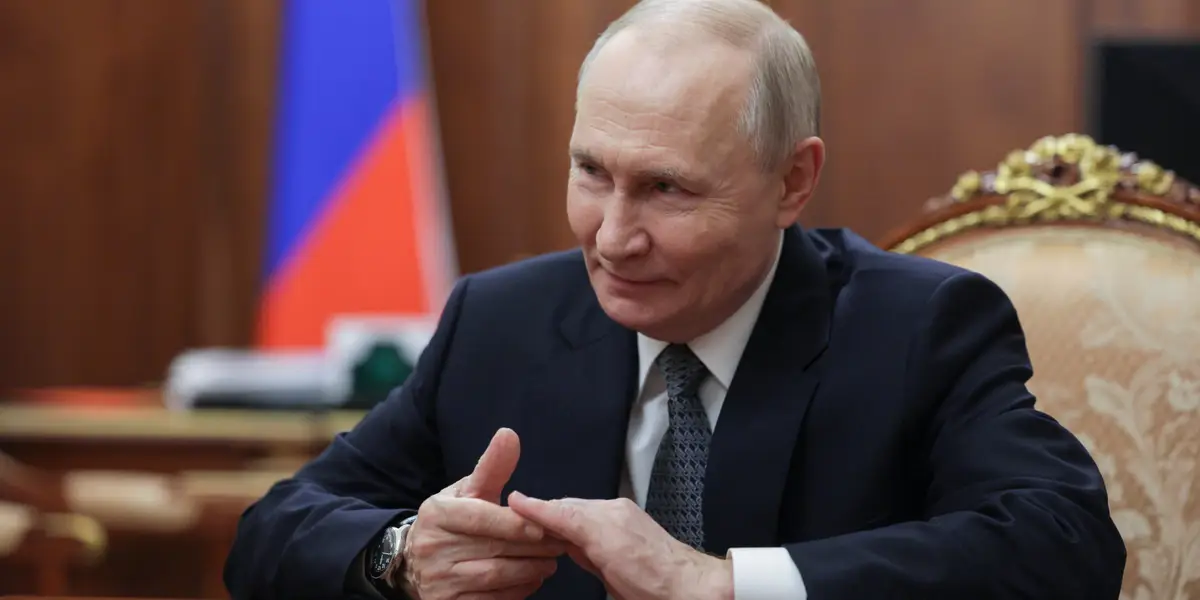
Russian President Vladimir Putin said a spike in global energy prices is opening the door to more profitable gas markets for his country.
“Now other markets are opening up. And perhaps it would be more profitable for us to stop supplying the European market right now. To move into those markets that are opening up and establish ourselves there,” Putin said on state television on Wednesday.
His remarks come as oil and gas prices jump following US and Israeli strikes on Iran and retaliatory strikes from Tehran, raising fears of disruption to energy flows from the Middle East — which could benefit Russia and Putin’s war chest.
The Strait of Hormuz — a critical chokepoint for global energy shipments — has been at the center of market concerns after ships came under fire there.
Qatar, one of the world’s largest liquefied natural gas exporters, ships most of its cargo through the Strait of Hormuz, and any sustained disruption could tighten global supply and intensify competition for spot cargoes. The energy giant has also halted production at the world’s largest LNG export plant after Iranian strikes.
Benchmark European natural gas futures have risen about 50% this week.
Meanwhile, the Platts Japan Korea Marker for spot prices has also jumped, as the two countries — which are among the world’s top LNG buyers — rely heavily on imported fuel, much of it from the Middle East.
Any threat to supply could force them to compete more aggressively for cargoes, driving up global benchmark prices and rippling into Europe’s gas market.
“Customers have emerged who are willing to buy the same natural gas at higher prices, in this case due to events in the Middle East, the closure of the Strait of Hormuz, and so on,” Putin said.
“This is natural; there’s nothing here, there’s no political agenda – it is just business,” he added.
Russia eyes leverage in tighter LNG market
Russia holds the world’s largest natural gas reserves. It was once Europe’s largest gas supplier but lost its dominant foothold in the market after its full-scale invasion of Ukraine in 2022 prompted the European Union to curb reliance on Russian energy.
Any prolonged disruption in the Strait of Hormuz could reshape trade flows and strengthen Moscow’s hand in LNG markets.
“Russia benefits without firing a shot in the Gulf. A tighter LNG market strengthens the perceived value of residual Russian flows,” wrote Andrei Covatariu, a non-resident senior fellow at the Atlantic Council’s Global Energy Center, on Tuesday.
“Moscow does not need to regain market dominance to gain leverage; it only needs to remain a marginal supplier in a tight system,” Covatariu added.
Energy markets are volatile, fraught with uncertainty
The situation reflects fragile market conditions as traders struggle to assess supply risks.
International benchmark Brent crude oil futures were trading around $84.80 per barrel early on Friday, up more than 17% this week.
Analysts say confidence in where prices should settle remains fragile.
“With geopolitical developments evolving rapidly and most market participants lacking deep expertise in geopolitical strategy, conviction around where prices should trade is currently very low,” wrote Chris Weston, the head of research at Pepperstone.
Against this backdrop, the US has taken steps to stabilize markets.
On Thursday, Treasury Secretary Scott Bessent wrote on X that the US was issuing a temporary 30-day waiver to allow Indian refiners to purchase Russian oil.
The move is to “enable oil to keep flowing into the global market,” wrote Bessent.
He said the short-term measure would not deliver meaningful financial gains to the Russian government because it applies only to oil already stranded at sea.
“This stop-gap measure will alleviate pressure caused by Iran’s attempt to take global energy hostage,” he added.
On Tuesday, President Donald Trump said the US Navy could escort oil tankers through the Strait of Hormuz and that the United States Development Finance Corporation would offer political risk insurance to guarantee the financial security of maritime trade in the Persian Gulf.