



“Stranger Things” began as a scrappy suburban mystery. It took its final bow as a franchise too big to commit to delivering real consequences to its characters.
Over five seasons and nine years, “Stranger Things” has evolved from an ’80s-set story about a small Indiana town reeling from the sudden disappearance of a local boy into Netflix’s big-budget flagship show. The fifth and final season, which premiered on Nov. 26 and concluded on New Year’s Eve, broke streaming records and led the platform to its biggest Christmas Day viewership of all time. It’s the most-watched show in Netflix history, with over 1 billion all-time views.
Thus, the long-anticipated series finale was saddled with sky-high expectations. It’s impossible to please everybody with a piece of art — especially an expectant audience of many millions, all with their own theories and favorite characters to root for — but creators and showrunners Matt and Ross Duffer were determined to try, ultimately to the show’s detriment.
The series’ two-hour finale episode, titled “The Rightside Up,” has a climax and conclusion that are weakened by conspicuous fan service, cheap thrills, and shoehorned happy endings for essentially all of its leads. It’s the kind of CGI-fueled, character-stuffed spectacle one might expect from an “Avengers” film.
Gone are the shadowy threats and chill-inducing enigmas from seasons one and two. Instead, we get a dramatic chase sequence in a space desert and a fleshy super-monster that somehow takes mere minutes to subdue. In one scene, beloved babysitter Steve (Joe Keery) falls off a collapsing radio tower and momentarily seems to plummet to his death when the screen cuts to black. But when Steve reappears, he’s been miraculously rescued by his frenemy, Jonathan (Charlie Heaton), in a scene obviously designed for theater applause (let’s not forget the finale also premiered in select movie theaters across the country). Sitting at home witnessing the Marvel-ification of TV in real time, I could only laugh.
Like most fans of the show, I adore Steve, and I would have been gutted if he’d died. But I’d much rather be gutted than utterly unmoved, and nothing about that scene made me feel like Steve was actually in danger. He’s had a near-death experience in every season, just so fans will cheer when he survives.
‘Stranger Things’ used to be much more brutal
I have to keep reminding myself that “Stranger Things” used to be a show with consequences, so I don’t feel dumb for expecting to have felt something during the series’ supersized conclusion.
In the series premiere, Will (Noah Schnapp) was kidnapped before the opening credits rolled. Later in the episode, Eleven (Millie Bobby Brown) — a traumatized child who escaped from a government lab — watched the man who tried to help her get shot point-blank in the forehead. Two episodes later, another main character’s best friend, Barb (Shannon Purser), was attacked and murdered by a faceless creature that walks on two legs.
By season five, the show’s sharp, high-stakes storytelling has been deprioritized in favor of pageantry and plot armor. Apparently terrified of angering any contingent of the show’s now-massive and vocal fan base, the Duffers couldn’t commit to harming any core characters, despite hyping the show’s main villain as an extra-dimensional embodiment of evil.
Vecna (Jamie Campbell Bower) was intent on destroying the world, and he displayed a particular sadistic fixation on Eleven, her friends, and her family. He had magical psychic powers and could exploit private fears and weaknesses. And yet, in the end, Vecna’s head was chopped off by Joyce (Winona Ryder), a normal middle-aged woman. His plan was thwarted by a group of literal children wielding guns and slingshots, all of whom made it back to our realm with hardly a scratch. Not even Max (Sadie Sink), who had her limbs snapped and her eyes gouged in season four, suffers lasting damage from her injuries.
The finale was too focused on pleasing everyone
Since its inception, “Stranger Things” has boasted an array of lovable personalities, from Steve, Jonathan, Will, and Joyce to Dustin (Gaten Matarazzo), Lucas (Caleb McLaughlin), Mike (Finn Wolfhard), and Nancy (Natalia Dyer). Any one of their deaths would have been emotional and poignant, while reminding us of the true dangers of the world of the show — but it also would have sparked controversy and discourse online. Allowing all the show’s good guys to cross the finish line was the easiest way for the Duffers to pacify as many viewers as possible. It also stripped the finale of any sense of stakes or urgency.
Courtesy of Netflix
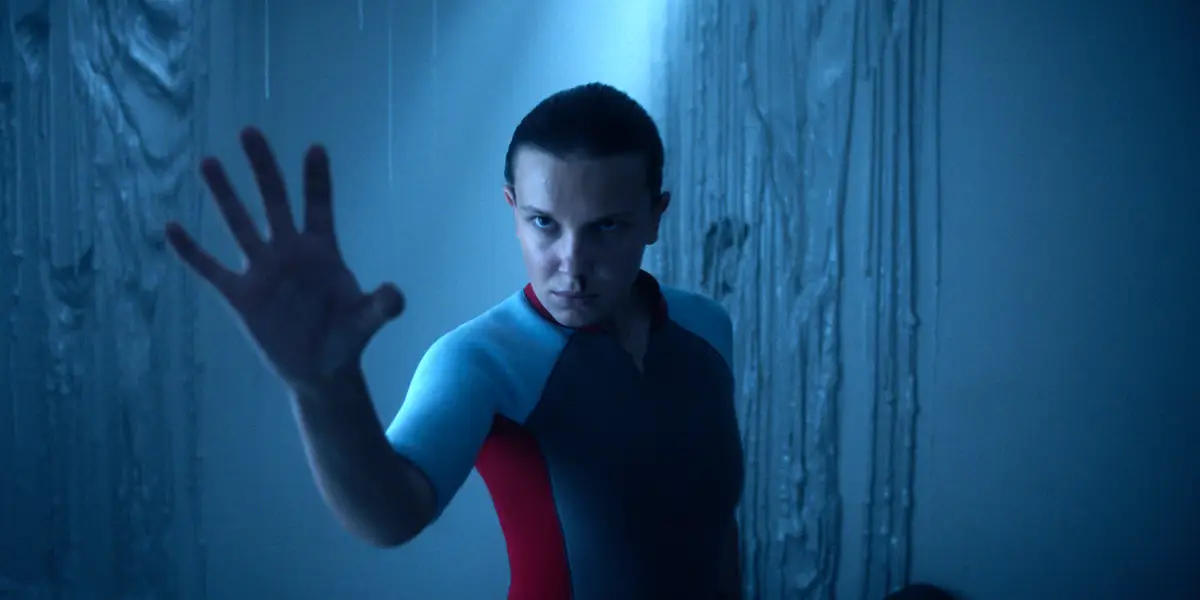
The only controversy-courting decision the Duffers made — to allow Eleven to sacrifice herself to the Upside Down for the greater good — was undermined by intentional ambiguity. Eleven was the heart of “Stranger Things” and, as a character, she deserved to outlive Vecna. Still, her sacrifice made narrative sense: She had long been portrayed with an abnormal capacity for altruism, and she was determined to end the cycle of violence that her magic would always invite.
However, much like Steve’s, her “death” scene failed to induce panic. Even watching Eleven disappear as her friends cried and screamed her name — heart-wrenching performances all — I kept thinking to myself, “This isn’t real.” The ground rule of “Stranger Things” is that if you don’t see a dead body, that character isn’t dead.
Naturally, that’s exactly the effect the Duffers intended. In the show’s final moments, Mike posits a theory that Eleven staged an illusion and secretly escaped. The show cuts to clips of Eleven alive and well in Iceland, finally free from the threat of capture.
The audience is left to choose whether to believe Mike’s story or not, though the show makes it clear which version the writers prefer. “I believe,” Mike, Will, Dustin, Lucas, and Max dutifully recite.
By reframing Eleven’s fate as an open-ended source of hope, the show cedes power to the viewers — exactly where it needs to be to keep the still-expanding “Stranger Things” universe humming and profitable. If Eleven reappears in a reboot in 20 years, don’t say I didn’t warn you.