



The US has sent Taiwan a growing number of asymmetric weapons intended to help deter and defeat a potential Chinese invasion.
Taiwan needs a more balanced arsenal of systems to counter other conflict scenarios, such as a sustained blockade, the president of the US-Taiwan Business Council recently argued.
Asymmetric warfare, which relies on large numbers of relatively inexpensive, mobile, and difficult-to-target systems like drones, missiles, and dispersed units, offers Taiwan an advantage against the military might of China.
But more conventional capabilities, such as those needed to sustain operations, defend sea lanes, and maintain air and missile defense over time, are still necessary should China attempt to blockade the island. In recent years, US military support has skewed away from those needs.
The asymmetric bet
Anadolu/Anadolu via Getty Images
At a Hudson Institute think tank event earlier this month, Rupert Hammond-Chambers, the president of the US-Taiwan Business Council, described the state of US military aid to Taiwan as out of balance.

Every time Chris publishes a story, you’ll get an alert straight to your inbox!
Stay connected to Chris and get more of their work as it publishes.
Hammond-Chambers said that US arms sales have “swung from one extreme” — the weapons deals years ago for MQ-9 Reaper drones, M1A2 Abrams tanks, and F-16 Fighting Falcon fighter jets — “to the other extreme where we’re only doing asymmetric,” a shift he warned leaves potential vulnerabilities.
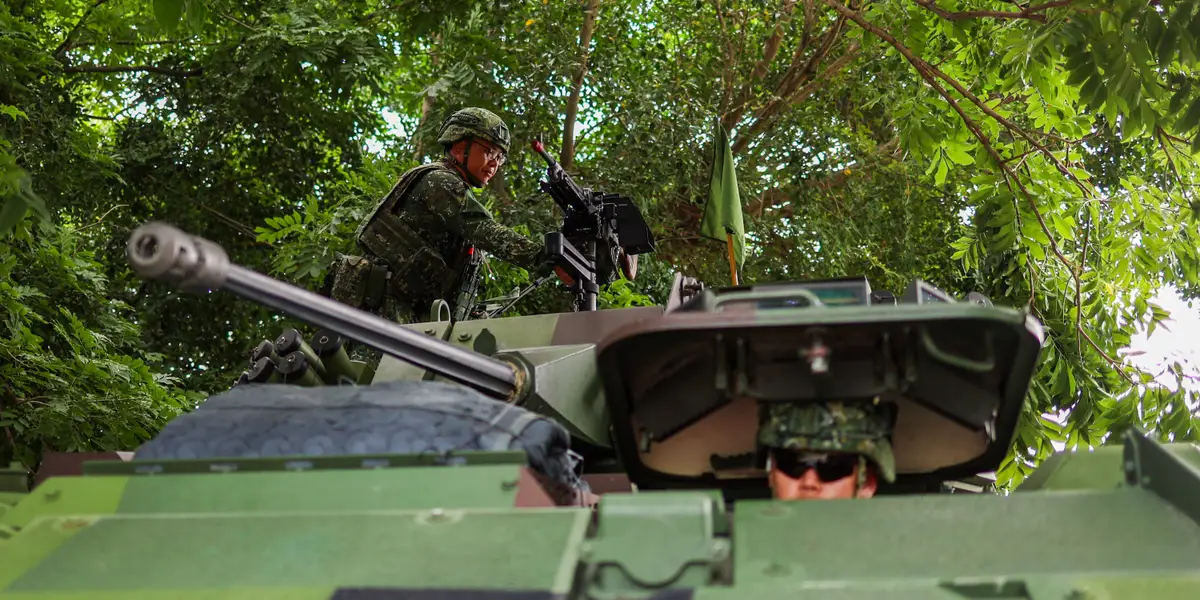
Over the last five years, the US has sold and delivered large quantities of missiles, drones, command-and-control upgrades, ammunition, software, and spare parts, marking a shift away from the higher-profile platforms like tanks and fighter jets.
US officials have argued that survivable, distributed, and networked systems are better suited to helping Taiwan counter China’s daily gray-zone pressure, as well as complicating Beijing’s plans in a crisis or blockade.
Big platforms to distributed firepower
JADE GAO/AFP via Getty Images
Taiwan’s focus has been on building a network of asymmetric capabilities to deter and defend against a full-scale invasion, what some have referred to as a “D-Day scenario.”
Hammond-Chambers said military support and sales have been aligned with countering that, “but we are not doing every day, and there needs to be a swing back and more of a balance.”
Just this month, the US announced a massive $11 billion arms sale to Taiwan that included High-Mobility Artillery Rocket Systems, Army Tactical Missile Systems, Javelin missiles, howitzers, and drones. Many of those systems are designed to be mobile, dispersed, and survivable, reinforcing Washington’s emphasis on asymmetric and precision-strike capabilities.
Taiwan’s defense ministry said the US “continues to assist Taiwan in maintaining sufficient self-defense capabilities and in rapidly building strong deterrent power and leveraging asymmetric warfare advantages, which form the foundation for maintaining regional peace and stability.”
Taiwan’s government has also proposed billions of dollars in supplemental funding for asymmetric capabilities and an island-wide air defense system called Taiwan Dome or T-Dome.
Building on its own
Annabelle Chih/Getty Images
Taiwan’s domestic investment in these weapons raises a key question: “Will American security assistance adjust given that Taiwan is putting an enormous amount of money further down for this so-called asymmetric approach and allow for consideration of other platforms and systems?” Hammond-Chambers said.
One of the most complicated challenges facing Taiwan is how it can develop and stockpile its own weapons systems should a blockade prevent assistance from the US and other allies and partners. The simple answer, retired admiral and former chief of the general staff for Taiwan’s defense ministry Lee Hsi-Min said at the event, is to make weapons at scale on the island, rather than relying primarily on co-production or foreign supply.
Experts and officials have long pointed to the need for a stronger local defense supply chain, including spare parts, munitions, and sustainment capabilities, so that Taiwan can remain operational if outside support is delayed or disrupted.
While Taiwan’s domestic defense industry can continue to develop its own weapons, “the fastest way to production is to license American and Ukrainian and European designs and to produce on island,” Betsy Shieh, former senior commercial officer with the US Department of Commerce, said at the event.
That approach, while not without political and logistical hurdles, could allow Taiwan to scale production more quickly. Taiwanese companies will learn to innovate as that goes on, she said, “but the short term is license, license, license, build on island.”
Taiwan’s government budgets for defense have increased substantially, and it continues to assess what types of weapons and capabilities are most needed for the different ways China could attempt to seize the island.
At this moment, some of its domestic companies have been going all-in on drone production, and a government-created national drone team is focused on bringing together firms from across Taiwan’s industrial base to help build those systems at scale, but more engagement may be necessary to realize its potential.