



When JT Batson thinks about the FIFA World Cup, he compares it to an IPO.
The head of US Soccer, the sport’s governing body, recently recalled a conversation with a veteran CFO who described what it’s like to take a company public: lots of work building toward a single, high-profile moment.
Yet, ultimately, Batson said, the real test is what happens afterward.
That long-term mindset is shaping how he’s approaching what might be the biggest event in American soccer history.
As the US prepares to co-host the World Cup starting Thursday, Batson said he’s focused on building an organization capable of capitalizing on the attention it will bring.
“This summer is a springboard,” Batson said. “This summer is not the destination.”
A business mindset for soccer
Batson, 43, came to US Soccer from the business world, where he co-founded and ran an advertising technology company before becoming US Soccer’s CEO in late 2022.
The start of his tenure followed a tumultuous period for the federation, including a settlement earlier that year with the US women’s national team over a pay-equity lawsuit.
Batson, who played the game growing up in Georgia and later worked as a ref, said he often looks to business for lessons that might apply to US Soccer. Organizational challenges often aren’t unique, he said, even if their application at the nonprofit might be.
“There is someone who solved a similar problem in another environment, somewhere in the world,” he said.
The trick, Batson said, is to take those best practices and “bring them to life” in a way that benefits US Soccer and the game.
“One of the things that I’ve really come to appreciate is that when you apply basic business principles to most any problem we have, the answer becomes quite obvious,” he said.
One example of that philosophy was US Soccer’s decision to take direct control over its commercial business. Since assuming responsibility for its sponsorship, media, and licensing rights in 2023, US Soccer has built an internal operation that handles those deals directly.
Under Batson, US Soccer has brought in executives from outside the sport, including COO Dan Helfrich, who spent more than two decades at Deloitte.
Batson describes soccer as “the challenger sport” in the US and the nation as “the challenger country” in global soccer. After all, despite the hype around hosting the World Cup, soccer isn’t one of the Big Four leagues in the US, while it’s the most popular sport in most of Europe.
“That means if we want to win, we’ve got to out-innovate, we’ve got to outwork, and we’ve got to out-align,” he said.
Building for growth
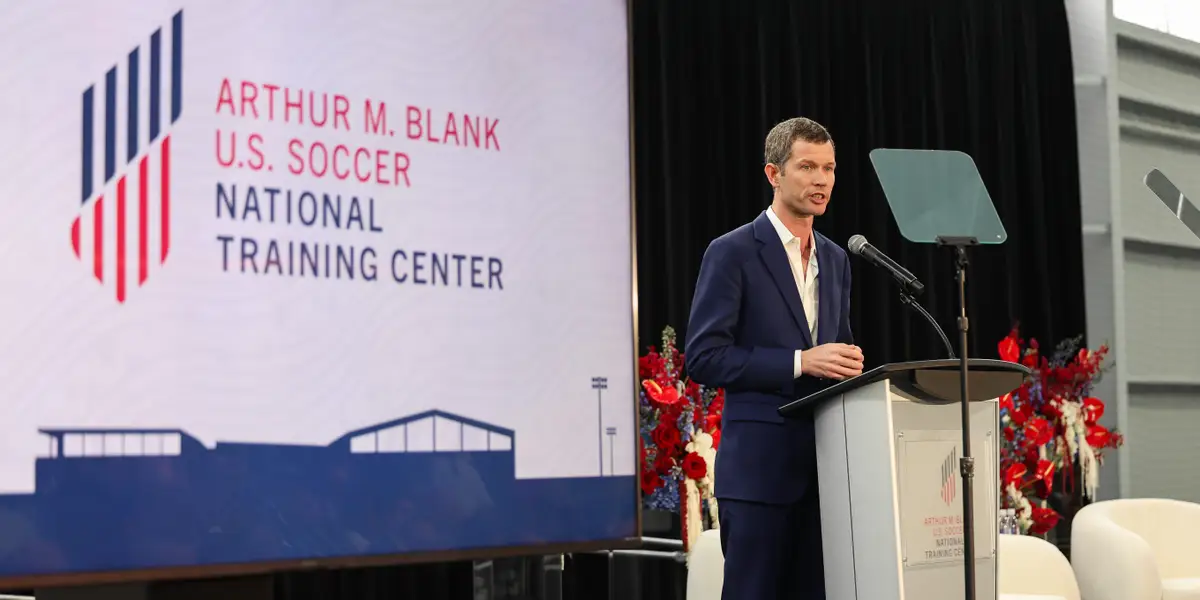
The philosophy is showing up in tangible ways. In May, US Soccer opened a national training center south of Atlanta. The sprawling facility is home to the federation’s 27 national teams, including the marquee men’s and women’s rosters, as well as more than a dozen youth squads.
Beyond the completion of the training center, Batson points to three straight years of profitability for US Soccer and a tripling of revenue as evidence of the federation’s momentum.
He said one of his top priorities since joining US Soccer has been to build trust with those who have a stake in the beautiful game.
As he sees it, US Soccer’s customers include a child learning to kick a ball, aspiring national team players, and every family in America that cares about soccer.
Batson said polling makes clear that the opportunity for soccer is larger than many people realize. A Harris Poll survey found that seven in 10 Americans are interested in soccer. Among those, a quarter are “dedicated,” and 20% are “obsessed.”
Beyond the World Cup
Despite growing popularity in the US, some of the challenges Batson talks about come down to scale.
One of those is helping US Soccer rely more on digital technology, software, and, increasingly, AI to reach players, coaches, and fans spread across such a large country, he said. The federation is exploring, for example, how the technology can help scouts identify promising players from game footage.
Reaching large numbers of people will remain a priority as the sports world’s attention shifts to North America for what is likely to be the most expensive FIFA World Cup.
“Ninety-nine percent of the fans experiencing the World Cup were always going to do it outside the stadiums,” Batson said. “How do you make sure that they really feel a part of that?”
That mindset also shapes how he thinks about what comes after the tournament.
Batson’s longer-term objectives include getting more people involved in the game, setting the US up for success at the 2028 Olympics in Los Angeles, and co-hosting the women’s World Cup in 2031.
“How do we use this summer? How do you use LA ’28? How do you use the Women’s World Cup bid for 2031 to get people to make these big bets and make these big bets together?” he said. “That’s been the focus for us.”