




In Philadelphia, a few steps from the Liberty Bell, there stands a ghost house. It consists of partially reconstructed red brick walls, an empty door frame and windows and, etched on a free-standing stone slab, the names of nine enslaved people who served George Washington there.
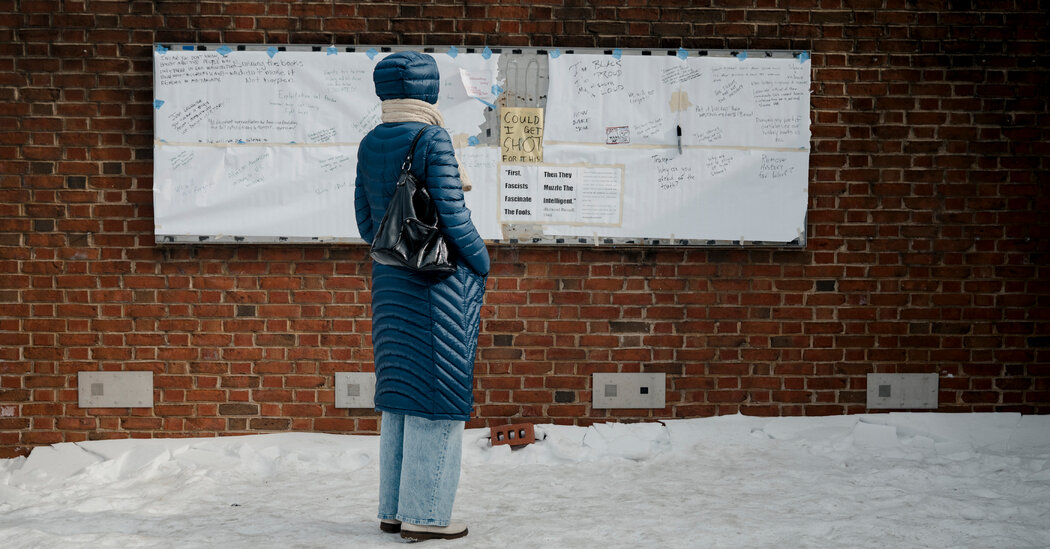
The President’s House, as the open-air site is known, was the seat of the executive branch of the United States’ fledgling democracy from 1790 to 1800, when Washington and then John Adams lived there. But since Jan. 22, when workers arrived unannounced with crowbars and pried all 30 interpretive signs off the walls, it has become a front in the red-hot political battle over American history.
The National Park Service, whose leadership ordered the removals, says it was merely complying with President Trump’s executive order last March calling for the removal or revision of displays that “inappropriately disparage Americans past or living.”
The actions at the President’s House, whose signs had been flagged as problematic during a review of all sites ordered last June by Interior Secretary Doug Burgum, were intended to ensure “accuracy, honesty and alignment with shared national values,” Elizabeth Pease, a Park Service spokeswoman, said in a statement.
But to many Philadelphians who having been coming daily ever since to leave protest messages, it felt like an attack on a hard-won monument, and even on the city itself. Within hours of the removal, the city filed a lawsuit in federal court contesting it, arguing that the Park Service had violated a 2006 agreement creating the site.
The fight over the President’s House is also a microcosm of a much bigger fight over history, one that promises only to escalate as this summer’s 250th anniversary of the Declaration of Independence approaches.
How should Americans balance celebration of the system of self-government initiated in 1776 with frank discussion of its shortcomings? How to weigh the courage and achievements of the founders, versus their flaws and failings?
And perhaps most important: Who gets to decide?
President Trump and his supporters have one answer. They want a celebratory account of the nation’s history focused, as the president put it in his executive order, on “the progress America has made and the ideals that continue to inspire millions around the globe.”
But those who have rallied in defense of the site and the scholarship behind it see a brazen erasure of history.
Michael Coard, a criminal justice lawyer and leader of the Avenging the Ancestors Coalition, a group formed in 2002 to advocate for the site, called the removal an act of “blatant racist desecration.”
The Museums Special Section
“If you want to make the argument that George Washington was a great general, that he was a great president, go ahead and make it,” Coard said. “But can you be a great human being when you hold 317 people in brutal bondage?”
“That any president would want to stop that information from being out there,” he said, “is outrageous.”
‘The Foundingest Father’
The founders’ relationship with slavery is a well-trod subject these days, but still a fraught one. And nowhere more so than when it comes to Washington.
“He is the Foundingest Father,” said John Garrison Marks, the author of “Thy Will Be Done,” a forthcoming book about how Americans have thought, and fought, about Washington and slavery. “Washington serves as this symbol of America for everyone, both for people who want to celebrate and people who want to criticize.”
Black Americans have long highlighted Washington’s slaveholding, Marks said, even if some white citizens and white institutions have not wanted to hear it. In recent decades, a number of early presidential houses, including Washington’s Mount Vernon, have added substantial discussion of slavery, often in response to pressure from descendants of those enslaved there.
At some houses, descendants have been granted seats on the board. But nowhere have Black citizens had as direct a voice in creating a site as at the President’s House.
The recently dismantled display grew out of a controversy in the early 2000s, when it was revealed that a new $9 million home for the Liberty Bell would be partly on top of the site of the house’s slave quarters.
In 2006, after a prolonged push by historians and local advocates, the Park Service and the city entered into an agreement to establish the President’s House as a site dedicated to slavery and freedom, with particular focus on the enslaved people in Washington’s household.
Washington’s record with slavery is complex. Defenders point to his criticism of slavery in private letters, as well as his will, written a few months before his death in 1799, which stipulated that the enslaved people he owned would be freed after the death of his wife, Martha. (At his death, 123 of the 317 enslaved people at Mount Vernon were Washington’s property, with the rest owned by a trust connected with Martha’s first husband or rented from others.)
But others note that Washington said and did nothing publicly to criticize or restrict slavery, much less end it. And when it came to the people he held in bondage, he believed their freedom was his and his alone to grant.
While living in Philadelphia, Washington quietly rotated enslaved servants back and forth to Mount Vernon, in Virginia, to skirt Pennsylvania’s 1780 gradual abolition law, which allowed enslaved people brought to the state to petition for freedom after six months. And when some ran away, he doggedly pursued them.
A sign formerly at the President’s House put the site’s point of view plainly: “Be aware that here you are following in the footsteps of these enslaved as much as those of the founding fathers.”
‘Hijacking’ 1776?
Since its dedication in 2010, the President’s House seems to have aroused little controversy among visitors.
But one person who did take exception was Jeffrey Anderson, a political scientist and former Trump administration official who visited the site last August with his son. Last fall, he published a critical article in The Claremont Review of Books, a conservative intellectual journal, called “Hijacking America’s Story.”
Anderson, who lives in Virginia, was dismayed at what he saw as the site’s relative lack of information about the many precedent-setting accomplishments of the Washington administration, including the creation of the Cabinet and the peaceful transfer of power. Instead, he saw an overemphasis on slavery, which, by his count, was discussed in 25 of the 30 panels.
“It was odd,” Anderson said in an interview. “You came away thinking here was the legislative branch, the judicial branch and then almost the slavery branch.”
He was also disturbed by what he saw as a relentlessly negative portrayal of Washington. “If you came to Independence Park and only saw this site,” he said, “you would walk away thinking he was the biggest villain.”
Anderson, who led the Bureau of Justice Statistics in the first Trump administration, sent his essay to some people in the administration, including in the Department of the Interior. “I’d like to think it had some effect,” he said.
Anderson said he has gotten favorable reactions from readers. But in Philadelphia, where a coalition of 45 historical groups have rallied in defense of the President’s House, it’s hard to find anyone cheering.
The morning after the removals, passers-by recorded their reactions on blank pieces of paper that someone had taped up where the signs used to be. They were a mix of reflection, anger and local pride.
“Slavery is Real, Go Birds!” one read, referencing the Philadelphia Eagles (and throwing in a vulgar reference to Immigration and Customs Enforcement). On the ground was a bouquet of roses, with a note: “I’m so sorry for OUR loss.”
Sharon Pearson, a resident of West Philadelphia, said she had visited the site many times over the years. The removals, she said, were “sad,” but it didn’t mean the stories would be forgotten.“Removal does not mean non-remembrance,” she said.
Still Telling the Story
The stories of Black Americans are hardly gone from the area around Independence Hall. Across the street from the President’s House, a state historical marker tells the story of Ona Judge, an enslaved woman who escaped from the house in 1796 and defied Washington’s extensive efforts to recapture her.
A few blocks away, on the facade of the Museum of the American Revolution, there’s a large bronze plaque of Washington crossing the Delaware, but also banners showing costumed actors representing the diverse population of colonial America. (In 1776, roughly 20 percent of people in the 13 colonies were of African descent.)
R. Scott Stephenson, the museum’s chief executive and a historian, said its research showed that people of all stripes are open to history that includes the hard parts.
The President’s House site “was there because people cared about that story and wanted it to be told,” Stephenson said. “And it will continue to be told.”
The museum is a private nonprofit, so the federal government has no say over its content, like its current exhibition, “The Declaration’s Journey,” which puts a chair where Thomas Jefferson may have sat while drafting the document with a rusted bench from the cell where Martin Luther King Jr. wrote “Letter from a Birmingham Jail.”
But at Park Service sites, more removals may be coming.
The Trump administration has also ordered the removal or alteration of texts at the Liberty Bell center and Independence Hall, according to internal Park Service documents reviewed by The Times.
And as part of last year’s review, the Park Service has also flagged a interactive display at the Benjamin Franklin Museum, according to a report in The Philadelphia Inquirer. That display invites visitors to weigh evidence about whether Franklin was pro- or antislavery — something, the display notes, that historians disagree about.
The Park Service’s concern: Visitors who don’t finish the exercise “may walk away with the impression that Franklin was only pro-slavery, without seeing his later transformation.”
For some scholars that misses the complexity of history, which offers few clear-cut verdicts.
“There is not a single right answer, or a single piece of evidence that will settle it,” Marks said. “Reckoning can only be done by us, in the present.”
Maxine Joselow contributed reporting from Washington.