
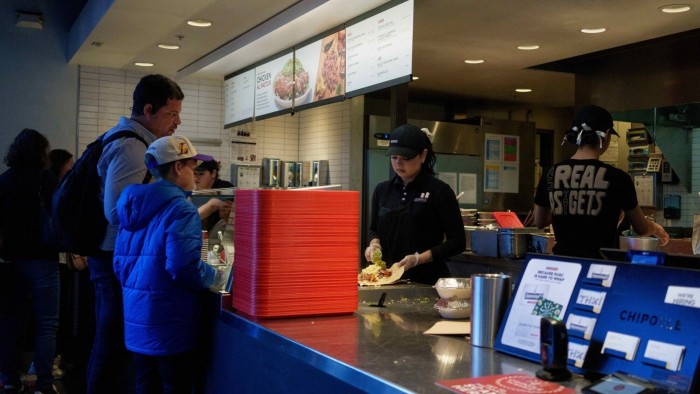
A New York Times article on how Americans have embraced buy-now-pay-later loans caused a minor online stir this week, with the sentence highlighted below causing some alarm:
“Food prices have skyrocketed,” said Mrs. Hodge, of Austell, Ga., who plans how much she’ll spend on each trip to the grocery store based on her cash flow and other expenses that month, including credit-card debt and student loans. Being able to spread out the payments for groceries has helped her family of four — soon to be five — budget better, she said.
Mrs. Hodge, 29, is hardly alone. Nearly a quarter of consumers using buy now, pay later loans finance groceries, up from 14 percent a year ago, according to a recent LendingTree survey. And it’s not just groceries; more Americans are using these loans to pay for recurring monthly bills, such as electricity, heat, internet and streaming services like Hulu.
Some people seemed to read this to mean that almost a quarter of all adult Americans are using BNPL loans to finance their grocery shopping, rather than that a quarter of BNPL loans are now used for groceries.
But even this is a little disconcerting. Given that the traditional FICO credit scores don’t pick up BNPL debts, the rising prevalence of BNPL even for small ticket items could be obscuring signs of consumer stress that would otherwise be picked up on by investors. We’ve already been making jokes about “burrito-now-pay-later”, so it made Alphaville wonder how alarmed we really should be.
Unfortunately, LendingTree’s website is glitching for us — it seems to have identified Alphaville’s curiosity as a DDOS attack and has blocked us — so we weren’t able to check out its survey’s methodology and raw data.
Fortunately, Morgan Stanley’s research team has been digging into the same subject, and found a similar if more nuanced picture.
The investment bank’s “AlphaWise” data science team ran its own survey in April, which showed that 28 per cent of Americans it polled had a BNPL loan. That’s shockingly high — at least to us — but these spanned the gamut from groceries and bigger-ticket items like pricey electronics. The most common items reportedly purchased through BNPL were clothes and shoes.
As you’d expect, the younger you are the more likely you are to use BNPL. However, Morgan Stanley found that wealthier people are more likely to have a BNPL loan than poorer ones. This probably isn’t what you’d expect, and runs counter to previous research by the NY Fed.

Alphaville suspects that this is because the well-heeled will tend to be more financially sophisticated, and simply treat BNPL as a short term zero-interest loan (which they often are, as long as you make all the payments on time).
With CD interest rates of about 4.5 per cent, this makes sense (even if it feels very late-stage-capitalism that wealthy Americans are possibly in practice getting free loans to buy air fryers thanks to poorer ones getting shafted on late fees).
Morgan Stanley’s analysts note that there does seem to be an increasing willingness — or need — to use BNPL for smaller everyday items like food. About 30 per cent of survey respondents that reported having used BNPL had used them for groceries, even higher than the LendingTree survey’s reading.

Moreover, data from asset-backed securities issued by Affirm — one of the big players in the BNPL space — indicates that the average loan size has decreased steadily from an average of $760 in 2020 to $372 in 2025.
This is obviously not ideal, as Morgan Stanley writes:
Increased use of BNPL on everyday items could be a sign of greater market penetration and outreach from the companies, but it also could be a sign of increased consumer stress. If BNPL usage were to grow rapidly later this year, when we expect consumers to be more stretched due to elevated inflation from tariffs and slow income growth, we would potentially take that as a warning sign of the latter.
However, there are other elements that make the bank’s analysts relatively relaxed, at least in the short term.
Firstly, at least some BNPL companies are working on integrating their data into credit reports, and over time most of them probably will. That should at least ameliorate the hidden-debts issue.
Secondly, BNPL remains tiny compared to credit card debt or student loans. A report by PYMTS last month estimated that the size of the US BNPL market had hit $175bn, but credit card balances stand at $1.18tn, car loans at $1.64tn, and student loans at $1.63tn at the end of the first quarter, according to the NY Fed.
Thirdly, the delinquency and default rates on the BNPL loans contained by Affirm’s ABSs are actually lower than in other unsecured loan ABS. This is probably mostly because of the extremely short-term nature of most BNPL loans, but it implies that the credit quality probably isn’t quite as shocking as commonly assumed.
Alphaville would also add that while Klarna last month reporting a 17 per cent year-on-year jump in credit impairments to $136mn is obviously not great, as a percentage of its overall payment volumes this only translated into an uptick from 0.51 per cent to 0.54 per cent.
Morgan Stanley therefore argues that “we do not see this as large enough yet to be a macro risk from an economic standpoint”.
However, that doesn’t mean that the BNPL industry itself isn’t heading for trouble. As the bank’s analysts conclude:
We expect consumer spending to slow this year and consumer loan performance to weaken as policy changes dampen income and wealth growth. Student loans pose another risk, and this risk is likely more pronounced for unsecured and BNPL compared to other types of consumer debt. The Trump administration announced last month that it would start to collect on defaulted student loans for the first time in five years. Meanwhile, consumer credit scores are taking hits from late student loan payments for the first time in five years as well.
We estimate that 10-15mn borrowers are late or defaulted on their federal student loans. If these borrowers start to pay again, this could be another ~$300-400 monthly payment (on average) that could eat at their ability to spend and to pay other debts. In our 2023 survey, we also found that BNPL had the most overlap in borrower base with student loans. At that time, 34% of consumers in our survey with BNPL loans also had federal student loans. This makes sense considering both debt types are concentrated in younger borrowers. Debts such as auto loans and mortgages are likely further up consumers’ payment priority, so we expect unsecured loans and BNPL to face the most risk from resumption of federal student loan payments.