
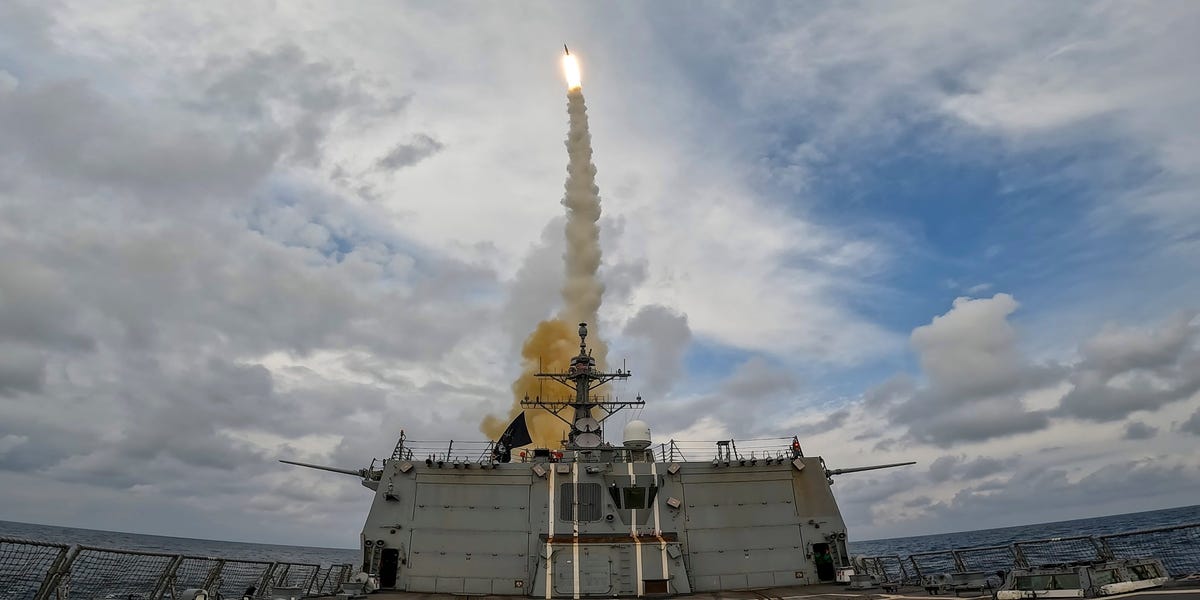
Warning signs are flashing, cautioning that a high-intensity war with China could swiftly burn through US missile stockpiles, leaving it hamstrung in a drawn-out conflict.
War games have, for instance, shown that in a heated fight over Taiwan, American forces could run out of long-range, precision-guided munitions in less than a week. Replacing those in the middle of a fight could stress both US industries and budgets. Trying to expand the arsenal ahead of a war might do the same.
To fix this problem, some defense firms are shifting toward cheaper, easier-to-produce weapons, breaking away from the Pentagon’s preference for the costly, high-end systems.
In a new Cogs of War podcast, industry leaders from defense firms Anduril, Mach Industries, and Castilian talked with War on the Rocks founder Ryan Evans about how their companies are working on cheaper missiles that can be quickly made in larger quantities for far less money than some other munitions.
“Everybody’s been hearing, kind of across the services, about this affordable mass problem,” Steve Milano, senior director of advanced effects at Anduril, said, “and we’ve got the exquisite weapons systems, but we really need affordable, sufficient mass” in missiles and munitions.
Last year, Anduril unveiled the Barracuda family of cruise missiles with different increments depending on size, range, and payload. On the podcast, Milano said Anduril was opening its first production facility for Barracuda in January 2026. “We’ll be pumping out 2,000 units a shift at that facility alone,” he said.
U.S. Army Security Assistance Command
Anduril has called Barracuda “software-defined” and capable of being upgraded based on enemy countermeasures. The company also has said the drone also addresses a key US vulnerability, the possibility that precision-guided munitions that “would be exhausted in a matter of days in a high-end fight.”
Related stories

Business Insider tells the innovative stories you want to know
Business Insider tells the innovative stories you want to know
When Anduril announced Barracuda, it said that the US defense industrial base and arsenal struggle with limited production capacity and little flexibility for upgrades because of complicated missile designs with bespoke parts and specialized supply chains.
Castelion’s CEO Sean Pitt said on the podcast that his company noticed the same problems and thus pursued affordable hypersonic missiles. It’s been raising funding and testing its Blackbeard missile for years, with plans to field it in 2027.
US Army budget documents identified Blackbeard as a launched effect for High Mobility Artillery Rocket Systems and suggested the missile could be useful as a way to hit time-sensitive targets at a reduced cost-per-missile compared to other weapons in the service’s inventory.
And Mach Industries won an Army contract earlier this year with its Viper vertical takeoff strategic strike cruise missile that costs less than $100,000 to manufacture at scale. CEO Ethan Thornton said on the podcast that the two big optimizations the company pursued were asymmetry, having low-cost munitions with ranges that can be produced en masse, and survivability.
All three companies are effectively looking to disrupt the traditional costs and supply chains of American missiles with goals of not only making systems cheaper in larger quantities but also with less intricate designs that can slow down production or upgrade cycles. But that doesn’t mean these companies are necessarily always competing with defense primes, larger American defense companies that have decades of weapons production experience and deep, established relationships with DoD.
Japanese Ground Self Defense Force Courtesy Photo
There is certainly some antagonism in this space, perhaps exacerbated as some military leaders push for shake-ups. “They view us as a threat in a lot of ways, and we view them as kind of a threat in a different way, in that they can pollute your culture, they can slow you down a little bit,” Milano said of the big players.
But “the primes are necessary,” he said, and other companies “are a compliment to” them, not a replacement.
On the podcast, the industry leaders said that the way the Pentagon has traditionally bought missiles has been a long process with many requirements that result in yearslong development cycles with significantly higher costs.
The Anduril, Mach Industries, and Castelion approaches are part of a larger shift among some American defense companies toward a disruptive Silicon Valley-like model of moving quickly on designs, breaking and fixing things, and upgrading as needed, something services like the Army have also been embracing more and more with emerging technology linked to new software, artificial intelligence, autonomy, and drone systems.
That’s now spreading to missile development as the DoD and others increasingly recognize that having massive stockpiles of varied munitions that can be made affordably at scale are potentially more important to readiness for a peer-level fight than a limited arsenal of exquisite systems.
Recent conflicts in the Middle East have shown just how quickly combat can stress American missile arsenals. Shooting down Houthi missiles and shielding Israel from Iranian weapons came at tremendous cost in THAAD, SM-2, SM-3, and SM-6 interceptor expenditures. The Ukraine war has drawn heavily on Patriot interceptor stocks, and there are concerns about Tomahawk cruise missile stockpiles.
Last fall, Adm. Samuel Paparo, the head of US Indo-Pacific Command, said conflicts around the world had eaten into stocks of some air-to-air missiles, which were crucial for the region he oversees. “It imposes costs on the readiness of America to respond in the Indo-Pacific region, which is the most stressing theater for the quantity and quality of munitions, because [China] is the most capable potential adversary in the world,” he said.