

What's Hot

    Your Favorite Restaurant Is Becoming a Tech Company | Invesloan.com

    March 7, 2026

    New Era of Drone Warfare Creates Higher Risks for Civilians | Invesloan.com

    March 7, 2026

    Subscribe to learn | Invesloan.com

    March 6, 2026
    Facebook Twitter Instagram
    Finance Pro
    Facebook Twitter Instagram
    invesloan.cominvesloan.com
    Subscribe for Alerts
    • Home
    • News
    • Politics
    • Money
    • Personal Finance
    • Business
    • Economy
    • Investing
    • Markets
      • Stocks
      • Futures & Commodities
      • Crypto
      • Forex
    • Technology
    invesloan.cominvesloan.com
    Home » Crypto “Kill Switch” Exposed: Bybit Warns 16 Blockchains Can Freeze User Funds | Invesloan.com
    Crypto

    Crypto “Kill Switch” Exposed: Bybit Warns 16 Blockchains Can Freeze User Funds | Invesloan.com

    November 12, 2025
    Share
    Facebook Twitter LinkedIn Pinterest Email

    A new report from Bybit’s Lazarus Security Lab has revealed that 16 blockchain networks possess built-in mechanisms that can freeze or restrict user funds, questioning how decentralized they really are.

    The report, published on Tuesday, analyzed 166 blockchain networks using a combination of AI-driven detection and manual code review.

    Source: Bybit’s Lazarus Security Lab

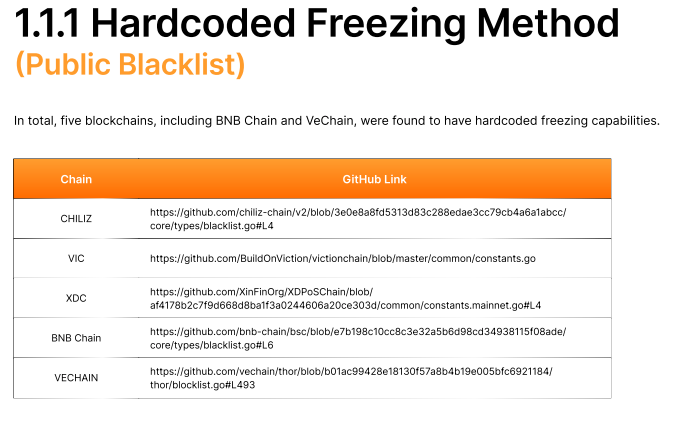
    It found that major chains, including Binance-backed BNB Chain, VeChain, Chiliz, Viction, and XinFin’s XDC Network, have hardcoded freezing functions, allowing developers or validators to halt transactions or lock specific wallets.

    BNB Chain, Aptos Among Networks With Built-In Freezing Mechanisms

    Bybit’s researchers categorized these control mechanisms into three main types: hardcoded freezing, configuration-based freezing, and on-chain contract freezing.

    Ten of the 16 blockchains rely on configuration files like YAML, ENV, or TOML to manage private blacklists accessible only to validators or foundations.

    Examples include Aptos, EOS, and Sui, which can freeze funds via validator-level configuration changes.
    Source: Bybit’s Lazarus Security Lab

    Another five networks, including BNB Chain, embed freezing features in their source code, allowing blacklisted wallets to be blocked at the protocol level.

    They noted that the Heco Chain (Huobi Eco Chain) stands out as the only network using a smart contract-based blacklist, executing freezes through an on-chain contract.

    Though designed for security, some of these mechanisms introduce new risks of centralization and censorship.

    “The existence of fund-freezing functions, even when implemented for security purposes, challenges the notion of full decentralization,” Bybit’s researchers wrote.

    The Lazarus Security Lab also identified 19 additional blockchains that could introduce similar capabilities with minor protocol modifications.

    Among them are several built on the Cosmos ecosystem, which uses “module accounts,” addresses controlled by on-chain logic rather than private keys.

    Module accounts could theoretically freeze addresses by hard fork adjustments. Though no Cosmos-based chains have done so yet.

    “This function could, in theory, be modified in the future to add a hacker’s address,” the report said.

    A Debate Over Security vs. Decentralization

    The findings add fuel to an ongoing debate in the crypto industry over whether blockchains should have the power to intervene in user transactions.

    Supporters argue that such features are essential for responding to hacks or criminal activity, while critics warn that they undermine the foundational principles of decentralization and censorship resistance.

    Bybit just confirmed 16 coins can literally freeze your funds.

    3 types of “freezing”:
    – Hardcoded in protocol (like $BNB)
    – Validator / Foundation control (like $SUI, $APT)
    – On-chain contract execution (like HECO)

    Everyone screams “decentralization,”
    but most don’t realize how… pic.twitter.com/LtTfAWMuo2

    — Ji-hoon 지 (@0xJiHoon) November 12, 2025

    Advocates of freezing mechanisms point to the rise in crypto-related crimes, where court-authorized freezes can recover or contain stolen assets.

    Fund-freezing capabilities can also help prevent money laundering or terrorist financing and provide protection for investors in cases of fraud.

    The moment your funds can be frozen, you’re not in crypto anymore.

    This is a reminder.

    If code can freeze your funds, it was never your money.

    Decentralisation was the point.

    Somewhere along the way, everyone forgot that. https://t.co/p7tZNc0ke3

    — Grace (@GraceNft89) November 12, 2025

    Opponents, however, argue that such powers create central points of control, allowing foundations or validators to block transactions arbitrarily.

    This, they say, erodes trust in blockchain immutability and opens the door to censorship. Once a chain has a “kill switch,” even if unused, it can no longer be considered permissionless in practice.

    The timing of Bybit’s research is noteworthy. It comes just months after the exchange suffered a $1.5 billion cold wallet hack, one of the largest in the industry’s history.

    In that incident, coordinated efforts with partners such as Circle, Tether, THORchain, and Bitget led to the freezing of $42.9 million in stolen funds, while the mETH Protocol recovered an additional $43 million worth of tokens.

    The event showed both sides of the fund-freezing argument. While the intervention helped recover tens of millions of dollars, it also reinforced how centralized the power to freeze assets has become, even on networks marketed as decentralized.

    The report stops short of making policy recommendations but urges greater transparency around such features.

    “Blockchains that include freezing capabilities should disclose them clearly,” the authors wrote, warning that undisclosed intervention points could mislead users about the degree of control they truly hold over their funds.

    The post Crypto “Kill Switch” Exposed: Bybit Warns 16 Blockchains Can Freeze User Funds appeared first on Cryptonews.


    Share. Facebook Twitter Pinterest LinkedIn Tumblr Email

    Keep Reading

    Bitcoin Price Prediction: Major Miner Just Expanded in Texas: Is a Massive BTC Production Surge Coming? | Invesloan.com

    Crypto Price Prediction Today 25 February: XRP, Solana, Bitcoin | Invesloan.com

    Hong Kong to Link New Digital Bond Platform With Regional Crypto Tokenization Hubs | Invesloan.com

    An AI Crypto Agent Sent a ‘Beggar’ Six Figures, Then He Lost It All This Way | Invesloan.com

    Ethereum Locks In FOCIL for 2026 as Foundation Moves $6.8M ETH to Staking | Invesloan.com

    Bitcoin Price Prediction: $400 Million Suddenly Pulled From ETFs — Is Smart Money Quietly Exiting BTC? | Invesloan.com

    Crypto Price Prediction Today 24 February – XRP, Bitcoin, Ethereum | Invesloan.com

    XRP Price Prediction: Arizona Just Named XRP in a State Crypto Reserve Bill — Is Government Adoption Beginning? | Invesloan.com

    Bitpanda Offers €15 in Silver to New Users Trading €50 in Metals | Invesloan.com

    LATEST NEWS

    Your Favorite Restaurant Is Becoming a Tech Company | Invesloan.com

    March 7, 2026

    New Era of Drone Warfare Creates Higher Risks for Civilians | Invesloan.com

    March 7, 2026

    Subscribe to learn | Invesloan.com

    March 6, 2026

    Alphabet CEO’s New $692M Pay Package Tied to Waymo, Wing Performance | Invesloan.com

    March 6, 2026
    POPULAR

    China’s first passenger jet completes maiden commercial flight

    May 28, 2023

    Numbers taking US accountancy exams drop to lowest level in 17 years

    May 29, 2023

    Toyota chair faces removal vote over governance issues

    May 29, 2023
    Advertisement
    Load WordPress Sites in as fast as 37ms!
    Facebook Twitter Pinterest WhatsApp Instagram
    © 2007-2023 Invesloan.com All Rights Reserved.
    • Privacy
    • Terms
    • Press Release
    • Advertise
    • Contact

    Type above and press Enter to search. Press Esc to cancel.

    invesloan.com
    Manage Cookie Consent
    To provide the best experiences, we use technologies like cookies to store and/or access device information. Consenting to these technologies will allow us to process data such as browsing behavior or unique IDs on this site. Not consenting or withdrawing consent, may adversely affect certain features and functions.
    Functional Always active
    The technical storage or access is strictly necessary for the legitimate purpose of enabling the use of a specific service explicitly requested by the subscriber or user, or for the sole purpose of carrying out the transmission of a communication over an electronic communications network.
    Preferences
    The technical storage or access is necessary for the legitimate purpose of storing preferences that are not requested by the subscriber or user.
    Statistics
    The technical storage or access that is used exclusively for statistical purposes. The technical storage or access that is used exclusively for anonymous statistical purposes. Without a subpoena, voluntary compliance on the part of your Internet Service Provider, or additional records from a third party, information stored or retrieved for this purpose alone cannot usually be used to identify you.
    Marketing
    The technical storage or access is required to create user profiles to send advertising, or to track the user on a website or across several websites for similar marketing purposes.
    • Manage options
    • Manage services
    • Manage {vendor_count} vendors
    • Read more about these purposes
    View preferences
    • {title}
    • {title}
    • {title}