
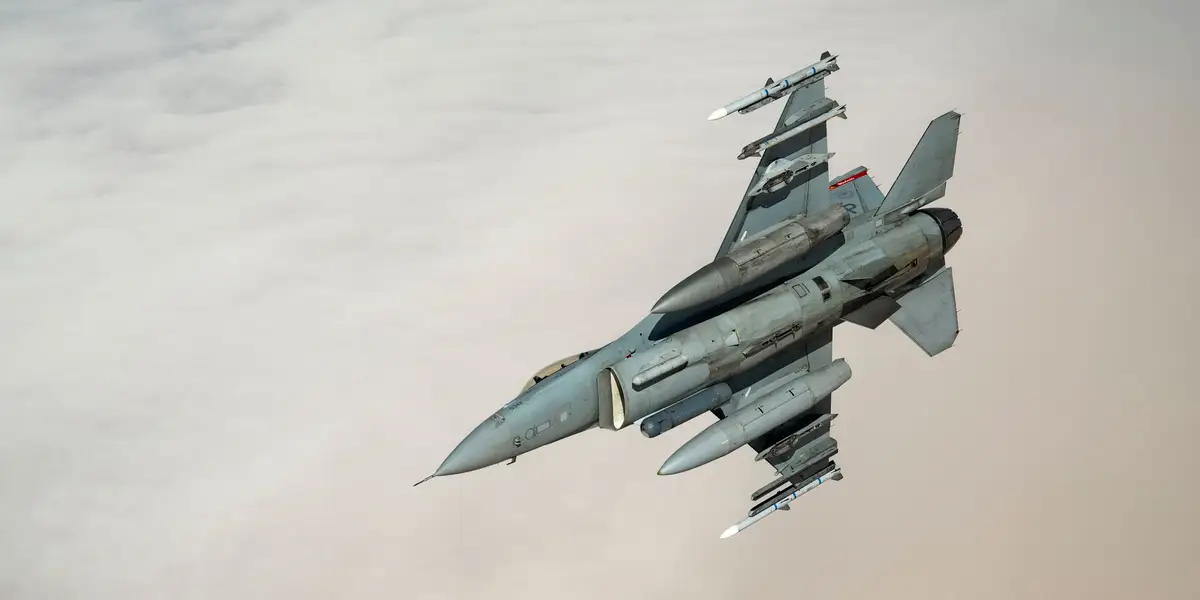
A US Air Force pilot survived 15 minutes of enemy missile fire during a mission in the Middle East this year, making extreme high-G maneuvers as warheads exploded only feet away from his fighter jet.
Lt. Col William Parks was awarded the Silver Star Medal, the nation’s third-highest military citation for valor in combat, at the Pentagon last week for his actions, according to an Air Force news release and a service citation obtained by Business Insider.
The Air Force said the March 27 mission occurred within the US Central Command area of responsibility, which includes the Middle East region, but did not specify where exactly. However, the timeline aligns with Operation Rough Rider, the military’s weekslong bombing campaign against the Houthi rebels in Yemen.
Parks served as the mission commander overseeing a force package of 21 strike aircraft, while also leading four F-16 Fighting Falcon jets in suppression of enemy air defenses.
SEAD missions are designed to clear radars and surface-to-air missile launchers, giving friendly aircraft greater freedom to operate. The US military targeted Houthi air defenses throughout the Red Sea conflict.
During the mission, Parks “intentionally placed himself” within the range of air defenses protecting the “enemy’s capital,” the award citation reads. This decision allowed US aircraft to destroy ballistic missile production facilities.
US Air Force photo by Staff Sgt. Jackson Manske
Parks’ fighter was targeted by a barrage of surface-to-air missiles and antiaircraft artillery that lasted for 15 minutes. The pilot pushed his F-16 through a string of high-G maneuvers and deployed countermeasures as munitions exploded just feet away.
F-16s can withstand up to nine G’s, or nine times the force of gravity, with a full fuel load during acceleration or a turn. The human body can generally handle 4-5 Gs for short periods of time; trained fighter pilots can handle higher Gs. Too long, though, and even a trained pilot may black out. It’s unclear how many Parks pulled on March 27.
The mission’s dangers didn’t end there. Parks, with fuel below minimum levels and still over enemy territory, quickly coordinated an “emergency rendezvous with two separate tankers, ensuring his flight access to critical fuel and preventing the probable loss of two aircraft due to fuel starvation,” his award citation reads.
“His courageous and steadfast actions directly contributed to the survival of his wingman and himself,” it says of Parks, a former commander of the 480th Expeditionary Fighter Squadron.
Parks’ fighter squadron defeated a “record” 108 enemy drones and land attack cruise missiles during its eight-month deployment, which supported a handful of US military operations in the Middle East, including one dedicated to fighting the Islamic State, the Air Force said in a Sunday release.
The Air Force added that Parks showed “innovative” weapons employment by firing cheap laser-guided rockets and decades-old AIM-9M air-to-air missiles to shoot down hostile targets, saving the US more than $25 million in munitions costs.
Mohammed Hamoud/Getty Images
The engagement also marked the first time in three decades that the AIM-9M Sidewinder, a supersonic missile developed by the US Navy in the 1950s, was used successfully in combat.
“It’s a rare day when someone earns a Silver Star, with less than 100 being earned during the Air Force era,” said Gen. Ken Wilsbach, the Air Force chief of staff, at an award ceremony last week.
Wilsbach said after hearing about Parks’ experience, “I absolutely believe he deserves this honor. Recognizing valor in combat matters, and it is a privilege to serve alongside warfighters like him.”
The Air Force credited Park with the interception of six weapons that posed a threat to the aircraft carrier USS Harry S. Truman, which played a leading role in the counter-Houthi operations in the Red Sea, and five surface-to-air missiles that targeted his F-16.
Parks, who has several airmen in his family, described the Silver Star Medal as “incredible” and said it “means a lot.”
“The amount of aviation and everything that we have in our family, that’s what shaped me and helped mold me,” he added.