
The steel structure sealing off the Chernobyl nuclear disaster site has suffered so much damage that it’s no longer containing radiation effectively, the International Atomic Energy Agency said on Friday.
The agency, or IAEA, wrote in an update that its team had visited the protective shield in the prior week and found that it “had lost its primary safety functions, including the confinement capability.”
This shield is known as the New Safe Confinement, or NSC, which was installed in 2016 as a second protective layer to stop the spread of radioactive material from Reactor Four of the Chernobyl power plant.
Damage to the shield increases the risk of leaks, which are difficult to contain because radioactive materials, such as gas and dust, can easily disperse widely and remain hazardous for extended periods.
The NSC fully encases an original, smaller concrete structure for containment called the Sarcophagus, built by the Soviet Union after Reactor Four exploded in 1986 and sparked a nuclear crisis across continental Europe.
The NSC, which cost $1.75 billion to install, was urgently needed because the Sarcophagus had an estimated lifespan of 30 years and wasn’t airtight, allowing radioactive dirt and gas to escape.
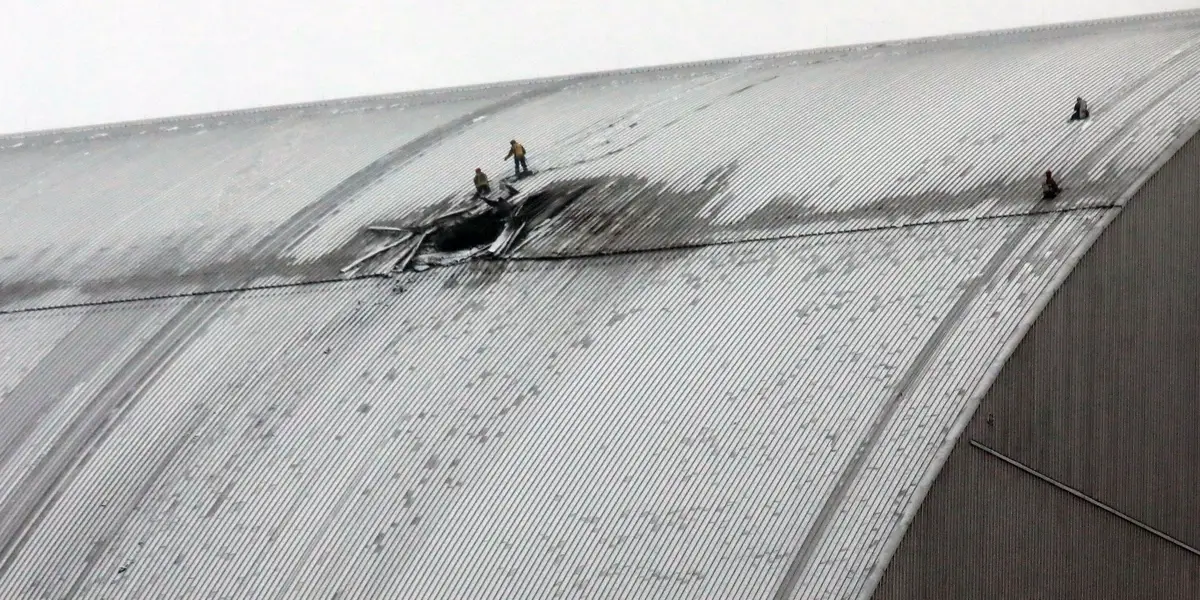
Now, the IAEA said its team confirmed that the NSC can’t do its job after being “severely damaged” by a drone strike in February.
The strike, which Ukraine has said was caused by a drone belonging to Russia, set fire to the steel structure’s outer cladding.
“Limited temporary repairs have been carried out on the roof, but timely and comprehensive restoration remains essential to prevent further degradation and ensure long-term nuclear safety,” said the IAEA’s director general, Rafael Mariano Grossi.
The February drone strike left a roughly 160-square-foot hole in the shield, which is shaped like a massive aircraft hangar. At its tallest point, the shield stands at about 360 feet above the ground.
The fire created by the strike lasted for weeks, and the structure’s main crane was damaged, the IAEA said earlier this year.
In the months following the strike, the IAEA reported that emergency work to extinguish the resulting fire had created about 330 openings in the NSC’s outer cladding.
Volodymyr Tarasov/Ukrinform/NurPhoto via Getty Images
Authorities were initially concerned that radioactive dust around the shield could be scattered if the shelter was hit by an explosive. No radiation leaks were reported, authorities had said at the time.
The IAEA’s latest findings, however, now indicate that the long-term damage to the NSC may be more significant than first understood. Still, the agency added that it hadn’t found any risk to the shelter’s load-bearing structures or monitoring systems.
The nuclear watchdog urged major repairs and upgrades to the shield, including humidity control measures and an improved program to monitor corrosion.
After the February drone strike, Ukrainian officials accused Russia of deliberately targeting the Chernobyl disaster site, a claim that the Kremlin has denied.
The Chernobyl exclusion zone was initially captured by Russia in 2022 when its forces tried to sweep into Kyiv in the early months of the war.
Moscow later withdrew from the area, and Ukrainian authorities could resume work on the Chernobyl disaster site in April 2022.