
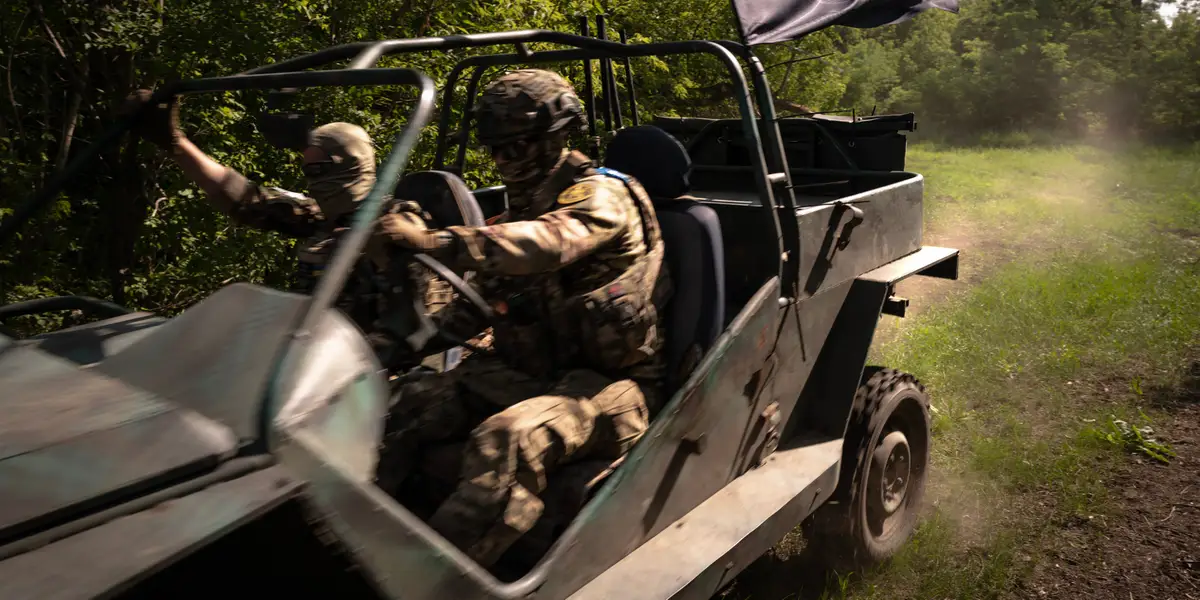
Ukraine’s elite special operators rely on light buggies to swiftly move along the front lines, banking on their speed and maneuverability to execute high-stakes missions.
These run-and-gun vehicles don’t come with much in the way of external protection, leaving them exposed and vulnerable to Russian drone strikes, but that’s the tradeoff for flexibility in combat.
Two soldiers in Ukraine’s 4th Ranger Regiment, a special operations unit modeled after its US Army counterparts, talked to Business Insider about how they found themselves under Russian drone fire near the front lines while riding in the buggies.
Both attacks, which were carried out in Ukraine’s northeastern Sumy region in recent months, left soldiers injured, the two special operators said. They could only be identified by their call signs for security reasons.
In September, Khyzhak and two other operators were driving back to base from a mission when a Russian first-person-view (FPV) drone appeared behind their buggy and started chasing the vehicle.
Khyzhak said that his driver skillfully maneuvered away from the Russian drone at the last second, which detonated a few feet away on the side of the road. The Ukrainians, having narrowly survived, jumped out of the buggy. One of the operators landed awkwardly and broke his leg.
Two months earlier, in July, Drago and several other operators were out in a buggy when they were attacked by a massive swarm of Russian FPV drones — so many, in fact, that he described how their tiny propellers made the whole sky sound “noisy.”
Drago said his buggy was struck and shrapnel from the explosion injured his left hand and pelvis. Then, another Ukrainian buggy that went to help came under drone fire. Multiple operators from the 4th Ranger Regiment found themselves caught in the large attack.
Khyzhak speculated that the Russian drone pilots may be intentionally targeting the Ukrainian buggies because these vehicles are known to carry elite troops, forces that tend to stir up trouble behind enemy lines.
In his case, the Russian drone didn’t react to any other vehicles in the vicinity, he said. However, Drago said that when he was struck, the concentration of Russian drones was so high that pilots attacked anything they could, including ATVs and armored personnel carriers.
Although several buggies were caught in the attack, Drago said that it’s hard to say whether they were priority targets.
It’s unclear to what extent the targeting of buggies may reflect a broader trend. The Russian defense ministry and its embassy in the US did not immediately respond to a request for comment from Business Insider.
FLORENT VERGNES/AFP via Getty Images
The buggy is a four-wheel car with virtually no external protection. It is one of the lightweight vehicles used in the conflict for infantry assaults, rapid movement, and other specialized missions, alongside quad bikes, motorcycles, and even electric scooters.
These buggies can also run logistics missions — hauling ammunition to the front or evacuating wounded troops. Ukraine’s defense industry has signaled it intends to mass-produce them.
The US Army is notably interested in something very similar, the Infantry Squad Vehicle, a lightweight buggy-style combat asset that comes as the service and soldiers look to prioritize speed and flexibility over cumbersome heavy armor.
Unlike armored vehicles, which have hardened exteriors, the buggies used in Ukraine look more like militarized golf carts. However, their main advantages are speed, maneuverability, and off-road capabilities that allow access to areas other vehicles can’t reach and a shot at dodging drones, though these can be tough to evade.
These characteristics are particularly useful for special operators, who try to keep a low profile during their missions.
Khyzhak, who joined Ukraine’s special operators forces nearly two years ago and commands a small unit, said that he faced the threat of Russian drones earlier in the war while riding in US-made High Mobility Multipurpose Wheeled Vehicles (Humvees) or Bradley Infantry Fighting Vehicles.
Andriy Andriyenko/SOPA Images/LightRocket via Getty Images
The September near-miss, though, was the first time he experienced a Russian drone attack while riding in a buggy.
Ukrainian officials have said that attack drones are destroying most battlefield targets now, making large mechanized assaults with armored vehicles far harder for both sides.
The increasing threat of drones has pushed Ukraine and Russia to acquire and field smaller, lighter, and faster vehicles as alternatives to more traditional — often slower, less flexible, and more easily spotted — systems, such as tanks and heavy armor.
At least 14,000 tanks and armored vehicles have been destroyed in this conflict, according to the open-source intelligence platform Oryx, which tracks equipment losses on both sides. Many systems have been taken out by drones.
The expanded use of light vehicles for combat and logistics missions underscores how Ukraine and Russia are adapting to the threat of drones, which dominate the battlefield all along the front line.