
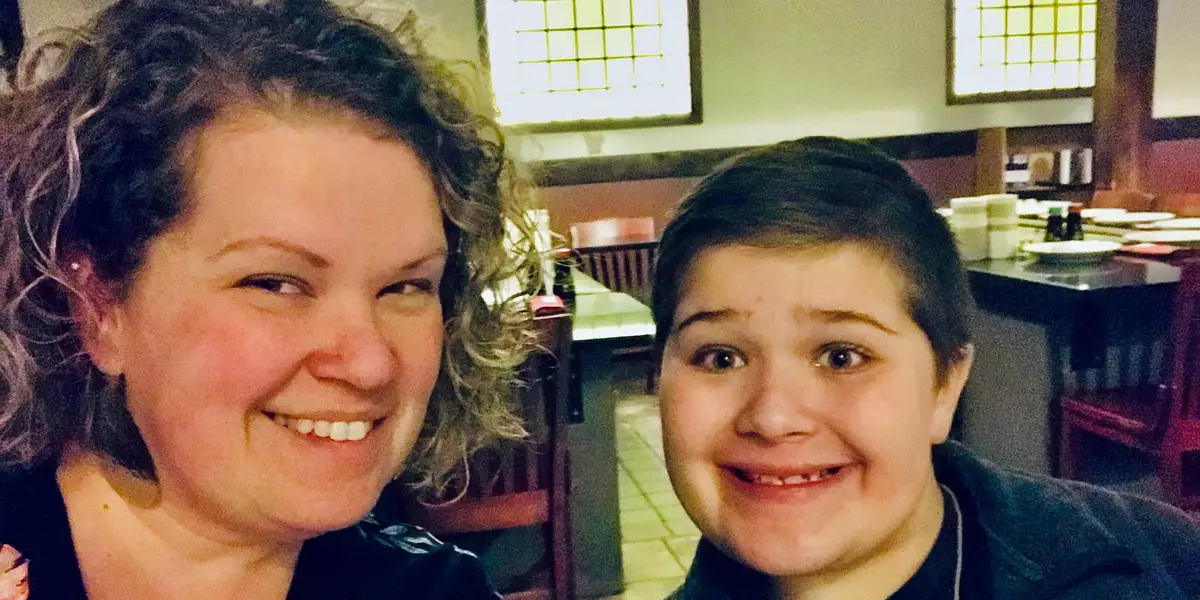
A few years ago, my son, Logan, was a shadow of his former self.
He was 12 years old, disassociating from his peers, losing his hair to stress-induced alopecia, and battling clinical depression. He couldn’t communicate in the way that mattered most to teens — texting. He played video games, but felt excluded because he couldn’t read the in‑game chats. In class, he withdrew to avoid the embarrassment of being called on to read or participate. He put on a brave front to protect a secret: he couldn’t read.
As an educator, I felt a growing sense of panic. As a mother, I was heartbroken.
It caused him to have anxiety
For Logan, it wasn’t just an academic problem; it was a mental health crisis. The frustration, anxiety, and low self-esteem he felt were manifesting as behavioral issues, avoidance, and social withdrawal. These were his coping mechanisms for the shame of being left behind.
Logan, now 16, had always struggled. He was diagnosed with autism at age 6, and for years, the educational system made a simple, devastating assumption: his inability to read was due to his autism. He was passed along, reading at what was believed to be a “sufficient” level year after year, even as the gap between him and his peers became a chasm.
As I began to lead a systemic shift toward the Science of Reading in my own elementary school, I was facing a crisis at home. The “one-size-fits-all” balanced literacy approach, which was failing students in classrooms across the country, was also failing my son.
The turning point, for Logan, came when I brought my work home.
As the science of reading began to gain traction across the country, my elementary school started using the phonics-forward curriculum, Reading Horizons, to assess student abilities that we had never previously evaluated, such as phonemic awareness, encoding, and decoding. Curious, I sat down with Logan and gave him these assessments. I asked him to segment the sounds in the word “cat.”
He couldn’t do it. My 12-year-old son couldn’t tell me that “cat” was made up of the sounds /c/ /a/ /t/.
I was dumbfounded. He didn’t understand basic word construction. I felt an immediate, immense guilt — as a parent and educator. College had not prepared me to teach an older child to read, especially not my own teenager. We sought a psychoeducational evaluation, and the answer was finally clear: Logan had dyslexia.
He needed support for his dyslexia
His struggle to read wasn’t a result of his autism. And it certainly wasn’t his fault. It is a condition that makes reading and spelling difficult — and with the right help, people with dyslexia can overcome it.
But that help was nowhere to be found in the secondary school support offered to him. He didn’t need more “reading time.” He needed explicit, systematic phonics instruction. During his sophomore year, we finally found a new option: Logan’s high school introduced a phonics-forward, Orton-Gillingham-aligned, multisensory, evidence-based intervention for a small group of students. It was everything he had been missing.
The journey was not easy. It required sacrifice. Two to three nights a week, Logan had intensive tutoring as well. He missed youth group, practices, and family functions. We all understood what was at stake: his future.
Like so many older students who finally receive the support they need, he had to unlearn the narrative that he was beyond help. Within one year, his curriculum-based measures moved from 22 words correct per minute with 65% accuracy to 71 words correct per minute with 96% accuracy.
Courtesy of the author
My son’s inability to read blocked the immense pride and confidence he so desperately needed. But Logan’s story is not a celebration of the system; it’s an indictment of it. While the system he has been a part of is starting to make changes, they are not happening fast enough. And unfortunately, his story is not unique.
Millions of children graduate from elementary school without sufficient reading skills, not because teachers aren’t doing their best, but because their hands are tied to dated, failed curricula. The problem then explodes in secondary school.
There is a dangerous misconception that the path to reading looks different in middle or high school, or that kids will magically catch up. It does not, and they won’t. The path is the same, whether a child is in 1st grade or 10th grade. They need to be taught phonics through systematic, explicit instruction.
I had no idea how to help him, even as an educator
As a previous middle school teacher, I had no idea how to help a struggling reader. Most secondary teachers are considered content specialists, not reading specialists. There is a common misconception that learning to read is the sole responsibility of elementary schools, and most students entering secondary school are reading proficiently. However, research shows that only 35% of 12th graders are proficient readers, while 65% are at a “basic” or “below basic” reading level.
As an instructional coach, I now have a platform to help my school get it right. We’ve implemented ability grouping, and we use assessments that inform instruction. Most of our teachers are trained in Language Essentials for Teachers of Reading and Spelling (LETRS), a professional development program that teaches educators the science of reading.
Today, Logan is almost unrecognizable. He is on the honor roll, a member of the National Honor Society, was named “Student of the Month” at his high school, and is playing varsity sports. On a car ride home last month, he told me, “School seems easier this year.”
I replied, “That’s because you are a reader now.”