
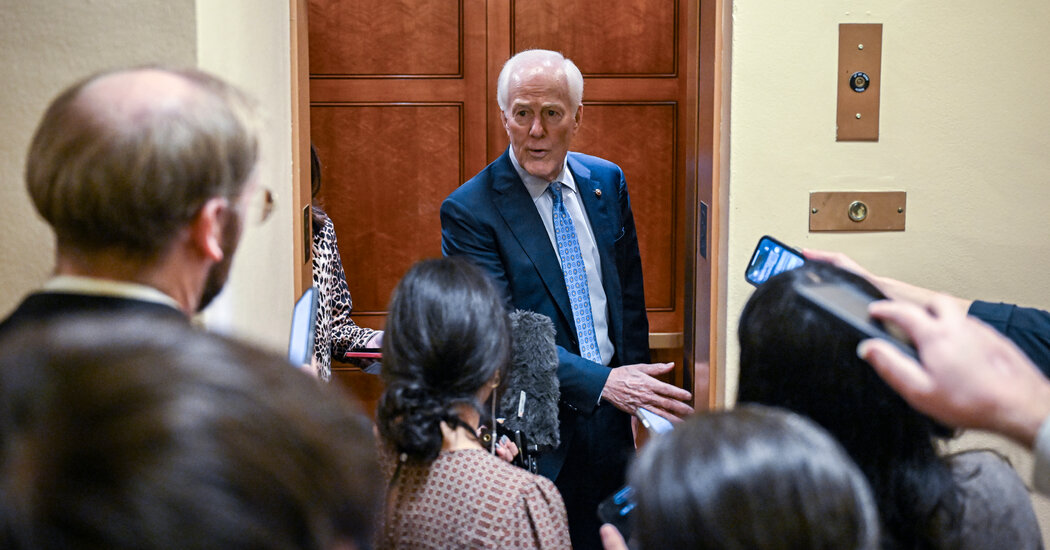
Some of the country’s richest conservative donors have been pouring tens of millions of dollars into an effort to save Senator John Cornyn of Texas as he faces a daunting Republican primary challenge next month.
It may only buy him some more time.
Allies of Mr. Cornyn have spent about $50 million on advertising on his behalf since last July, an unheard-of sum to support a fourth-term incumbent running for re-election in a primary contest.
The outlay is all the more remarkable because the three-way March primary race is widely expected to go to a runoff election in May. That Cornyn supporters believe he needs millions of dollars in spending just to advance to the runoff speaks to how precariously he is positioned in a party in which he was once seen as a potential Senate leader.
By contrast, his top challenger, the hard-line Texas attorney general Ken Paxton, has been so confident in his support from the Republican base that he has done barely any advertising at all. The main super PAC supporting Mr. Paxton has so far spent less than 1 percent of the amount spent by Mr. Cornyn’s groups combined, which have heavily outraised Mr. Paxton’s.
The vast gulf in advertising spending tells the story of the Republican primary race for Senate in Texas, among the most bitter and expensive in the nation.
Republican leaders in Washington, with the help of establishment party donors, are making an all-out push to stop Mr. Paxton, worrying that his right-wing politics, his history of legal and ethical troubles and a messy divorce could give Democrats an opening in the red-state race.
Alex Latcham, who runs political groups tied to Senator John Thune, the majority leader, has been telling Republican donors for about a year that Mr. Cornyn was in danger of losing the primary.
“We were the first to raise the alarm bells that this race was going to be a problem if Ken Paxton is the nominee,” Mr. Latcham, the executive director of the Senate Leadership Fund, the main super PAC working to elect Senate Republicans, said in an interview.
His message to donors? “Spend now, shore up support for John Cornyn and ensure that he’s the nominee — so you don’t have to spend $100 million to $150 million in November.”
Mr. Latcham’s allied donors were doing just that through ads — attacking Mr. Paxton over his well-documented history of ethics concerns, including an impeachment by the Republican-dominated State House, and trying to lift Mr. Cornyn’s polling numbers.
But Cornyn allies’ task grew more complicated in October, when a third Republican challenger, Representative Wesley Hunt of Houston, jumped into the race. With three well-known Republican candidates, and none likely to clear the necessary 50 percent of the vote to capture the nomination outright, the donors’ strategy changed.
Now, the March 3 primary is almost certain to winnow the field to a two-candidate runoff in late May.
Some of Mr. Cornyn’s donors have had serious concerns in recent months about his viability, according to people close to them, but they now largely think he will at least make the runoff. What happens next is a subject of debate. Some donors are hoping to save resources for the May runoff.
But some major donors feel “fatalistic” about the embattled Mr. Cornyn, in the words of one adviser, and some are already privately wondering when, not whether, wealthy Republicans should cut bait, according to two people close to those donors. Some establishment Republicans worry that no matter his financial advantage, he will be a serious underdog against Mr. Paxton in the runoff — and that donors’ money would be better spent helping Republicans like Senator Susan Collins of Maine in the fall.
The big wild card is President Trump, who has not endorsed a candidate in Texas but said recently that he was taking “a very serious look.”
The Democratic primary race for Senate in Texas is also about to get more expensive.
The two top Democrats, James Talarico and Representative Jasmine Crockett, have stockpiled millions in their campaign accounts and, in the final weeks, are mobilizing donors to back allied super PACs, which are not subject to contribution limits.
The first ad from the super PAC backing Mr. Talarico, Lone Star Rising PAC, is expected to begin airing on television this week, according to a person with direct knowledge of the private planning.
Mr. Talarico’s aides recently posted a code of sorts on his website, seemingly pointing the super PAC or other allied groups to messages that the candidate hoped would be broadcast. (Candidates are not allowed to directly coordinate with super PACs.) The group had raised just $400,000 as of Jan. 1, according to recent federal filings, and two donor-advisers backing Mr. Talarico said they were making an invigorated push for contributions.
Allies of Ms. Crockett, meanwhile, are engaging their own donors in conversations about a new super PAC called Forward Texas, according to a person close to the effort. Ms. Crockett is expected to travel to the San Francisco Bay Area next week for two fund-raising events with major liberal donors, according to invitations reviewed by The New York Times.
A co-host of one of the events is Karla Jurvetson, who notably spent nearly $15 million in one month to help Senator Elizabeth Warren of Massachusetts during the 2020 presidential race.
“Representative Crockett is a brilliant, brave leader and the type of proven fighter that is needed in these times,” Ms. Jurvetson said. “I’m proud to have been a supporter of hers since 2021, and I’m continually thinking about how to help her.”
Asked whether she planned to donate to the nascent pro-Crockett super PAC, she reiterated that she was “continually thinking about how to help her.”
Time is running out — neither Democratic candidate’s super PAC is on television yet. Early voting starts on Feb. 17.
For now, Mr. Cornyn rules the airwaves.
His main outside super PAC has spent about $17 million on his behalf, financed by the likes of Stephen A. Schwarzman, the chief executive of Blackstone, and Harlan Crow, the real estate magnate.
Mr. Cornyn has also enjoyed about $29 million in spending from undisclosed donors, through a nonprofit group linked to former Gov. Rick Perry and through the nonprofit group tied to Mr. Latcham’s super PAC, according to AdImpact, a media tracking firm. But the pro-Cornyn spending by those groups has tapered off since Mr. Hunt entered the race.
The Cornyn campaign described the volume of campaign spending as a sign of the senator’s importance to the Republican Party in 2026. “As the G.O.P. nominee, Senator Cornyn takes Texas off the map, so Republicans can focus on growing our majority in other races,” said Matt Mackowiak, a campaign spokesman.
Mr. Paxton, who entered the race with a lead in public polling that Mr. Cornyn has worked to claw back, is largely absent from the ad wars: His super PAC has spent only about $375,000 on ads, according to Federal Election Commission filings.
“We feel good about where we are at this point in the race and are going to deploy our resources when it’s necessary, and not before,” said Gregg Keller, who runs Mr. Paxton’s super PAC.
Mr. Hunt, battling to make the runoff, does not have the luxury of biding his time. A new allied super PAC, Fighting for Texas, booked its first television time this week, disclosing on Tuesday a $240,000 purchase.
Mr. Hunt has aggressively sought out one of the country’s biggest Republican donors and wealthiest Texans: Elon Musk. Last month, Mr. Hunt even implied in a fund-raising email subject line that the billionaire had offered his support: “Elon agrees with Wesley Hunt.”
Mr. Musk has engaged with Mr. Hunt several times on X in recent weeks — but he has not endorsed the congressman’s campaign.