
Recently, I found myself in a pickle. I had a physical copy of a book from the library I wanted to read — a history of the Battle of Bunker Hill. (I feel certain there’s a sizable cohort of people like me who only had their middlebrow hyperfixations on Ken Burns’ “The American Revolution” PBS miniseries broken by “Heated Rivalry.”)
In the last few years, I have embraced the convenience of audiobooks for driving/walking/exercising/doing dishes. As a result, I am consuming more books than ever, but not so much with my eyeballs. (If you have opinions about the superiority of paper books over audiobooks, please know that I respect you and you are valid, but I do not want to hear them.)
So here’s what would happen: I’d be listening in the car, and then a paper copy of the book would sit on my nightstand, taunting me. But it was too annoying to try to figure out which paper page I was on in the audio version, so I resorted to listening to the audiobook on my phone in bed at night while playing a Solitaire game app at the same time.
No more!
Spotify
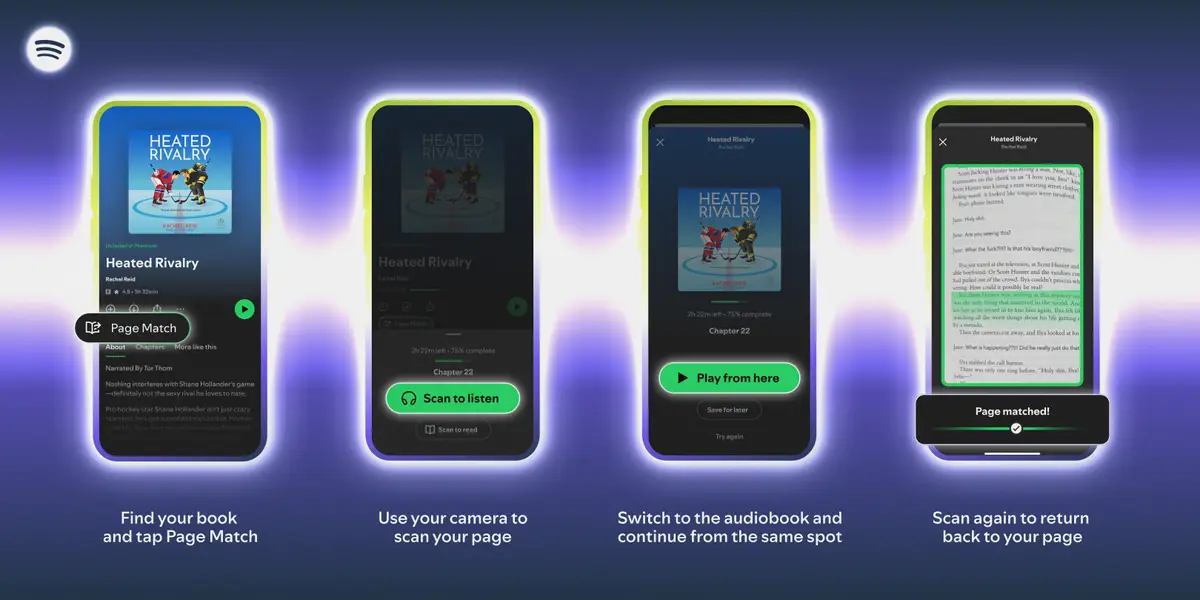
Spotify is launching a new feature in its audiobook section called Page Match, which lets you switch between a physical book and the audiobook without having to flip back and forth to find your place.
It works by having you take a photo of the page you left off on and cueing up that part of the audiobook. If you’re going from audio back to paper, it will help you flip through the paper chapter and match you right at the paper page and paragraph you just listened to.
The idea of switching between eyes and ears to finish a book isn’t new — Amazon has something somewhat similar that syncs the Audible version with your Kindle version. But until now, there’s been no way to match audio with a physical paper book.
This is huge for people like me, who enjoy the convenience of audiobooks but also want to switch between formats. For paid Premium users, you get about 15 hours of free time a month with your plan.
Spotify is also adding links to buy physical books from BookShop.org, the e-commerce site that works with independent booksellers. Spotify will take the standard 15% affiliate fee on completed sales, which may become a new revenue stream, albeit perhaps a trickle at first.
It is also a tiny step on Amazon’s toes — entering the audiobook space was already an encroachment on Audible’s business (Audible works slightly differently, where you get a certain number of credits for books each month instead of a flat number of hours). Working with BookShop.org to sell physical books by mail, well, that’s just icing on the cake.
Look, sure, this is a teeny tiny feature added to the lesser-used part of Spotify. But to the handful of eager audiobook fans out there who have yearned to switch between formats more easily — this is huge!