
This story originally ran in Welt and appears on Business Insider through the Axel Springer Global Reporters Network.
“All we’ve got left now,” the Russian soldier said, “are radios, cables and pigeons.”
A decision earlier this month by SpaceX to shut down access to Starlink satellite-internet terminals caused immediate chaos among Russian forces who had become increasingly reliant upon the Elon Musk-owned company’s technology to sustain their occupation of Ukraine, according to radio transmissions intercepted by a Ukrainian reconnaissance unit and shared with the Axel Springer Global Reporters Network, to which POLITICO and Business Insider belong.
The communications breakdown significantly constrained Russian military capabilities, creating new opportunities for Ukrainian forces. In the days following the shutdown, Ukraine recaptured roughly 77 square miles in the country’s southeast, according to calculations by the news agency Agence France-Presse based on data from the Washington-based Institute for the Study of War.
Viktor Lysenko/BI
SpaceX began requiring verification of Starlink terminals on Feb. 4, blocking unverified Russian units from accessing its services. Almost immediately, Ukrainian eavesdroppers heard Russian soldiers complaining about the failure of “Kosmos” and “Sinka” — apparently code names for Starlink satellite internet and the messaging service Telegram.
“Damn it! Looks like they’ve switched off all the Starlinks,” one Russian soldier exclaimed. “The connection is gone, completely gone. The images aren’t being transmitted,” another shouted.
Dozens of the recordings were played for Axel Springer Global Reporter Network reporters in an underground listening post maintained by the Bureviy Brigade in northeastern Ukraine. Neither SpaceX nor the Russian Foreign Ministry responded to requests for comment.
“On the Russian side, we observed on the very day Starlink was shut down that artillery and mortar fire dropped drastically. Drone drops and FPV attacks also suddenly decreased,” said a Ukrainian aerial reconnaissance operator from the Bureviy Brigade who would agree to be identified only by the call sign Mustang, referring to first-person view drones. “Coordination between their units has also become more difficult since then.”
The satellite internet network has become a crucial tool on the battlefield, sustaining high-tech drone operations and replacing walkie-talkies in low-tech combat. Since Russia’s February 2022 invasion, which destroyed much of Ukraine’s traditional communications infrastructure, Western governments have provided thousands of the Starlink units to Kyiv.
Viktor Lysenko/BI
Viktor Lysenko/BI
With the portable terminals, there is no need to lay kilometers of cable that can be damaged by shelling or drone strikes. Drone footage can be transmitted in real time to command posts, artillery and mortar fire can be corrected with precision, and operational information can be shared instantly via encrypted messaging apps such as Signal or Telegram.
At the outset of the Russian invasion, Starlink access gave Ukraine’s defenders a decisive operational advantage. Those in besieged Mariupol sent signs of life in spring 2022 via the backpack-size white dishes, and army units used them to coordinate during brutal house-to-house fighting in Bakhmut in 2023.
Satellite internet became “one of, if not the most important components” of Ukraine’s way of war, according to military analyst Franz-Stefan Gady, an adviser to European governments and security agencies who regularly visits Ukrainian units. “Starlink constituted the backbone of connectivity that enabled accelerated kill chains by helping create a semi-transparent battlefield.”
The operational advantages of Starlink did not go unnoticed by Russian forces. By the third year of the war, Starlink terminals were increasingly turning up in Russian-occupied territory. One of the first documented cases surfaced in January 2024 in the Serebryansky forest. Month by month, Ukrainian reconnaissance drones spotted more of the devices.
The Ukrainian government subsequently contacted Musk’s company, urging it to block Russian access to the network. Mykhailo Fedorov, then digital minister and now defense minister, alleged Russian forces were acquiring the devices via third countries. “Ukraine will continue using Starlink, and Russian use will be restricted to the maximum extent possible,” Fedorov pledged in spring 2024.
Yet Russian use of the terminals continued to grow throughout 2025, and their use was not limited to artillery or drone units. Even Russian infantry soldiers were carrying mini Starlink terminals in their backpacks.
“We found Starlink terminals at virtually every Russian position along the contact line,” said Mustang. “At some point, it felt like the Russians had more devices than we did.”
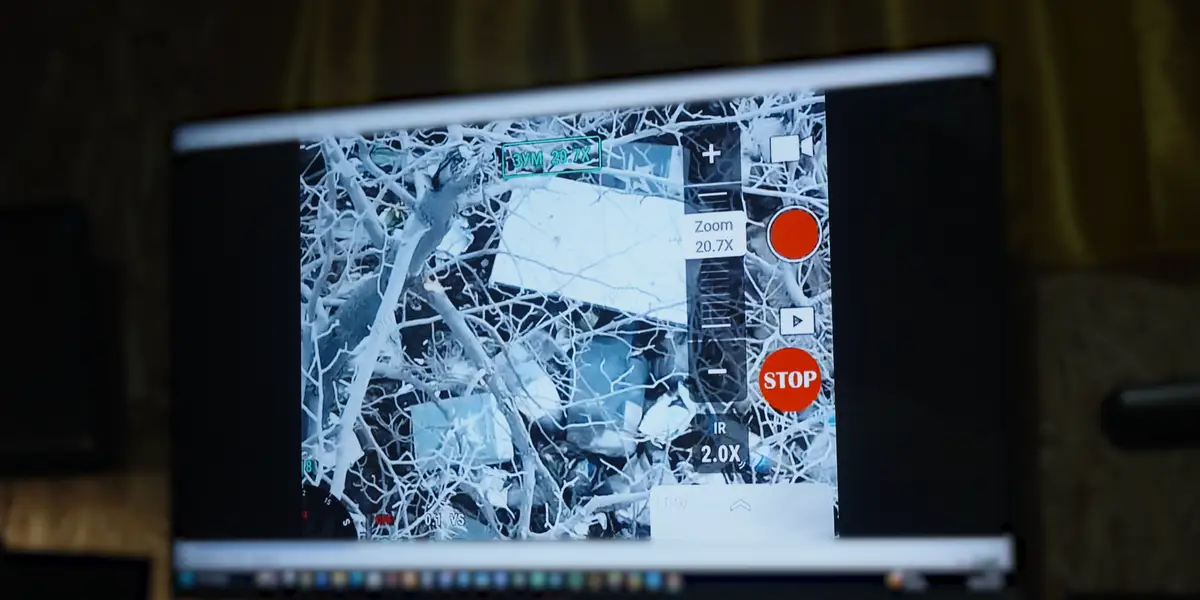
In the listening post this month, he scrolled through more than a dozen images from late 2025 showing Russian Starlink terminals set up between trees or beside the entrances to their positions.
“We targeted their positions deliberately,” Mustang continued. “But even if we destroyed a terminal in the morning or evening, a new one was already installed by the next morning.”
In the Russian-occupied eastern Ukrainian city of Kreminna, there was even a shop where soldiers could buy Starlink terminals starting in 2024. According to Ukrainian officials, these devices were not registered in Russia.
SpaceX’s move in early February to enforce a stricter verification system effectively cut off unregistered Starlink terminals operating in Russian-occupied areas. Only devices approved and placed on a Ukrainian Ministry of Defense “whitelist” remained active, while terminals used by Russian forces were remotely deactivated.
“That’s it, basically no one has internet at all,” a Russian soldier said in one of the messages played for Axel Springer reporters. “Everything’s off, everything’s off.”
The temporary shutdown allowed Ukraine to slow the momentum of Vladimir Putin’s forces, although the localized counteroffensives do not represent a fundamental shift along the front. Soldiers from other Ukrainian units, including the Black Arrow battalion, confirmed the military consequences of the Starlink outage for Russian forces in their sectors in interviews with the Axel Springer Global Reporters Network.
By mid-February, Russian shelling had increased again, though largely against frontline positions that had long been identified and precisely mapped — suggesting that Russia has yet to fully restore all of its lost capabilities.
Now, analysts from the Bureviy Brigade say Russian forces are scrambling for alternatives. They have been forced to rely far more heavily on radio communication, according to Mustang, which creates additional opportunities for interception.
Russian units will likely attempt to switch to their own satellite terminals. But their speed and connection quality are significantly lower, Mustang says. And because of their size, the devices are difficult to conceal.”The shutdown of Starlink, even if only of limited effect for now, highlights the limited ability of the Russian armed forces to rapidly implement ongoing cycles of innovation,” said Col. Markus Reisner of the Austrian Armed Forces. “This could represent a potential point of leverage for Western supporters to provide swift and sustainable support to Ukraine at this stage.”
Ibrahim Naber is a chief reporter at Welt.