
What's Hot

    April’s stock-market rebound is about to face its first main check as earnings season swings into gear | Invesloan.com

    April 12, 2026

    GOP senators focused in $5M advert marketing campaign to cross SAVE America Act | Invesloan.com

    April 12, 2026

    I Left Journalism at 53. Now I Make $85,000 As a Mail Carrier | Invesloan.com

    April 12, 2026
    Facebook Twitter Instagram
    Finance Pro
    Facebook Twitter Instagram
    invesloan.cominvesloan.com
    Subscribe for Alerts
    • Home
    • News
    • Politics
    • Money
    • Personal Finance
    • Business
    • Economy
    • Investing
    • Markets
      • Stocks
      • Futures & Commodities
      • Crypto
      • Forex
    • Technology
    invesloan.cominvesloan.com
    Home » Inside a Decommissioned Nuclear Silo From the Cold War | Invesloan.com
    Money

    Inside a Decommissioned Nuclear Silo From the Cold War | Invesloan.com

    April 12, 2026Updated:April 12, 2026
    Share
    Facebook Twitter LinkedIn Pinterest Email

    A decommissioned nuclear silo near Denver, Colorado, that could once launch three 4.5-megaton nuclear missiles at a moment’s notice is now an entrepreneur’s pet project.

    Nik Halik, an Australian venture capitalist, purchased the decommissioned Cold War-era nuclear missile silo from the US government in 2021 for more than $10 million. For the past five years, Halik has been overseeing its transformation into a modern, renovated facility, where he plans to house an AI data center.

    The project is on brand for Halik, a self-described “thrillionaire” whose past endeavors have included skydiving over Mount Everest, training in Russia as a civilian cosmonaut, and diving 5 miles deep to the deck of the Titanic.

    He said his interest in these types of structures pairs with his vision for what they could become.

    “I’m immersed in the world of castles and underground bunkers,” Halik told Business Insider. “I’m a value-facturer. I like things that I can add value to.”

    Halik took Business Insider on a tour of the facility. See what it looks like inside the roughly 75-year-old nuclear silo.

    The facility was built in Colorado in 1959 for $47 million, or $350 million in today’s dollars.


    Missile silo under construction.

    Other Titan I silos like Halik’s were built in Colorado.

    Carl Iwasaki/Getty Images

    At the beginning of the Cold War, the US began developing intercontinental ballistic missiles (ICBMs) at a rapid pace. Following the US’ first operational ICBM, the SM-65 Atlas, the Titan I went under development in the mid-1950s.

    According to the National Park Service, the Titan I missiles were 98 feet tall and could deliver a nuclear warhead over 6,000 miles.

    Eighteen silos, like Halik’s and the one pictured, were built across the US to house these missiles during the Cold War.

    Four large diesel engines powered the facility.


    A person walking into a Titan I facility.

    Another Titan I silo near Denver. Thanks to diesel power, the facilities could be powered without the grid.

    Carl Iwasaki/Getty Images

    Thanks to the silo’s use of diesel fuel, it had the ability to stay running without being connected to the electrical grid. The amount of fuel in the silo was enough to fuel around 2,000 houses for roughly 2 weeks.

    Just one of the silo’s three diesel tanks has the capacity to hold about 50,000 gallons of fuel, Halik told Business Insider.

    The missiles were removed from the silo less than a decade later.


    A construction worker attached to a crane touching the tip of a missile.

    All Titan I missiles were decommissioned in 1965.

    Carl Iwasaki/Getty Images

    In all, 54 Titan I missiles were operational between April 1962 and January 1965, according to the National Park Service.

    Despite the impressive stature of the Titan I silos, they proved to be short-lived. All were removed by early 1965, becoming obsolete due to rapid technological developments that led to the Titan II and Minuteman I ICBMs.

    In the years that followed, the US government removed valuable materials from the silos and sold off most of the facilities to public and private owners. Halik said after his bunker was decommissioned, it was used by government defense contractors and The Defense Advanced Research Projects Agency.

    Today, Halik is renovating the silo at an estimated cost of $30 million.


    Outdoor view of Halik's facility,

    Halik’s facility is in an isolated area near Denver, Colorado.

    Business Insider

    Halik, with help from others, has been renovating the facility, located in a top-secret location in Colorado, for over four years.

    Aside from the facility’s rusty metal scraps and loose wires, other hidden dangers lurk throughout the complex. The basement level, Halik said, is riddled with cyanide, lead paint, mercury, and asbestos.

    The entrepreneur has taken a hands-on role in exploring and renovating the facility.


    Halik holds a flashlight and points.

    Halik has taken a large role in the renovation process despite safety risks.

    Tyler Merkel

    He’s documented every step of his journey in the facility on the YouTube channel Nuclear Bunker Living. The first episode, uploaded in September 2021, shows him exploring the bunker by himself for the first time.

    As Halik’s videos show, he often jumps into the exploration and renovation headfirst, despite the safety risk. On one occasion, he crawled through a rusty pipe, only to realize later that it had a live wire running through it that he said could’ve electrocuted him instantly.

    “There are so many variables of danger here,” Halik said in a video. “This place is unforgiving, and it always reciprocates with interest.”

    The bunker totals 200,000 square feet.


    View from the bottom of the bunker's stairs.

    The bunker needed to be deep enough to house the 98-feet-tall Titan I missiles.

    Tyler Merkel

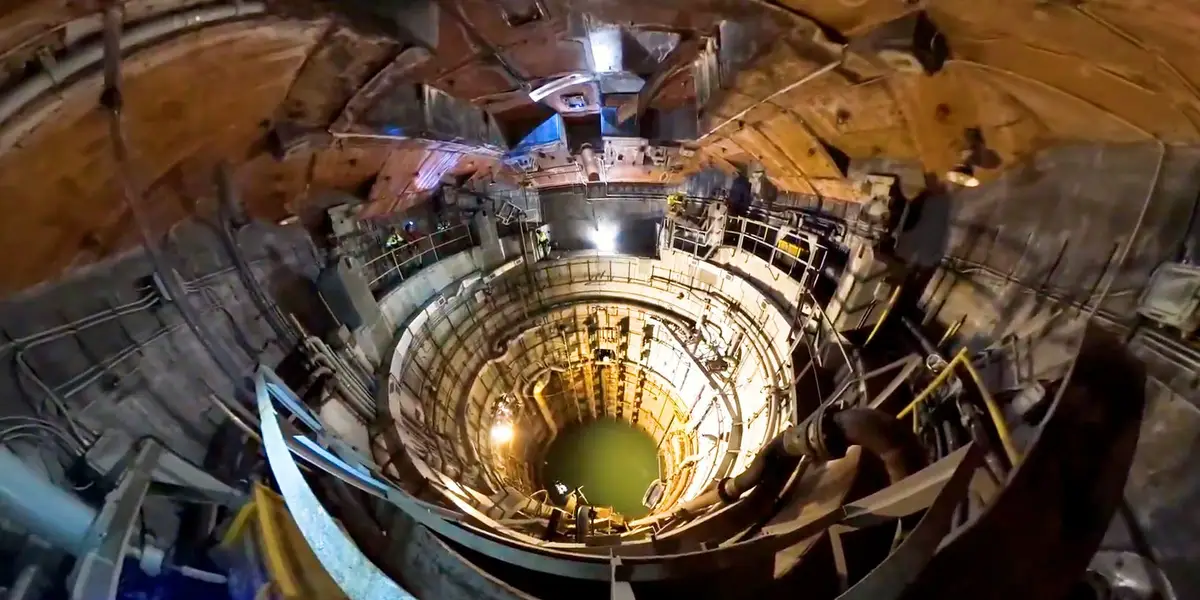
    The silo descends 165 feet below the surface, deep enough to house the missiles and the equipment necessary to launch them.

    Seventeen distinct chambers make up the facility, connected by a network of tunnels spanning 4,500 feet.


    A tunnel in Halik's complex.

    A network of tunnels connects the complex’s rooms.

    Tyler Merkel

    Different launcher rooms, control domes, a power dome, and other areas make the facility a sprawling complex.

    The most secure part of the complex can withstand a nuclear blast.


    A sign reading "Launcher Area No. 1." One part of the facility has strong concrete walls reinforced with steel.

    One part of the facility has strong concrete walls reinforced with steel.

    Tyler Merkel

    One portion of the facility was built by what Halik called “Hoover Dam-type engineering.” Featuring multiple layers of steel-reinforced concrete, each square inch of the wall could withstand roughly 15,000 pounds of pressure.

    In this room, operators would stand ready to launch the missiles at a moment’s notice.


    A desk from the control room of the facility.

    Operators for the missiles would stand ready for a call from the Pentagon.

    Nuclear Bunker Living/YouTube

    The control room was where the missile operators would have pressed the fateful buttons to launch missiles that were 300 times more powerful than the bomb dropped on Hiroshima.

    “The fate of the Western world was in the hands of these 21- to 22-year-olds who had the keys to the missiles, ready to employ them on the instructions of the Pentagon from the president,” Halik said.

    Halik wants to turn one part of the facility into a museum.


    An up-close shot of the launch deck.

    Halik and his team found papers pertaining to the missile’s launch in the bunker.

    Nuclear Bunker Living/YouTube

    Many relics still remain in the control room and other areas, including pieces of the desk where a launch would’ve been programmed.

    Recently, Halik and his team discovered papers containing launch codes, times, and other protocols.

    For other rooms, he has more creative plans.


    A large room that Halik said could be turned into a night club.

    Halik wants to turn one room into a nightclub.

    Nuclear Bunker Living/YouTube

    In another room, Halik envisions a nightclub, complete with a DJ, bar, consumption lounges, and Cirque du Soleil dancers.

    At a different decommissioned missile site in New Mexico, this vision may already be a reality. The Twistflower Nuclear Missile Silo in Roswell will host the ATOMIKA festival in November.

    The festival, promoted by Halik, describes itself as an “experimental, annual gathering that fuses immersive art, deep inquiry, and powerful music.”

    Chief among Halik’s plans is to turn part of the facility into a data center.


    The facility's power dome

    The facility’s power dome could once again be used to power a data center.

    Tyler Merkel

    Since AI requires large amounts of power, as well as a safe and reliable space for data, underground locations like Halik’s facility could prove to be prime locations.

    A critical factor is the bunker’s cool temperature of 52 degrees Fahrenheit, even during the summer, which is optimal for the interior of a data center to prevent servers from overheating.

    At some data centers, it can take more than 30% of a facility’s electricity to keep servers cool, the Pew Research Center reported.

    “AI needs power,” Halik said. “AI needs safe environments to basically have all their computational processing power.”

    The data center could be powered entirely in-house, without the grid.


    Halik said he would install small nuclear reactors for power.

    Halik said he would install small nuclear reactors for power.

    Tyler Merkel

    Halik said that to power the data center, he would swap the facility’s diesel infrastructure with small nuclear reactors in an attempt to avoid the hassles of refueling.

    Halik said he has already gotten the attention of tech and AI companies.


    View of one room with light bulbs and wires.

    Companies are increasingly looking to house data centers underground.

    Tyler Merkel

    Although Halik didn’t disclose the specific companies interested, it aligns with a growing trend of underground data centers becoming more commonplace.

    One company, called Iron Mountain, utilizes a former limestone mine in Pennsylvania for data processing and storage. The 220-foot-deep facility stretches 40 acres, about nine times the size of Halik’s bunker.

    Share. Facebook Twitter Pinterest LinkedIn Tumblr Email

    Keep Reading

    I Left Journalism at 53. Now I Make $85,000 As a Mail Carrier | Invesloan.com

    I Was Scared to Let My Kids Roam Unsupervised — I’m Glad I Did | Invesloan.com

    I Love When My College Daughter Visits; I Also Love When She’s Gone | Invesloan.com

    What 30 Years of Marriage Taught Me About Love, Life, and Parenting | Invesloan.com

    Inside My $240-a-Night Room at TheWit Chicago, a Hilton Hotel | Invesloan.com

    Laid Off Google Employee Shares Why He’s Not Applying to Jobs | Invesloan.com

    Ex-Tesla President Mimicked Domino’s Pizza Ordering to Boost Car Sales | Invesloan.com

    An AI Launched This Retail Store and Hired Employees on Its Own | Invesloan.com

    Anthropic May Soon Pass OpenAI on This Measure of AI Business Spending | Invesloan.com

    LATEST NEWS

    April’s stock-market rebound is about to face its first main check as earnings season swings into gear | Invesloan.com

    April 12, 2026

    GOP senators focused in $5M advert marketing campaign to cross SAVE America Act | Invesloan.com

    April 12, 2026

    I Left Journalism at 53. Now I Make $85,000 As a Mail Carrier | Invesloan.com

    April 12, 2026

    Box workplace buzz: Best quarter in 5 years fuels hopes for Hollywood comeback (AMC:NYSE) | Invesloan.com

    April 12, 2026
    POPULAR

    China’s first passenger jet completes maiden commercial flight

    May 28, 2023

    Numbers taking US accountancy exams drop to lowest level in 17 years

    May 29, 2023

    Toyota chair faces removal vote over governance issues

    May 29, 2023
    Advertisement
    Load WordPress Sites in as fast as 37ms!
    Facebook Twitter Pinterest WhatsApp Instagram
    © 2007-2023 Invesloan.com All Rights Reserved.
    • Privacy
    • Terms
    • Press Release
    • Advertise
    • Contact

    Type above and press Enter to search. Press Esc to cancel.

    invesloan.com
    Manage Cookie Consent
    To provide the best experiences, we use technologies like cookies to store and/or access device information. Consenting to these technologies will allow us to process data such as browsing behavior or unique IDs on this site. Not consenting or withdrawing consent, may adversely affect certain features and functions.
    Functional Always active
    The technical storage or access is strictly necessary for the legitimate purpose of enabling the use of a specific service explicitly requested by the subscriber or user, or for the sole purpose of carrying out the transmission of a communication over an electronic communications network.
    Preferences
    The technical storage or access is necessary for the legitimate purpose of storing preferences that are not requested by the subscriber or user.
    Statistics
    The technical storage or access that is used exclusively for statistical purposes. The technical storage or access that is used exclusively for anonymous statistical purposes. Without a subpoena, voluntary compliance on the part of your Internet Service Provider, or additional records from a third party, information stored or retrieved for this purpose alone cannot usually be used to identify you.
    Marketing
    The technical storage or access is required to create user profiles to send advertising, or to track the user on a website or across several websites for similar marketing purposes.
    • Manage options
    • Manage services
    • Manage {vendor_count} vendors
    • Read more about these purposes
    View preferences
    • {title}
    • {title}
    • {title}