
It’s a truth universally acknowledged that a single man with a crypto wallet must be in want of a West Village girlfriend. Jane Austen’s heroines had their balls and soirees; the downtown women of today have the Tax Day Party.
Attendees rode a rickety, manually operated elevator up to The Bench, a venue that purports to be a liminal space where people from disparate professional and cultural spheres can mix. The dress code was half stodgy button-downs, half slip skirts, and vintage watches.
Organized by the design agency Family Office — not to be confused with a generational wealth fund, as their tagline says — the annual Tax Day Party is held to bring together the city’s financial capitalists and its creative class. “We’re not celebrating pro or against the IRS,” said Diego Segura, the party’s chief organizer. “It’s kind of funny to say that we’re throwing a party on Tax Day.”
Kate Collins
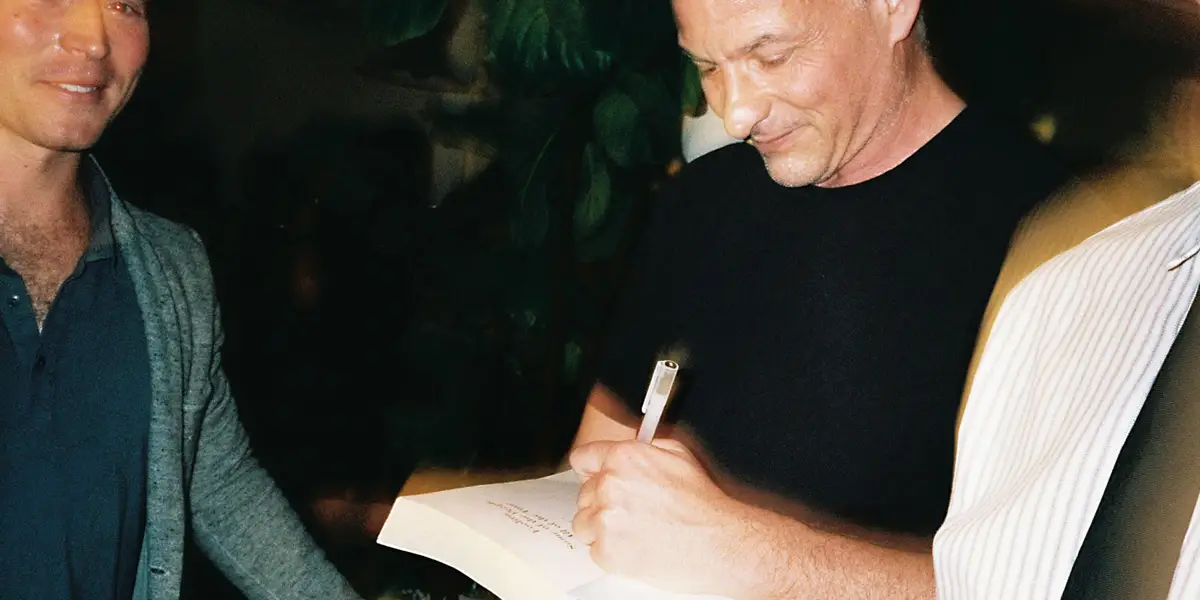
The annual event, which started in 2024, is headlined by four speakers who bridge midtown and downtown. This year, its undisputed centerpiece was legendary short-seller David Einhorn, who founded Greenlight Capital in 1996, before many in the audience were even born. The lineup also included venture capitalist Hansen Shi and journalists Brock Colyar and Cami Fateh.
Though some of the finance world may have shown up to get Einhorn’s take on the next big short, the Family Office organizers made it very clear that the party wasn’t a space to ask Einhorn about his bets. There were bigger fish to fry, such as: Is Wall Street still sexy?
Einhorn, 57, had one take. But as you’ll see, the denizens of the Lower East Side had opposing opinions. With my colleagues-in-arms, Henry Chandonnet and Sydney Bradley, I set out to find the answer.
‘How does a girl bag a man in finance?’
The question came from Fateh, the Feed Me columnist and party reporter. “Do you just ask for cocaine at the club? Is that it?”
Einhorn laughed: “That’s crazy!”
He couldn’t speak for this generation of junior bankers. He mentioned meeting a lot of people after his divorce, but he’s now happily settled with his girlfriend. “I didn’t appear around any of those dating apps. I think that could be a little dangerous,” he said, in an age where Google exists.
“I just say I’m David from Wisconsin. That usually works,” he said.
Kate Collins
I later asked Einhorn if he had a tried-and-true pickup line a la Bill Ackman’s “may I meet you.” Einhorn said that he was never really looking to “pick up” women in that way — he said he was more interested in meeting people and talking to people. I asked him if he thought that was a Midwest thing.
“No, it’s because I have no game,” he said.
Whether the artsy girls at the Tax Day Party used the function to actually bag a man in finance was unclear. The start time was part of the problem. With doors at 7 and the discussion at 7:30, the Zyn-fueled bros on the trading floor likely hadn’t left their desks. While waiting in line for a beer, Corissa Steiner, a private credit investor and one of the party organizers, described the party’s demographic as “soft finance.” Translation: venture capitalists.
I chatted with some bona fide finance people — a Goldman Sachs analyst, a Bank of America analyst, and a Point72 principal — hovering around Einhorn after the dialogue ended. Scattered in the crowd were fashionable women floating their design labels and startup founders hawking their apps. One discussed the Silicon Valley debate du jour: Can AI have taste? Another handed out cards with his AI-backed dating app to people waiting in line at the cash bar.
Does Wall Street have a nerd problem?
“I’ve never seen more Wall Street in the media,” Steiner said in her opening question, alluding to HBO’s “Industry,” and the “Finest Boys in Finance” magazine spread. “You’re living it. You’re living the dream, no?”
Einhorn sat there with wide eyes. “I can’t speak to the culture,” he said.
Later in the night, Steiner called Einhorn a “legendary partier” in his day. “A legendary partier?” Einhorn asked back. “OK.”
Kate Collins
Einhorn seemed to bristle at these moments of calling Wall Street cool. He loved “Billions,” but said that it was completely different from his own experience. “My life is so freaking boring,” he recalled telling a “Billions” producer.
Einhorn ended up appearing on the show in a cameo. “It didn’t remind me of me at all, which was great,” Einhorn said of playing himself on “Billions.” “I think I got paid a thousand dollars for that, and I have a — what do you call it? — IMD [sic] page.”
I was lucky enough to ask the last dialogue question: “Has Wall Street gotten too sober and too celibate?” Einhorn’s answer: “A simple no, at least from what I can see. But on the other hand, I have no idea what the 28-year-olds are doing.”
After the dialogue finished, several young people approached me and told me they thought the opposite. Kat Psaltos, a 25-year-old who works in fashion, tapped me on the shoulder and told me I was “absolutely right.”
“Nobody’s going on dates on like a Monday or a Tuesday anymore,” Psaltos said. “When I was like 20 or 19, I’d be going on dates with these 25-year-old finance guys on weekdays, and I feel like it’s way harder to get a match now,” she added — though she acknowledged that now, at 25, she might be too old to match with the 25-year-old finance guys who want to date 19-year-olds.
Sydney Bradley/BI
A 29-year-old hedge funder, who asked to remain anonymous for fear of professional repercussions, also thought that juniors were “kind of lame now.” The hedge funder described himself as “one of those people who partied through the pandemic,” but didn’t believe the pandemic was the cause of junior bankers’ sudden squareishness. “The people who are in these jobs now are just nerdier,” he said.
A part-time model, part-time assistant to the ultrawealthy, gave a different theory: The Wall Street guys were too busy sleepmaxxing, cold plunging, and popping peptides to stay up late and do drugs with the club rats. “It’s that whole ‘health is the new wealth’ thing,” the model said.
As the night wore on, it was clear that those who remained were almost entirely of the downtown, unemployed/self-employed culture set. Presumably, the Wall Street contingent had returned to their desks or their beds for red-light therapy before a full night of sleep.
Henry Chandonnet and Sydney Bradley contributed reporting.