
What's Hot

    Kyverna posts trial knowledge for myasthenia gravis drug (KYTX) | Invesloan.com

    April 20, 2026

    Pa. Democratic candidate’s previous pro-gun, anti-Kaepernick posts draw hearth | Invesloan.com

    April 20, 2026

    Kevin Warsh’s testimony to Congress is out early. He desires the Fed to ‘stay in its lane.’ | Invesloan.com

    April 20, 2026
    Facebook Twitter Instagram
    Finance Pro
    Facebook Twitter Instagram
    invesloan.cominvesloan.com
    Subscribe for Alerts
    • Home
    • News
    • Politics
    • Money
    • Personal Finance
    • Business
    • Economy
    • Investing
    • Markets
      • Stocks
      • Futures & Commodities
      • Crypto
      • Forex
    • Technology
    invesloan.cominvesloan.com
    Home » Inside the US Army’s Research Lab Testing Future Gear, Food, Warfare | Invesloan.com
    Money

    Inside the US Army’s Research Lab Testing Future Gear, Food, Warfare | Invesloan.com

    April 20, 2026Updated:April 20, 2026
    Share
    Facebook Twitter LinkedIn Pinterest Email

    From flash fires to freezing rooms, the US Army Natick Soldier Systems Center has spent more than 60 years pushing equipment and soldiers to their limits.

    The research facility opened in Massachusetts in 1954 following gear failures during World War II. In a 1943 Alaska operation, for example, soldiers’ leather boots couldn’t protect them from the constant damp, cold conditions, which resulted in more troops injured with trench foot than enemy fire.

    Today, Natick runs controlled experiments across clothing, food, and human performance. In one lab, uniforms are exposed to burns to measure how long a soldier would have to escape a flash fire. In another, low-oxygen environments replicate conditions above 14,000 feet to track how memory and alertness change.

    Scientists also study how sleep deprivation and sustained physical strain affect performance. Business Insider went inside the facility and spoke with scientists and soldiers about how these experiments influence the gear and systems of future warfare.

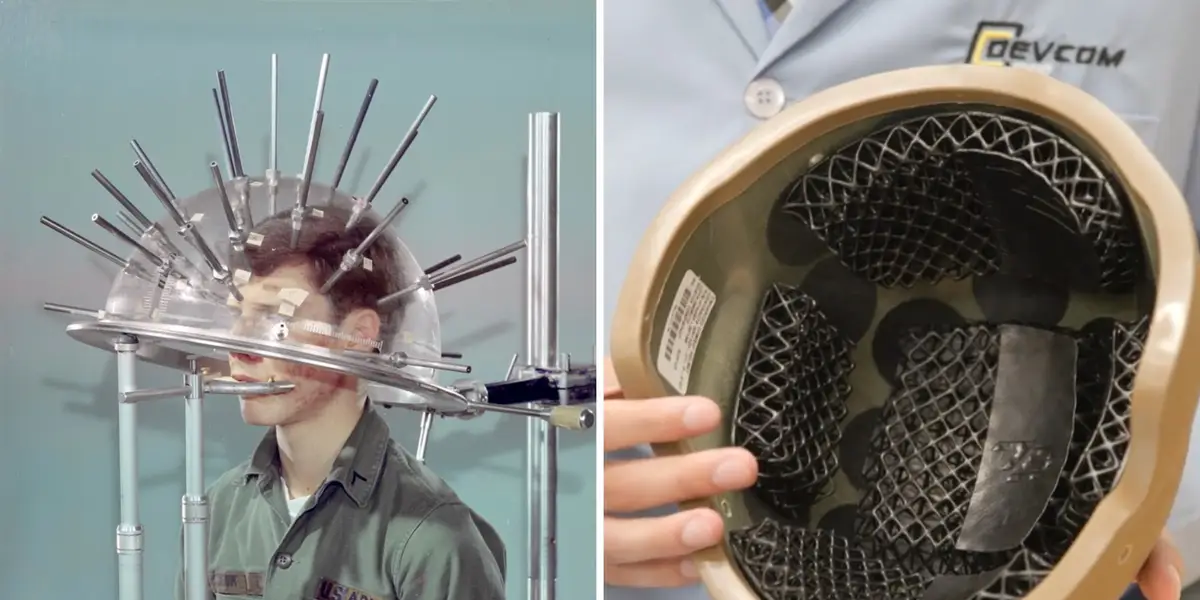
    The center has spent decades testing and refining military helmets.


    Side by side photos of helmet testing in the '70s (left) compared to modern day (right).

    Old helmet tests from the ’70s on the left compared to a modern helmet model on the right with custom padding.

    Digital Commonwealth / Business Insider

    The work dates back to the 1970s, when the lab began transitioning soldiers away from heavy steel helmets. Today, they’re made of lighter thermoplastics.

    That shift reduced weight, but it introduced new challenges. Modern gear, like night-vision devices, has pushed helmet weight to more than 6 pounds, increasing strain on soldiers’ necks.

    To address this, researchers are now studying how helmets fit at the individual level. They scan soldiers’ heads and develop custom padding systems designed to stabilize the helmet and prevent it from shifting and wobbling during use.

    Experts test Army uniforms to ensure they can protect soldiers during a “flash” — a sudden fire triggered when a military vehicle or aircraft ignites.


    Mannequin on fire

    Textile experts burn a mannequin dressed in an Army uniform for four seconds to refine its design.

    Business Insider

    The tests use mannequins equipped with 124 sensors to track heat exposure across the body.

    These sensors record the percentage of first-, second-, and third-degree burns the mannequin would receive.

    The goal is to evaluate how well materials protect against rapid bursts of heat while still remaining wearable.

    Researchers use the results to refine fabrics and designs that can balance fire protection with comfort and mobility.

    Soldiers also test uniforms by dragging this 180-pound dummy to simulate moving a wounded soldier to safety.


    A soldier dragging a dummy across the floor.

    A soldier drags the dummy, called “Randy,” across the floor as part of a 10-part obstacle course for gear testing.

    Business Insider

    The exercise places strain on the body, particularly the legs, allowing researchers to observe how gear affects movement and endurance.

    Sensors and tracking systems capture how soldiers perform as they drag the dummy across the floor.

    The data is then analyzed to see how different equipment designs impact speed, mobility, and effort.

    These tests help researchers evaluate whether gear supports or limits soldiers in physically demanding situations like rescue scenarios.

    The facility’s Doriot Climatic Chambers can simulate temperatures from -72 to 165 degrees Fahrenheit.


    A tracker on left showing temp, wind speed, humidity with the chamber on right.

    On left: Temperature, wind speed, and humidity monitors. On right: a climatic chamber, foggy with humidity.

    Business Insider

    The Doriot Climatic Chambers are designed to recreate some of the harshest environmental conditions soldiers may face.

    They can simulate extreme temperatures, high winds, and heavy rain, allowing scientists to evaluate how equipment holds up under combined stressors.

    One of the primary focuses is to test gear and soldiers’ performance in the Arctic, a region of growing importance to the US military.

    Oxygen-deprived rooms, called hypobaric chambers, simulate high-altitude environments where soldiers may operate.


    Three people inside a steel chamber.

    Soldiers often run treadmill exercises in these rooms while wearing masks that monitor vital signs.

    Business Insider

    By reducing oxygen levels, the facility can replicate conditions up to about 14,000 feet. Some tests last up to 24 hours to track performance over extended exposure.

    Researchers study how these conditions affect cognitive functions like memory, alertness, and decision-making.

    The facility previously conducted a long-duration experiment known as the “Everest study,” in which soldiers remained in simulated high-altitude conditions for about 40 days to simulate an ascent. Such extended studies are no longer performed.

    A virtual reality simulator tracks soldiers’ decision-making across live-fire scenarios.


    A soldier aiming a gun at a virtual screen with digital people walking toward him.

    Soldiers train on digital screens at Natick.

    Business Insider

    The system places participants in simulated environments with moving threats and targets.

    If a soldier misses a target or engages a non-target, the system can deliver a physical shock, adding immediate feedback to the simulation.

    During simulated missions, sensors track soldiers’ actions in real time, allowing researchers to measure how they respond under pressure.


    Solder in background and researcher in foreground with multiple computer screen in front of him.

    Natick’s new 4D body scanner uses real-time data to improve how military uniforms and gear are designed and fit soldiers.

    Business Insider

    The Army is expanding this type of training, citing lower costs compared with using live ammunition.

    The simulator also allows soldiers to train in a range of scenarios without needing a physical range.

    Natick has spent decades testing and refining military rations, including a long-running effort to develop a shelf-stable pizza.


    Old style pizza bar on left compared to a modern pizza bar on right.

    A bread alternative pizza bar from the early MRE days (left) compared to a modern pizza bar.

    Digital Commonwealth / Business Insider

    Early MREs (Meal, Ready-to-Eat) in the 1980s focused on durability and portability, but taste was a major issue, with limited menus leading to what researchers called “menu fatigue.”

    Over time, the lab expanded its food research beyond 12 menu items, working to improve both variety and quality. Pizza became one of the most complex items to engineer, requiring years of testing to maintain texture and stability.

    Researchers spent roughly two decades developing a version that could keep the crust from becoming soggy while remaining shelf-stable.

    Released in 2018, the US Army’s modern pizza MRE is designed to last up to three years at 100 degrees Fahrenheit.

    Not all experiments are successful. The facility’s exoskeleton prototype was eventually found impractical and abandoned.


    An army soldier walking up hill wearing exoskeleton.

    An army soldier wearing an exoskeleton prototype.

    Lockheed Martin

    Natick’s full-body exoskeleton was designed to enhance soldier strength and endurance.

    In testing, however, if a soldier fell while wearing the suit, it was difficult or impossible to get back up.

    While the applications of a full-body exoskeleton are promising, Natick researchers told Business Insider the technology is not yet advanced enough.

    Share. Facebook Twitter Pinterest LinkedIn Tumblr Email

    Keep Reading

    Best Small US Cities for Starting a Business | Invesloan.com

    Best Cheap Things I Buy at Aldi, From Someone Who Only Shops There | Invesloan.com

    Best Places I Visited in South America on Backpacking Trip | Invesloan.com

    AI Doesn’t Have Off Days, and It’s Raising the Bar for Everyone Else | Invesloan.com

    United Airlines Pilots Call in a Bomb Threat Over Mysterious Beeping | Invesloan.com

    Deloitte and Zoom Are Shrinking Popular Benefits. Will Others Follow? | Invesloan.com

    Nike’s Comeback Attempt: Better Shoes, More Retail Sales, Sports Focus | Invesloan.com

    China’s Robot Half Marathon Sets Record, Sparks Laughs | Invesloan.com

    Tesla Robotaxi Passenger Said Car Tried to Pull Over on Highway | Invesloan.com

    LATEST NEWS

    Kyverna posts trial knowledge for myasthenia gravis drug (KYTX) | Invesloan.com

    April 20, 2026

    Pa. Democratic candidate’s previous pro-gun, anti-Kaepernick posts draw hearth | Invesloan.com

    April 20, 2026

    Kevin Warsh’s testimony to Congress is out early. He desires the Fed to ‘stay in its lane.’ | Invesloan.com

    April 20, 2026

    ICE asks Harris County to carry man accused of sledgehammer homicide | Invesloan.com

    April 20, 2026
    POPULAR

    China’s first passenger jet completes maiden commercial flight

    May 28, 2023

    Numbers taking US accountancy exams drop to lowest level in 17 years

    May 29, 2023

    Toyota chair faces removal vote over governance issues

    May 29, 2023
    Advertisement
    Load WordPress Sites in as fast as 37ms!
    Facebook Twitter Pinterest WhatsApp Instagram
    © 2007-2023 Invesloan.com All Rights Reserved.
    • Privacy
    • Terms
    • Press Release
    • Advertise
    • Contact

    Type above and press Enter to search. Press Esc to cancel.

    invesloan.com
    Manage Cookie Consent
    To provide the best experiences, we use technologies like cookies to store and/or access device information. Consenting to these technologies will allow us to process data such as browsing behavior or unique IDs on this site. Not consenting or withdrawing consent, may adversely affect certain features and functions.
    Functional Always active
    The technical storage or access is strictly necessary for the legitimate purpose of enabling the use of a specific service explicitly requested by the subscriber or user, or for the sole purpose of carrying out the transmission of a communication over an electronic communications network.
    Preferences
    The technical storage or access is necessary for the legitimate purpose of storing preferences that are not requested by the subscriber or user.
    Statistics
    The technical storage or access that is used exclusively for statistical purposes. The technical storage or access that is used exclusively for anonymous statistical purposes. Without a subpoena, voluntary compliance on the part of your Internet Service Provider, or additional records from a third party, information stored or retrieved for this purpose alone cannot usually be used to identify you.
    Marketing
    The technical storage or access is required to create user profiles to send advertising, or to track the user on a website or across several websites for similar marketing purposes.
    • Manage options
    • Manage services
    • Manage {vendor_count} vendors
    • Read more about these purposes
    View preferences
    • {title}
    • {title}
    • {title}