
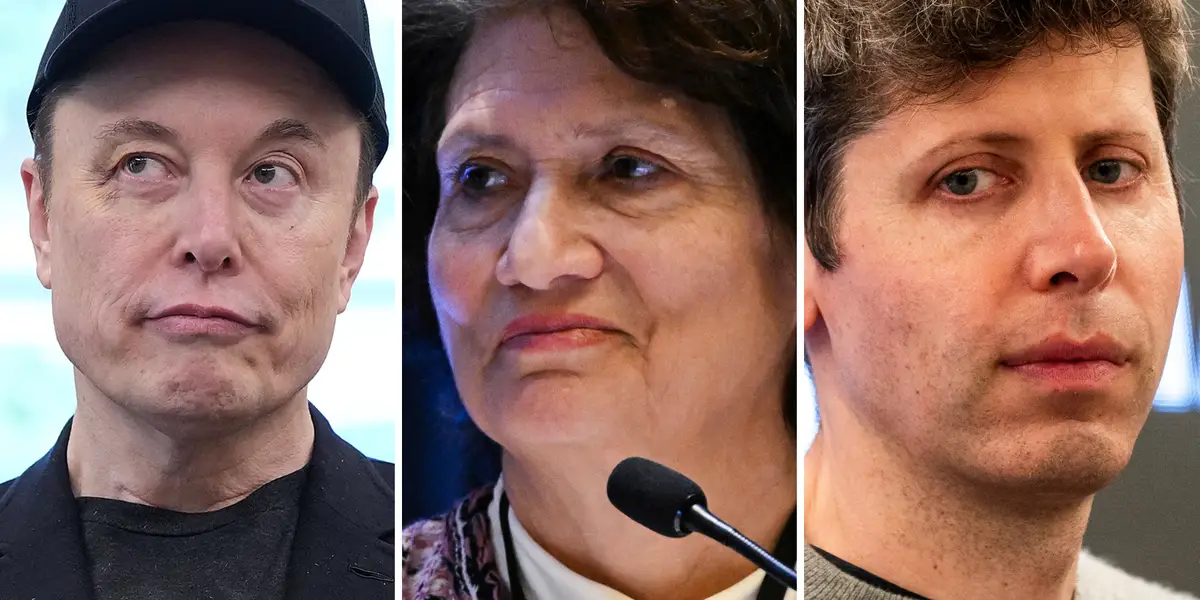
When Elon Musk and Sam Altman face off in court next week, they’ll be answering to a judge who isn’t afraid to call out billionaires.
Yvonne Gonzalez Rogers has built a reputation as a non-nonsense judge who runs a courtroom where everyone follows the rules regardless of how much money or power they may have.
After ordering Musk’s case to trial, the judge, who mowed lawns to pay for Princeton, told the lawyers in the case that their high-profile clients should not expect special treatment.
At a March hearing reported by Bloomberg, the judge said the trial witnesses — a list that includes Musk, Microsoft’s Satya Nadella, and Mira Murati of Thinking Machines Lab — will enter the courthouse through the public entrance. She also instructed the parties to pick up the tab for the jury’s lunch during deliberations.
“You have plenty of money to pay for it,” she said of the expense, which is usually covered by taxpayers.
Lawyers who’ve practiced before her say this is par for the course for Gonzalez Rogers, who is known for running a tight ship and is watchful of her jurors’ time.
“She’s a tough judge, and she knows that the public’s time is precious,” said criminal defense lawyer Shaffy Moeel.
As a federal judge in Oakland, appointed by then-President Barack Obama in 2011, she is known for her command of the courtroom, wrangling unruly lawyers or schooling them on the law and her preferred trial process.
She is a master at the pregnant pause: “Do I make myself clear?” she asked Musk and Altman’s lawyers last week, pausing for the chorus of yeses. She will clip her words to emphasize a point: “Experts. Are not. Conduits. For factual. Information,” she told the lawyers at the same hearing.
“She’ll control the courtroom,” added another lawyer who’s appeared before YGR, as she’s sometimes called by the lawyers. “It’s a hot bench,” he said, adding: “She comes at you. She doesn’t let you give these long-winded opening statements. She’ll have questions right from the beginning.”
The lawyer, who continues to appear before her in court, said he finds her style, at times, similar to that of Judge Judy, the popular television judge known for her probing questions and disdain for gamesmanship and grandstanding.
“She doesn’t care how much money the parties have, she doesn’t care who they are,” he said.
A history with Big Tech
Gonzalez Rogers was raised in San Antonio, Texas, by Mexican-American parents.
When it came time for college, a former teacher suggested Princeton, but no one in Gonzalez Rogers’ family was familiar with the school. Her dad “felt there was no reason to go anywhere but the University of Texas,” she told the Contra Costa Times in 2011.
Gonzalez Rogers went to Princeton, cleaning and cutting grass during breaks to help pay her tuition, former US Sen. Diane Feinstein told Congress in 2011.
After graduating from law school at UC Berkeley, she worked as a litigator at Cooley and in 1998 became its first Latina partner. In 2008, California Gov. Arnold Schwarzenegger appointed her an Alameda County Superior Court judge.
Musk’s trial against Altman, over OpenAI’s transition to a for-profit entity, starts on April 27 with jury selection.
See more on the Musk v. Altman trial
Gonzalez Rogers will solely preside over what may prove to be the fiercest battle of the case — how OpenAI should be held accountable should the jury find OpenAI cofounders, including Altman, liable for deceiving Musk about its for-profit plans before he left the company he cofounded in 2018.
Musk has asked the judge to consider removing Altman as an officer of the for-profit entity, among other requests that could change the face of the ChatGPT maker and Wall Street’s hopes for an IPO.
Musk v. Altman is not Gonzalez Rogers’ first rodeo with tech billionaires.
In 2018, she paved the way for a class-action lawsuit brought by Uber drivers who claimed they had been shortchanged by the ride-hailing company. She is currently overseeing a case brought by 33 state attorneys general against social media giant Meta for a platform that they say has been designed to addict children and teens.
In 2021, she oversaw the high-profile trial between Epic Games, the maker of Fortnite, and Apple. Epic had accused Apple of maintaining an illegal monopoly through its App Store, which took 30% commissions on purchases and blocked developers from offering customers alternative payment options. At one point, Gonzalez Rogers tossed a majority of Epic’s claims against Apple, including federal antitrust monopoly claims, finding instead that it was in violation of California’s Unfair Competition Law.
Last year, she referred the iPhone maker to a US attorney for criminal review over what she said was a “willful violation” of her orders to stop charging developers fees for sales made outside the App Store.
In her contempt of court order against Apple, she accused the company’s vice president of finance, Alex Roman, of lying under oath in the case. She also called out CEO Tim Cook, saying he ignored advice from Apple’s Phillip Schiller that the company comply with the court’s orders.
“Cook chose poorly,” she wrote of referring the case to the US Attorney for the Northern District of California.
Apple didn’t return a request for comment.
The Musk v. Altman fight could also get messy. Gonzalez Rogers has already called out lawyers on both sides for overlitigating the case on behalf of their billionaire clients.
“The court will not waste precious judicial resources on the parties’ gamesmanship,” she wrote in a 2025 ruling.
Lawyers who know Gonzalez Rogers told Business Insider to expect more such missives as the case intensifies.
“It’s not going to be easy to manage, but I don’t think that’ll be too much of a problem for her,” said Christopher Arriola, a former local prosecutor who has known the judge for 25 years. “She won’t put up with a lot of bluster or nonsense.”