
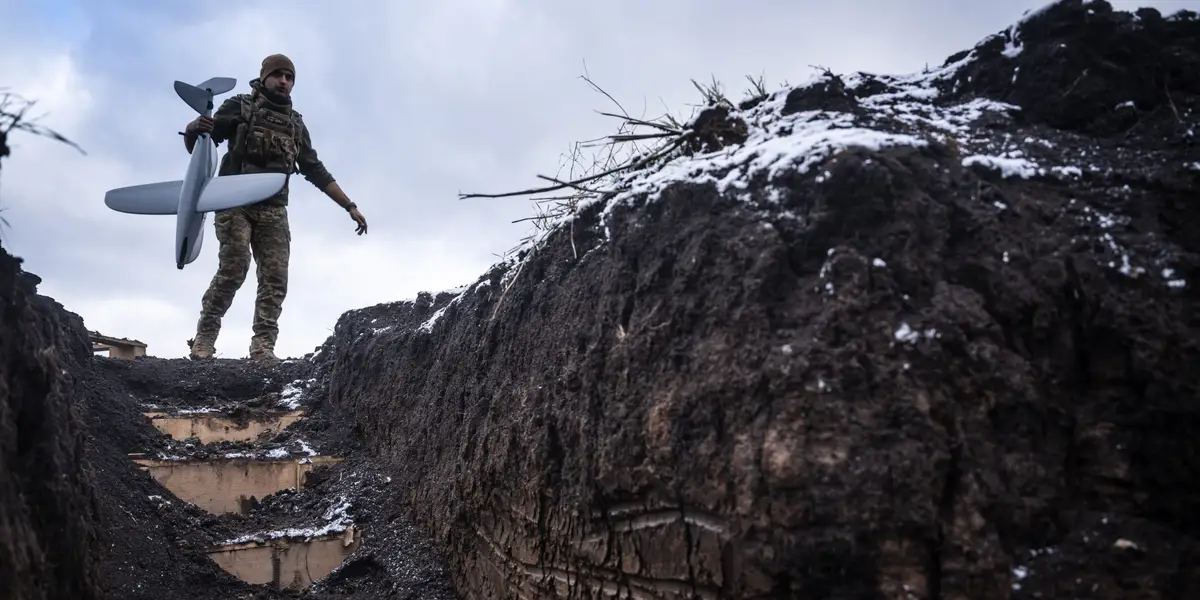
Ukraine’s fight against Russia’s invasion is showing weapons makers and militaries that the goal isn’t perfect weaponry — it’s having systems that are ready and working at scale.
The war has generated a host of lessons for Western allies, including the US, one being that a focus on perfection can leave stockpiles too limited and too slow to reach the battlefield.
Among the growing number of defense companies recognizing this shift is Robin Radar, a Dutch company that makes drone-detection radar systems used by Ukraine and US allies in the Middle East. Kristian Brost, general manager for Robin Radar USA, told Business Insider that an imperfect answer “right now, sometimes, is better than a perfect solution later.”
He said there is “a lot we can learn” from Ukraine, which is “in a spot where sometimes they need duct tape and rubber bands.” And, he continued, “I think that’s in itself a lesson: Use what works, use what is cheap.”
He said that while the exquisite weaponry the US loves to build shouldn’t disappear, “we’ve got to get real and just get stuff that works and get it into hands, get people trained, because something even at 80% is better than nothing.”
The counter-drone space, where Robin Radar is, is one of the main areas where allies are trying to copy Ukraine’s approach, focusing on cheaper, scalable systems.
The US and its allies, for instance, are increasingly interested in Ukrainian-style interceptor drones to counter drones instead of relying on expensive air-defense missiles.
Serhii Mykhalchuk/Global Images Ukraine via Getty Images
It’s a key area where companies should not wait for perfection, Brost said. “Especially when it comes to arguably one of the biggest gaps in US defense right now. We got to get gear out there, even if it’s not perfect, because we too can learn.”
The company is still making advanced weaponry and wants high performance, but it also wants systems that are more affordable, scalable, and adaptable than traditional Western gear.
Brost said some Western weapons are “phenomenal, but will they stand the test of time? Are they adaptable?”
His comments have been echoed by Western officials and defense companies working in Ukraine.
NATO Secretary General Mark Rutte said last year that the alliance has been too slow to innovate and “one of the problems here we have is that the better is the enemy of good: It has to be perfect.”
“But it doesn’t have to be perfect.”
He said the alliance must learn from Ukraine’s approach. Ukraine will move forward with equipment that can be ranked as a “six to seven,” out of 10, but NATO militaries insist that they reach “nine or 10.” Peace affords that luxury, but alliance leadership has cautioned that peace is increasingly under threat.
“Speed is of the essence, not perfection,” Rutte said, adding that the alliance needs to focus on speed and sufficient quality together.
The CEO of Origin Robotics, a Latvian drone maker that has products in Ukraine, previously told Business Insider that Ukrainian soldiers don’t care how advanced the technology is — they want systems that work and that they can get in quantity.
“They need something that simply works,” Agris Kipurs said.
“They really don’t care about the type of technology that is enabling that capability. They couldn’t care less if it’s an AI model, if it’s a computer vision algorithm, or if it’s just a skillful pilot flying it and doing it purely manually.”
ED JONES/AFP via Getty Images
He said that some of the incentives for Western companies are wrong, and they often prioritize gear that is more advanced or more flashy over what is immediately practical.
It’s not that his company is making the most basic gear, either, and it uses tech like AI. But it focuses on simpler, more affordable systems than traditional weapons like missiles.
Kuldar Väärsi, the CEO of Estonian robotics company Milrem Robotics, which has products used by Ukraine, told BI that the war has shown the company that “simplicity” is key to making weapons faster and more affordably.
“The more complex technology is, the more problems it can create,” he said. In war, reliable weaponry is what’s needed.
Ukraine’s defense industry has presented similar warnings. Serhiy Goncharov, the CEO of the National Association of Ukrainian Defense Industries, which represents about 100 Ukrainian companies, previously told Business Insider that in a long war, the West’s focus on having smaller numbers of advanced equipment isn’t the right approach. It needs mass quantities of “good enough” weapons.
Ukraine’s rapidly growing defense industry works differently from much of the West. It is made up of a host of companies, many of which are small operations making products that are rapidly upgraded, sometimes in hours or days, close to the battlefield with direct soldier input.
It means companies can start with a simpler design that they constantly update with soldier feedback. NATO says it needs to learn from the way Ukraine does that.
Europe is worried that Russia will attack elsewhere on the continent and spark a wider war, and officials across Europe argue NATO must rethink how it procures and develops weapons.
Key among the realizations is that Western militaries need masses of cheap weaponry and that they need to move away from a focus on smaller numbers of highly advanced systems.
NATO officials have raised this issue, including Danish Defense Minister Troels Lund Poulsen, who previously told Business Insider that “one of the lessons” from Ukraine is that the West needs large quantities of cheap weaponry.
It’s not that the West would not still need the cutting-edge weapons it is so good at making. But in a long, large-scale war, those systems can run out and take time to replace.
Oleg Fedoryshyn, director of R&D at Ukrainian robotic systems maker DevDroid, told Business Insider that in an intense, long war, the West could drain its stocks of advanced and expensive armored vehicles, forcing a shift to systems like ground robots — less capable in some ways but far cheaper and faster to build.

