Daniel Deceuster used to go to his colleagues for all manner of things big and small. If he needed to convert a rectangular logo into a square, he’d message one of the designers. If he wanted a new dashboard built, he’d set up a meeting with the engineers.
These days, all Deceuster needs is to open up Claude or ChatGPT — and often within seconds, he gets what he needs. “We’re getting more done than we’ve ever done before,” he tells me. But lately, he’s been mourning what that productivity has cost him.
Now that he no longer depends on his colleagues for these kinds of tasks, he estimates he’s interacting with them about 50% less than before.
“It’s sad to see that loss,” says Deceuster, a marketing director at the nonprofit Zion HealthShare. “I’m an extrovert. I want to be engaging with people. I want that interaction.”
Deceuster is early to recognize a profound shift underway as AI tools permeate corporate America. “People are increasingly choosing to work alone,” says Jessica Reif, an incoming professor of management at Wharton who’s been studying AI’s effects on teamwork.
Signs of strain are already emerging. In January, Cisco found that its employees who were the most active AI users trusted their teams less than intermittent users, likely because the power users were spending more time on their own and less time with their colleagues. “AI can unintentionally create isolation,” the company concluded, “when it’s adopted individually rather than collectively.” The coaching platform BetterUp found that some workers are turning to AI for the kind of feedback they used to seek from mentors and managers. Those employees tended to report lower levels of team coordination, along with higher rates of burnout and a greater desire to leave their jobs.
“We’re social animals,” says Kate Niederhoffer, chief scientist at BetterUp. Being social is “more than fuel. It’s how we survive.”
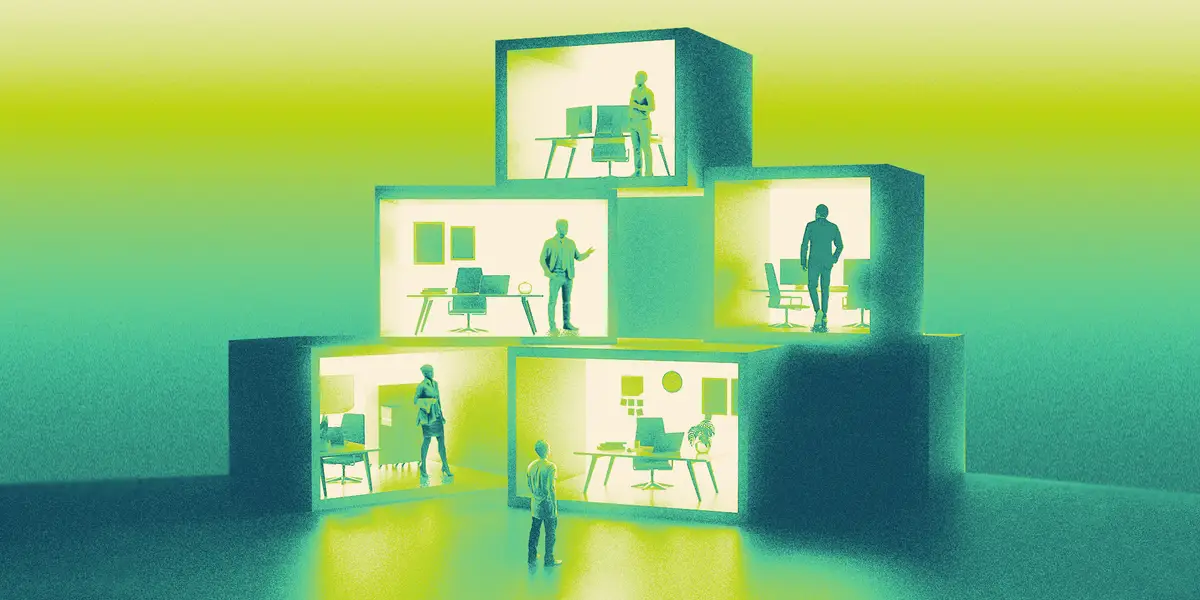
AI is unraveling the social fabric of work. For all the drudgery and indignities of our jobs, so much of what made them tolerable — even meaningful — was the way they brought us together with other people every day. We found mentors and confidants, work wives and sometimes real wives. We vented about bad bosses and gossiped after meetings and put our minds together to accomplish things we couldn’t have done on our own. Now those interactions are fading away.
“If we aren’t thoughtful about this, we risk turning work into something that feels more isolated and atomized,” Reif tells me. “We’ll just be combining our inputs in a way that feels more like an assembly line than a vibrant workplace.”
In the early years of American history, work was largely a self-reliant endeavor. The vast majority of people were farmers and artisans who worked for themselves. The Industrial Revolution changed that. Businesses suddenly needed large numbers of people to operate the new machines in their factories. And coordinating all that labor required another class of workers entirely with increasingly specialized skills: managers, accountants, engineers, clerks, and salespeople. Americans went from having no colleagues to a lot of colleagues — colleagues they spent most of their waking hours around. Work, in turn, became deeply social.
This was especially the case with white-collar jobs, which required people to combine their various areas of expertise. To do that they had to be in constant contact, giving feedback, negotiating priorities, diagnosing problems, brainstorming solutions. As the world’s complexity grew, so did the need for collaboration inside ever-sprawling corporations. Technologies like email, cellphones, Slack, and Zoom facilitated that collaboration.
For all the indignities of our jobs, so much of what made them tolerable — even meaningful — was the way they brought us together.
Then came AI. As evermore powerful models enhanced the productivity of white-collar workers, I predicted companies both large and small would soon need fewer employees — meaning we were heading back to a world where we have fewer colleagues (AI-driven layoffs in the last few months at companies like Meta, Block, and Cloudflare suggest this is happening sooner than I expected). But it’s only recently that I started to wonder if the AI revolution will go even deeper — that it won’t just shrink companies’ workforces, but also weaken the relationships between the employees still working inside them.
If the previous office tools made it easier for colleagues to connect, AI seems to be replacing those connections altogether. “ChatGPT and tools like it are giving us this alternative way to accumulate knowledge that would otherwise be shared interpersonally,” Reif tells me. “It gives people this option of opting out.”
I can see why people are opting out, because I’ve noticed myself opting out, too. Over the last two years, I’ve been tinkering with different ways to incorporate large language models into my work. I still write my own drafts. But once I’m polishing what I’ve already written, I’ve found AI useful as a sounding board before I hand my stories over to my editor, Zak. I’ll ask it the kinds of questions I used to ask him: Am I overexplaining this section? Is the conclusion lame? Should this sentence go here or should it go there? It’s been nice. ChatGPT is always available, so I don’t have to wait for Zak to reply. If I disagree with it, I can argue with it without things ever getting heated. I never worry about annoying it with my endlessly obsessive questions.
“Those interactions before required trust and demonstrating vulnerability to one another,” Reif tells me. “ChatGPT is lower friction.”
For a while, I was pleased with my lower-friction ways. But as I reported out this story, I started to wonder what I might be losing in my quest to bother Zak less. I was certainly talking to him less. Was I missing out on opportunities to learn from him? Was I losing my ability to navigate disagreements? Did I feel less close to him? I wondered what being less needy was doing to the most important professional relationship I have — and what that meant for how I ultimately felt about my job.
Some people might not see AI’s anti-social tendencies as that big of a deal. Over the years, white-collar work has gotten so collaborative that it may have gotten too collaborative. Nonstop meetings and constant Slack messages have made it hard for many of us to get any real work done. Those interactions were rarely deep or meaningful anyway.
Getty Images; Tyler Le/BI
In some cases, fewer interactions might even make workplaces more pleasant. Peter Pang, cofounder and chief technology officer at Creao AI, an AI agent platform, says there’s less conflict among his employees, now that he’s overhauled his company’s workflow in a way that gets agents to do most of the work. He’s gone from spending 60% of his time managing his employees to about 10%.
“My relationships with my cofounders and also engineers are actually getting better because we don’t need to be arguing with each other all the time,” he tells me. “Arguing with each other is not a very constructive way of building relationships.”
Those points, though, overlook something important. The small interactions that our jobs previously forced us to have were what made teams work well together — often without anyone realizing it. They built the goodwill colleagues need to navigate the disagreements that inevitably come up. Just as importantly, they helped employees keep track of what others were working on, preventing them from duplicating each other’s work.
“AI gives us this incredible velocity,” Reif tells me. “But there’s still a lot of interaction and strategic alignment that’s necessary to make sure that velocity is directed at the right target.”
Maybe that’s less true for the solopreneurs who’ve found ways to remain one-person operations with AI. But for almost every other business, people will still need to coordinate effectively and trust each other — even if their day-to-day work becomes more solitary.
So what’s the solution here? One option, says Betterup’s Niederhoffer, is to use these tools in ways that enhance our relationships with our colleagues instead of replacing them. Some people are already doing this, asking Claude to help them draft sensitive emails to a peer, or role-play a difficult conversation they’re about to have with a prickly boss. BetterUp found that people who use AI this way actually have more interactions than they did a year earlier — both with their direct reports and with colleagues in other parts of the company. “You’re learning a new way to relate to people,” Niederhoffer says.
We’re going to have to work a little harder to find those connections and to find the meaning in the relationships we have.
Another solution is to build back some of the social time that AI is taking away. Even if we have fewer opportunities to connect through our day-to-day tasks, we can still create other ways to build those bonds. Carol-Lyn Jardine, who advises marketing executives on AI through her consultancy Clarity & Motion Collective, says she can get most of her work done without relying on her two business partners thanks in part to the collection of AI systems that are assisting her. But she makes a point of staying in touch anyway.
“If I don’t stop and talk to them about what they’re seeing with their clients, we’re not really gaining all of those insights and learnings to apply across all of our clients,” she tells me. “We’re going to have to work a little harder to find those connections and to find the meaning in the relationships we have.”
The challenge for all of us will be to juggle these new tradeoffs: the immediate productivity benefits of a less interdependent workplace, alongside our need for teams that work well together and jobs that still give us a sense of connection. Deceuster, the extroverted marketing director, says it’s been a difficult balancing act. He’s been making it a habit to go out of his way to, for example, walk over to his colleagues’ desks to talk instead of slacking them. That’s helped restore some of his social time, but he knows those efforts can only go so far in the constraints of a workplace. “It’s hard because everyone’s trying to get work done,” he tells me. “What you don’t want to do is lose your job because you’re looked at as a distraction.”
That’s why it’s ultimately up to our companies — and the people who are redesigning the way work gets done inside them — to figure out systematic ways to preserve the social aspects of our jobs. And we actually know how. After the pandemic, when companies realized just how important employees’ everyday interactions were, many of them forced people back into the office. Others tried something different: They kept remote work and came up with ways to recreate those interactions with a distributed workforce. They rolled out mentorship programs, flew employees in for offsites, and mandated more frequent one-on-ones between managers and employees. They intentionally designed the kind of interactions that used to happen accidentally.
This is often how big changes go: We embrace something new, discover its unintended effects, and redesign our habits and institutions to correct for that. Deceuster says the current AI boom reminds him of the early days of social media. It took us years to understand just how isolating these platforms proved to be, especially for kids. Only now are schools, parents, and governments finally putting up protections. How long will it take for our workplaces to figure out how to benefit from AI’s productivity boosts without driving us away from each other? “We don’t even know what we’ve unleashed yet,” says Deceuster, “or how to effectively use it.”
That matters especially now, at a time when our lives have already grown so solitary. We stopped going to church. We stopped going to union halls. We stopped going to rotary clubs and sports leagues and malls and movie theaters. But we still go to work. Even as all those other communal institutions withered away, work kept bringing us together with other people. If we lose even that to AI, we’ll become more efficient than we’ve ever been — and more alone, too.
Aki Ito is a chief correspondent at Business Insider.
Business Insider’s Discourse stories provide perspectives on the day’s most pressing issues, informed by analysis, reporting, and expertise.