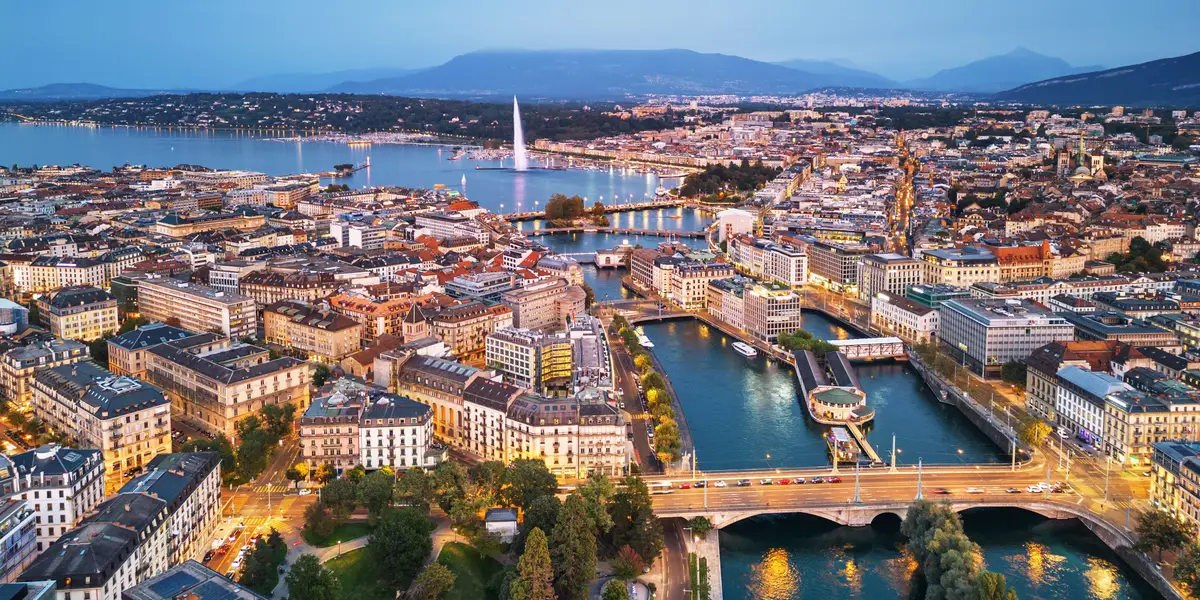
While many people know Switzerland best for its chocolate, watches, or neutrality, a new global ranking highlights its strengths in a range of areas.
Switzerland recently topped US News & World Report’s annual ranking of the best countries in the world, released in May. The ranking evaluated 100 countries on factors such as economics, environment, health, and infrastructure.
European countries were the most prominent among the top half of the list, occupying all but one spot in the top 15. Switzerland finished first overall — ahead of Denmark in second, and Sweden in third — thanks to its high scores in nearly every major category considered by the study.
Switzerland’s cultural contributions come in different forms, from art to academics
nuchun/Shutterstock
Switzerland ranked No. 2 in culture and tourism in the report, which cited 19 Nobel Laureates who were born in Switzerland. This doesn’t include Albert Einstein, who emigrated from Germany and lived in Switzerland for roughly 20 years.
Switzerland is home to 13 UNESCO World Heritage Sites. Other notable historic sites include Chillon Castle on Lake Geneva, a medieval castle dating back roughly 800 years, classified as a Swiss Cultural Property of National Significance.
The country draws large numbers of tourists for its mountains and historic cities. In 2024, the Swiss hotel industry had a record number of overnight stays, largely because of American tourists, Reuters reported.
The country also exports $59 billion in creative goods and services per year, according to US News & World Report.
It has one of the highest GDPs per capita in the world
aletheia25/Shutterstock
Switzerland ranked No. 1 in economic development. The report cites “low corporate tax rates, a highly developed service sector led by financial services and a high-tech manufacturing industry” as factors contributing to the country’s strong economy.
The country also has a high number of patent applications, indicating strong research and innovation. Switzerland exports $90 billion in high-tech products each year, according to the report.
“Exports surge, inflation stays low, and innovation keeps us ahead,” Sven Siepen, a senior partner at Roland Berger’s Zurich office, said in a 2025 report about the country’s economy. “Even as global challenges mount, Swiss stability remains our greatest asset.”
Switzerland also has a strong and stable government
Ad Gr/Shutterstock
This earned the country the No. 1 spot in the governance category. US News & World Report gave the country perfect scores in political violence, regime turnover, and inflation volatility.
Switzerland has a federalized government in which two chambers elect a seven-member body known as the Federal Council, according to Presence Switzerland.
Swiss residents generally find their government to be trustworthy. In 2023, “62% of people had high or moderately high trust in the national government,” according to the OECD. Across all OECD countries, the average is 39%.
Despite these promising figures, the country has issues with voter turnout — which averages 46.09%, per the International Foundation for Electoral Systems — earning a low score from US News & World Report.
High life expectancy and ample medical care can be found in the country
Robert Hradil/Getty Images
The report ranked Switzerland No. 4 in health. The country has a life expectancy at birth of 84.1 years, earning it a perfect score in the metric in the report. Based on data from the World Bank Group, Switzerland has the fourth-highest life expectancy in the world.
The country has universal health coverage through a mandatory private system. Though everyone is covered, the country spends the second-most per capita on healthcare in the world, trailing only the US, according to the Bern University of Applied Sciences.
In 2022, the country had 4.5 physicians per 1,000 residents, compared to 3.7 in the US and the global average of 1.9, according to the World Bank Group.
It did, however, receive a low score for the number of hospital beds per 1,000 residents, at 4.4 in 2023. This is below the European Union average, which was 5.1 beds per 1,000 people in 2022, according to World Bank data.
Swiss residents have access to educational opportunities
YueStock/Shutterstock
Switzerland, which is home to top universities such as the University of Zurich, ranked No. 2 in opportunity. The average number of years spent in formal education for adults aged 25 and older is 13.9 years, according to the report. This is roughly on par with the US, per the State of the Nation Project.
The average annual tuition for Swiss students at public universities was equivalent to $1,427 in 2022-23, according to the OECD.
Though Switzerland has strong educational opportunities, the report found that it lagged behind in economic opportunity, indicated by low scores in income taxation and foreign direct investment.
Despite ranking highly in most major categories, the country fared lower in others
Bloomberg/Getty Images
Switzerland ranked 19th in natural environment, with only 12.5% of its land designated as protected areas, compared with 21.1% across the European Union, according to World Bank data.
The country ranked 15th in civic health, having relatively low scores in anxiety, which measures anxiety disorders per 100,000 residents, and income equality, among other metrics.
It also ranked 15th in infrastructure, where the report gave it lower marks on the renewable-electricity metric. The report’s metric excludes hydroelectric power, Switzerland’s biggest renewable electricity source.