
What's Hot

    Summer journey season is right here: Make this important buy earlier than your subsequent trip | Invesloan.com

    July 10, 2026

    Laptops Closed: Chicago Law School Adopts New Rule to Combat AI | Invesloan.com

    July 10, 2026

    My insurance coverage firm mentioned my roof misplaced just a few tiles. Loss adjusters discovered $10,000 in storm injury. How may this occur? | Invesloan.com

    July 10, 2026
    Facebook Twitter Instagram
    Finance Pro
    Facebook Twitter Instagram
    invesloan.cominvesloan.com
    Subscribe for Alerts
    • Home
    • News
    • Politics
    • Money
    • Personal Finance
    • Business
    • Economy
    • Investing
    • Markets
      • Stocks
      • Futures & Commodities
      • Crypto
      • Forex
    • Technology
    invesloan.cominvesloan.com
    Home » Ethereum AI Security Agents Found Bug That Could Crash Any Node With a Single Message | Invesloan.com
    Crypto

    Ethereum AI Security Agents Found Bug That Could Crash Any Node With a Single Message | Invesloan.com

    July 10, 2026Updated:July 10, 2026
    Share
    Facebook Twitter LinkedIn Pinterest Email

    Ethereum News: The Ethereum Foundation’s Protocol Security team disclosed on July 9 that coordinated AI agents scanning Ethereum’s core codebase identified CVE-2026-34219, a remotely-triggerable panic in libp2p’s gossipsub layer that allows any unauthenticated peer to crash a vulnerable node with a single crafted control message.

    The bug has been patched in libp2p-gossipsub v0.49.4, and every operator running consensus clients on an older version should treat the upgrade as non-negotiable.

    Ethereum (ETH)
    24h7d30d1yAll time

    Discover: The Best Token Presales

    Ethereum News: What the Bug Actually Does

    Gossipsub is the P2P messaging layer all Ethereum consensus clients depend on to propagate blocks and attestations across the network.

    CVE-2026-34219 lives in the PRUNE backoff expiry handler: when a peer sends a crafted PRUNE control message carrying a near-maximum backoff value, the implementation performs unchecked Instant + Duration arithmetic on the next heartbeat tick. That arithmetic overflows and triggers a panic, according to SentinelOne’s vulnerability database.

    According to NVD’s CVE record, the vulnerability carries a CVSS v3.1 base score of 8.2 HIGH with an attack vector of network, no privileges required, and no user interaction.

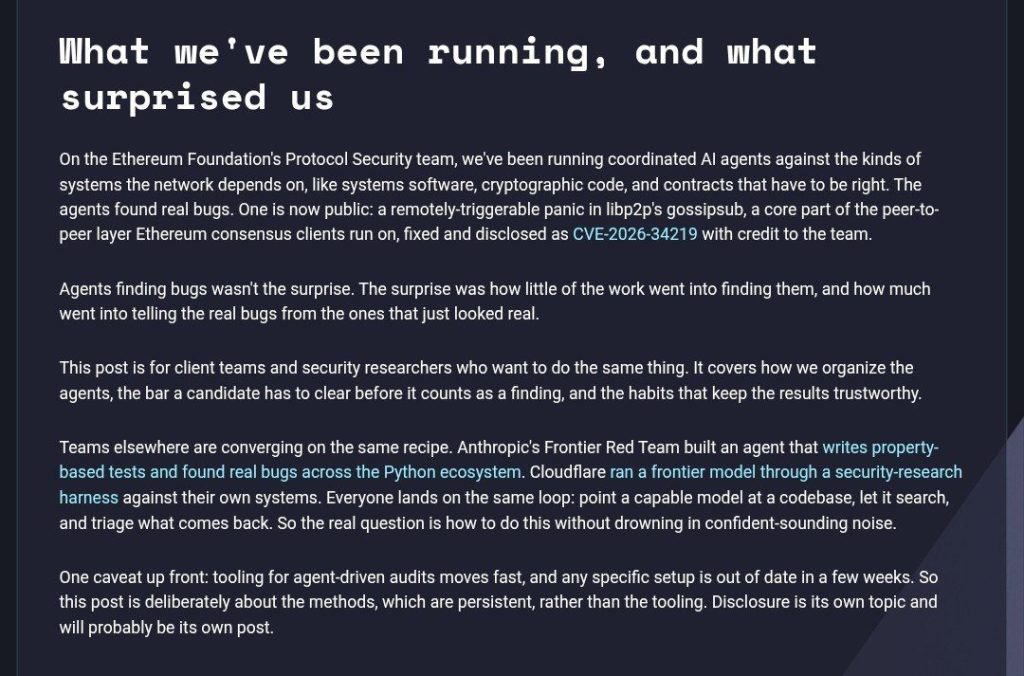
    The Protocol Security Team has been pointing AI agents at Ethereum’s protocol code. Our core takeaway wasn't about finding bugs, it was about triage.

    Here are field notes from the work.https://t.co/HVtc8XcrJK

    — Ethereum Foundation (@ethereumfndn) July 9, 2026

    The attacker can reconnect and replay the message after each crash, making the denial-of-service repeatable at negligible cost. Affected scope is any validator, indexer, or sidecar tool running Rust libp2p-gossipsub below v0.49.4, the vulnerability is not confined to Ethereum deployments, as Snyk’s advisory flags it as a risk for any application using the vulnerable crate in production.

    Discover: The Best Crypto to Diversify Your Portfolio

    How the AI Agent Pipeline Found It

    Nikos Baxevanis of the Ethereum Foundation’s Protocol Security team published the methodology behind the find.

    The team ran many AI agents in parallel against Ethereum’s systems software, cryptographic code, and contracts, coordinating through a shared Git repository with no central dispatcher, a structure borrowed from Anthropic’s fleet-based compiler work.

    Roles were generated dynamically as the work surfaced them: Recon converted attack surface into testable hypotheses, Hunting traced code paths and built reproducers, Gap-filling tracked coverage, and Validation independently re-checked every candidate before it counted.

    The key discipline was a strict reproducibility threshold. As the EF post states: “A candidate isn’t a finding until there’s a self-contained artifact that reproduces the failure against the real code, and that runs for someone who didn’t write it.”
    Source: Ethereum Foundation

    That single rule filtered out the most common false-positive traps – panics that vanished in production builds, reproducers that relied on internal values no real attacker input could ever produce, and formal proofs that were trivially satisfied regardless of actual code behaviour.

    The EF team’s candid framing of the triage burden is the most operationally useful part of the disclosure. “The surprise was how little of the work went into finding them, and how much went into telling the real bugs from the ones that just looked real,” Baxevanis wrote.

    Most candidates were wrong, duplicate, or out of scope, and the volume AI generates means that false-positive rate compounds fast without rigorous triage infrastructure.

    What This Means for Protocol Security Going Forward

    CVE-2026-34219 is not an isolated incident in libp2p’s backoff handling. According to external CVE listings, a prior vulnerability, CVE-2026-33040, reportedly involved a similar PRUNE/backoff overflow fixed in v0.49.3 and carried a CVSS score of 8.7. CVE-2026-33040 and CVE-2026-34219 appear to be back-to-back high-severity bugs in the same subsystem across consecutive minor releases, suggesting a pattern of systematic hardening in libp2p’s backoff handling rather than a one-off patch, and suggesting the gossipsub control-message surface warrants continued scrutiny.

    The broader implication for Ethereum infrastructure is structural. AI-assisted security work has been applied to smart contract audits for years; this disclosure marks a meaningful shift toward deploying the same capability against core networking and systems code.

    The EF team’s conclusion is direct: “The bottleneck didn’t go away. It moved from finding bugs to trusting the results, which is a better place for it, because that’s where human judgment actually matters.” For Ethereum’s ongoing protocol development, that’s a durable process improvement – not just a one-time find.

    Operators running consensus clients or any auxiliary tooling built on Rust libp2p should verify their gossipsub version immediately and upgrade to v0.49.4 or later. The patch adds bounds checking on backoff duration values in PRUNE messages before they enter heartbeat arithmetic, closing the overflow path entirely.

    Don’t Miss Out on Our $1,000 USDT Airdrop on ByBit

    The post Ethereum AI Security Agents Found Bug That Could Crash Any Node With a Single Message appeared first on Cryptonews.


    Share. Facebook Twitter Pinterest LinkedIn Tumblr Email

    Keep Reading

    Bitcoin Price Holds Above $63K as Analysts Eye $74K Target, Boosting Interest in Scaling Solutions | Invesloan.com

    Ex-SWIFT CIO Tom Zschach Shuts Down XRP Partnership Claims in Two Words | Invesloan.com

    Charles Hoskinson Denies Retirement Rumor That Reached London Cab Drivers | Invesloan.com

    Ethereum Price Prediction: Tom Lee Predicts $5 Trillion Ethereum | Invesloan.com

    Ethereum Crypto Resilience Proved as ETH Defends $1,700 While Cross-Chain Innovator LiquidChain Nears $1M | Invesloan.com

    Criminal Complaint Against Circle Puts USDC Freeze Policy Under a Microscope | Invesloan.com

    Bitcoin Price Prediction: Overlooked BTC Gold Ratio Is Flashing an Unexpected Signal | Invesloan.com

    AscendEX Collapse: MiCA Deadline, Failed Financing, and Empty Hot Wallets | Invesloan.com

    Robinhood Chain: From Wall Street Roots to Onchain Memecoins – How to Bridge Safely | Invesloan.com

    LATEST NEWS

    Summer journey season is right here: Make this important buy earlier than your subsequent trip | Invesloan.com

    July 10, 2026

    Laptops Closed: Chicago Law School Adopts New Rule to Combat AI | Invesloan.com

    July 10, 2026

    My insurance coverage firm mentioned my roof misplaced just a few tiles. Loss adjusters discovered $10,000 in storm injury. How may this occur? | Invesloan.com

    July 10, 2026

    Ethereum AI Security Agents Found Bug That Could Crash Any Node With a Single Message | Invesloan.com

    July 10, 2026
    POPULAR

    China’s first passenger jet completes maiden commercial flight

    May 28, 2023

    Numbers taking US accountancy exams drop to lowest level in 17 years

    May 29, 2023

    Toyota chair faces removal vote over governance issues

    May 29, 2023
    Advertisement
    Load WordPress Sites in as fast as 37ms!
    Facebook Twitter Pinterest WhatsApp Instagram
    © 2007-2023 Invesloan.com All Rights Reserved.
    • Privacy
    • Terms
    • Press Release
    • Advertise
    • Contact

    Type above and press Enter to search. Press Esc to cancel.

    invesloan.com
    Manage Cookie Consent
    To provide the best experiences, we use technologies like cookies to store and/or access device information. Consenting to these technologies will allow us to process data such as browsing behavior or unique IDs on this site. Not consenting or withdrawing consent, may adversely affect certain features and functions.
    Functional Always active
    The technical storage or access is strictly necessary for the legitimate purpose of enabling the use of a specific service explicitly requested by the subscriber or user, or for the sole purpose of carrying out the transmission of a communication over an electronic communications network.
    Preferences
    The technical storage or access is necessary for the legitimate purpose of storing preferences that are not requested by the subscriber or user.
    Statistics
    The technical storage or access that is used exclusively for statistical purposes. The technical storage or access that is used exclusively for anonymous statistical purposes. Without a subpoena, voluntary compliance on the part of your Internet Service Provider, or additional records from a third party, information stored or retrieved for this purpose alone cannot usually be used to identify you.
    Marketing
    The technical storage or access is required to create user profiles to send advertising, or to track the user on a website or across several websites for similar marketing purposes.
    • Manage options
    • Manage services
    • Manage {vendor_count} vendors
    • Read more about these purposes
    View preferences
    • {title}
    • {title}
    • {title}