
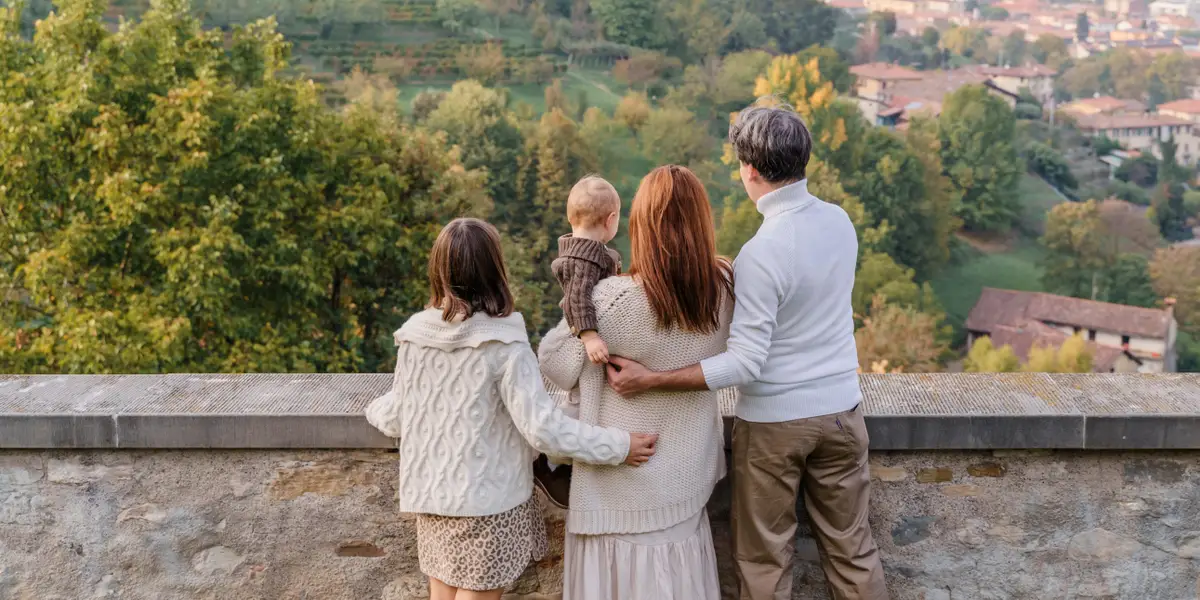
When my family moved from the United States to a small town in Southern Italy 12 years ago, I expected our children to grow up speaking another language and experiencing a different way of life.
I didn’t fully anticipate how much the move would challenge my ideas about parenting (in a good way).
I was born and raised in Cleveland and attended Ohio State University, so my instincts were influenced by life in and around large American cities. I was accustomed to parents closely supervising where their children went, organizing their schedules, and treating late evenings as adult territory.
In our part of Southern Italy, Mormanno, a mountain town in the Calabria region with a population of less than 3,000 people, many of those assumptions do not apply.
Over the years, I have had to decide which local customs to embrace, which American values to preserve, and how to raise children who understand both cultures without feeling that they must choose between them.
Children here are typically given more freedom in public
Daniel Llao Calvet/Getty Images
One of the first differences I noticed was how independently children move around town.
In the small community where we live, it’s not unusual to see kids walking through the town center, visiting friends, or spending time outside without a parent or adult directly beside them.
Older children and teenagers tend to remain outside much later than I would have considered normal growing up in Cleveland, too.
At first, this felt shocking and made me uncomfortable. My American instincts told me that children needed much closer supervision, particularly after dark.
But the environment is different from the one that birthed my expectations. Crime here in our town is extremely rare, and local families often know one another across generations.
A child may be outside without a parent, but that does not necessarily mean no adult is paying attention. Neighbors, relatives, shopkeepers, and family friends are often nearby.
The freedom children receive reflects both the community’s safety and the trust created by living in a place where people recognize one another.
It took me time to understand that independence here can exist within a strong communal safety net.
Kids seem to be included in adult social life more often
© Marco Bottigelli/Getty Images
I was also surprised by how naturally children are woven into social life here.
In the US, many parents arrange babysitters for late dinners or adult gatherings. We also tend to distinguish between spaces that are meant for children and those intended primarily for adults. Even at family events, kids may be given a separate table or activity area.
Where we live in Italy, children are usually part of the gathering. It’s not unusual for families to bring young children to restaurants, cafés, celebrations, and evening events, sometimes quite late at night.
What Americans might call a bar is often also a neighborhood café where people drink coffee, eat pastries, and socialize with their families.
The expectation is not necessarily that every environment must be specially designed for children. Instead, kids gradually learn how to exist within the broader social world of the family and other adults.
That approach can make evenings feel less structured than what many American parents are accustomed to. Strict bedtimes and carefully planned routines may give way to long dinners, spontaneous visits, and children falling asleep nearby while the adults continue talking.
I still value routine, particularly because every child responds differently to changes in sleep and structure. But I have come to appreciate a culture in which parenthood does not seem to automatically exclude families from so much of community life.
Independence means something different in each culture
ASphotowed/Getty Images
Perhaps the most interesting contrast is that Italian children can appear more independent when they are young but remain more closely connected to their families as they grow older.
American culture often defines independence as separation. Young people are encouraged to earn their own money, move out, and build lives apart from their parents. Living at home well into adulthood can sometimes be interpreted as a failure to progress.
In Southern Italy, independence seems less connected to leaving the family unit. Adult children may live with their parents longer, remain heavily involved in family decisions, or depend on relatives for practical support. In return, they are also expected to remain available to help parents, grandparents, and siblings.
Some of this is cultural, and some is connected to economic realities and limited job opportunities. To me, it also reflects a more interdependent idea of family life. Adulthood does not necessarily mean needing one another less.
That has challenged some of my American assumptions. I still want my children to become capable, responsible adults, but I no longer believe autonomy has to mean distance.
Ultimately, we are doing our best to raise our children between cultures
VICTORIA Strelets/Getty Images
I do recognize that much of what I’ve experienced here is probably very similar to how life is in small rural cities in the US. For me, however, it was like a whole new world.
Our greatest challenge has been helping our children participate fully in Italian life without losing their American identity or their identity as African Americans.
We want them to speak the language, understand local customs, and appreciate the community in which they are growing up. We also want them to know the history, traditions, and experiences that connect them to their family and culture in the US.
After 12 years, I no longer see Italian and American parenting as a contest in which one approach must be better than the other. Each reflects different ideas about safety, family, community, and what children need in order to thrive.
Raising our kids here has required constant negotiation. We have adopted some Italian habits, held firmly to some American ones, and created others that belong specifically to our family.
Our children are not growing up exactly as I did, but they are learning how to belong to more than one place. That may be the most unexpected part of raising them abroad, and perhaps the most valuable.