
What's Hot

    Bitcoin Price Prediction: Global Stocks Just Hit Record Highs, But Bitcoin Is Stuck Below $64,300 for the Fourth Time | Invesloan.com

    August 5, 2026

    ADP says companies add the less new jobs in six months | Invesloan.com

    August 5, 2026

    PGA Tour 2026: Wyndham Championship finest bets, ‘horses for the course’ for the Sedgefield Country Club | Invesloan.com

    August 5, 2026
    Facebook Twitter Instagram
    Finance Pro
    Facebook Twitter Instagram
    invesloan.cominvesloan.com
    Subscribe for Alerts
    • Home
    • News
    • Politics
    • Money
    • Personal Finance
    • Business
    • Economy
    • Investing
    • Markets
      • Stocks
      • Futures & Commodities
      • Crypto
      • Forex
    • Technology
    invesloan.cominvesloan.com
    Home » Military Leaders Are Sounding the Alarm on a Hidden Battlefield Threat | Invesloan.com
    Money

    Military Leaders Are Sounding the Alarm on a Hidden Battlefield Threat | Invesloan.com

    August 5, 2026
    Share
    Facebook Twitter LinkedIn Pinterest Email

    Roughly one-third of 33 recent US combat casualties evacuated from the Middle East were carrying bacteria resistant to multiple antibiotics, the Joint Staff’s top medical officer said Monday, offering an early warning about a military threat that’s already complicating the recoveries of wounded troops in Ukraine and is projected to worsen without significant medical advances.

    Only one of those US troops developed an active infection, Maj. Gen. Clinton Murray, the Joint Staff surgeon and an infectious disease physician, said at a military medical symposium in Florida. The others were “colonized,” meaning the bacteria were present on or in their bodies but were not necessarily making them sick.

    Those rates don’t imply that US troops are experiencing an outbreak of drug-resistant infections. It’s normal for healthy people to carry many types of bacteria, and Murray said the findings were consistent with rates seen around the world and in some intensive care units.

    However, those recent developments serve as an early indication of a looming danger that the military’s medical system is likely to contend with in a large-scale war, the kind the US military is trying to reinvent itself for, one in which infections and antimicrobial-resistant organisms could wreak havoc.

    “It’s not going to go away,” Murray said. “It’s only going to get worse.”

    Weapons — from high-end missiles to cheap drones — and accelerated kill chains are obvious threats, but evolving bacteria and the threat of antibiotic-resistant infections rarely receive similar attention in conversations about the challenges of a large-scale armed conflict.

    Such a devastating war could see thousands of severely injured troops waiting days or even weeks for casualty evacuations, receiving prolonged care in the field where their wounds can become contaminated with soil, debris, and bacteria, and, if they survive, moving through crowded hospitals where organisms and infections can spread. The resulting situation could resemble the frequently overwhelmed casualty flows of the World Wars.

    “We need to recognize the threat,” said Army Col. Jennifer Gurney, director of the Joint Trauma System, during the panel, which included presentations from Ukrainian health providers.


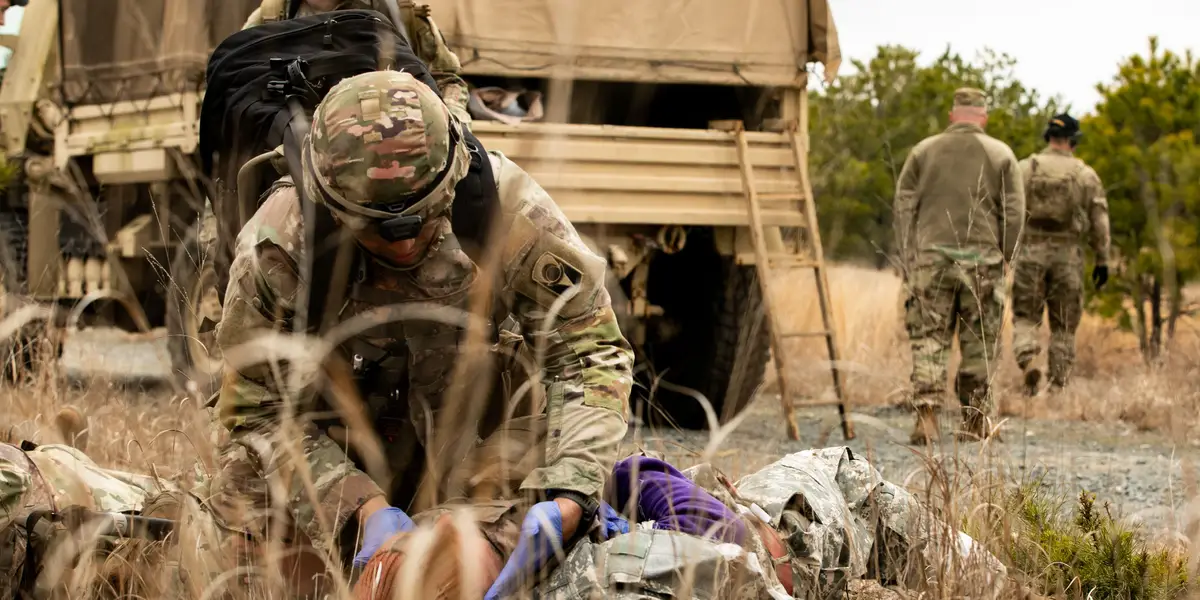
    Camouflaged US Army personnel with backpacks and helmets attend to a prone person in a sunlit pine forest.

    Army Soldiers going through the service’s Combat Medic (68W) Military Occupational Specialty Transition Course. 

    U.S. Army National Guard photo by Spc. Seth Cohen


    In Ukraine, infections and multidrug-resistant organisms, microbes that can resist commonly prescribed medications and antibiotics, have become a serious problem for wounded troops moving through the medical system or undergoing numerous surgeries to repair bodies mangled by explosive drone attacks, shrapnel, and burns.

    A 2024 study published in The Lancet predicted that more than 8 million people could die annually as a result of antimicrobial resistance by 2050.

    The threat has reached congressional ears, but draft language in the annual defense bill stops short of requiring action. It instead “encourages” the Pentagon to prioritize investments in total wound management and infection prevention.

    “Infection is a second hit and a threat to combat power,” Gurney said. “We must change the timeline and move capabilities and diagnostics much closer to the point of need.”

    “If we’ve been doing the same thing for 100 years and it hasn’t been working, we really have to think about the strategy,” she added.

    Infections and resistant bacteria are not a new battlefield problem. US troops experienced bacterial infections throughout the Global War on Terror, Murray said. But now, bacteria are evolving faster than researchers are developing new antibiotics, two military medical experts told Business Insider, arguing this warrants a more aggressive push for research.

    Speaking on condition of anonymity because they were not authorized to speak to the press, they said that the US military may need to become more creative in its approach to treating infections, relying less on antibiotics and more on other solutions.

    However, the medical diagnostic tools for identifying and managing infections early, which are key to reducing the heavy demand for antibiotics, have evolved more slowly than in other parts of medicine and are likely to be under significant strain in a large-scale war.

    Recalling her time at a military hospital a decade ago, Gurney told the audience that as US casualties arrived for care, doctors didn’t use diagnostic technology to discern types of infections — they used their noses.

    “Smell should not be our best early diagnostic capability.”

    “We shouldn’t normalize or romanticize this clinical intuition, and early detection must be engineered into battlefield care,” Gurney continued. “Our current approach is probably not working as well as we want it to.”

    She compared resistant bacteria to another threat — inexpensive drones that can be produced at scale and overwhelm sophisticated defenses.

    That drone threat “is ours now,” Gurney said. “And this [multidrug-resistant organism] threat will be ours as well.”


    Share. Facebook Twitter Pinterest LinkedIn Tumblr Email

    Keep Reading

    Google Is in Talks for a $1.5 Billion-Plus Deal With Mechanize | Invesloan.com

    Ex-FBI Profiler Quit BSU After Work Followed Her Home | Invesloan.com

    Wall Street Sees 3 AI Futures. the Same Winners Keep Showing up. | Invesloan.com

    SpaceX and Nvidia Are Taking Their Relationship Exclusive | Invesloan.com

    OpenAI Reported 2 More Incidents of Rogue AI Agents | Invesloan.com

    She Spent Her thirty fifth Birthday on a Solo Travel Adventure in Ecuador | Invesloan.com

    SpaceX Says It’s Coming for AT&T, Verizon, and T-Mobile Customers | Invesloan.com

    Biggest Questions From White House Meet With OpenAI, Google, Anthropic | Invesloan.com

    OpenAI Pays $3.2 Million to Settle US Worker Bias Claim | Invesloan.com

    LATEST NEWS

    Bitcoin Price Prediction: Global Stocks Just Hit Record Highs, But Bitcoin Is Stuck Below $64,300 for the Fourth Time | Invesloan.com

    August 5, 2026

    ADP says companies add the less new jobs in six months | Invesloan.com

    August 5, 2026

    PGA Tour 2026: Wyndham Championship finest bets, ‘horses for the course’ for the Sedgefield Country Club | Invesloan.com

    August 5, 2026

    Google Is in Talks for a $1.5 Billion-Plus Deal With Mechanize | Invesloan.com

    August 5, 2026
    POPULAR

    China’s first passenger jet completes maiden commercial flight

    May 28, 2023

    Numbers taking US accountancy exams drop to lowest level in 17 years

    May 29, 2023

    Toyota chair faces removal vote over governance issues

    May 29, 2023
    Advertisement
    Load WordPress Sites in as fast as 37ms!
    Facebook Twitter Pinterest WhatsApp Instagram
    © 2007-2023 Invesloan.com All Rights Reserved.
    • Privacy
    • Terms
    • Press Release
    • Advertise
    • Contact

    Type above and press Enter to search. Press Esc to cancel.

    invesloan.com
    Manage Cookie Consent
    To provide the best experiences, we use technologies like cookies to store and/or access device information. Consenting to these technologies will allow us to process data such as browsing behavior or unique IDs on this site. Not consenting or withdrawing consent, may adversely affect certain features and functions.
    Functional Always active
    The technical storage or access is strictly necessary for the legitimate purpose of enabling the use of a specific service explicitly requested by the subscriber or user, or for the sole purpose of carrying out the transmission of a communication over an electronic communications network.
    Preferences
    The technical storage or access is necessary for the legitimate purpose of storing preferences that are not requested by the subscriber or user.
    Statistics
    The technical storage or access that is used exclusively for statistical purposes. The technical storage or access that is used exclusively for anonymous statistical purposes. Without a subpoena, voluntary compliance on the part of your Internet Service Provider, or additional records from a third party, information stored or retrieved for this purpose alone cannot usually be used to identify you.
    Marketing
    The technical storage or access is required to create user profiles to send advertising, or to track the user on a website or across several websites for similar marketing purposes.
    • Manage options
    • Manage services
    • Manage {vendor_count} vendors
    • Read more about these purposes
    View preferences
    • {title}
    • {title}
    • {title}