
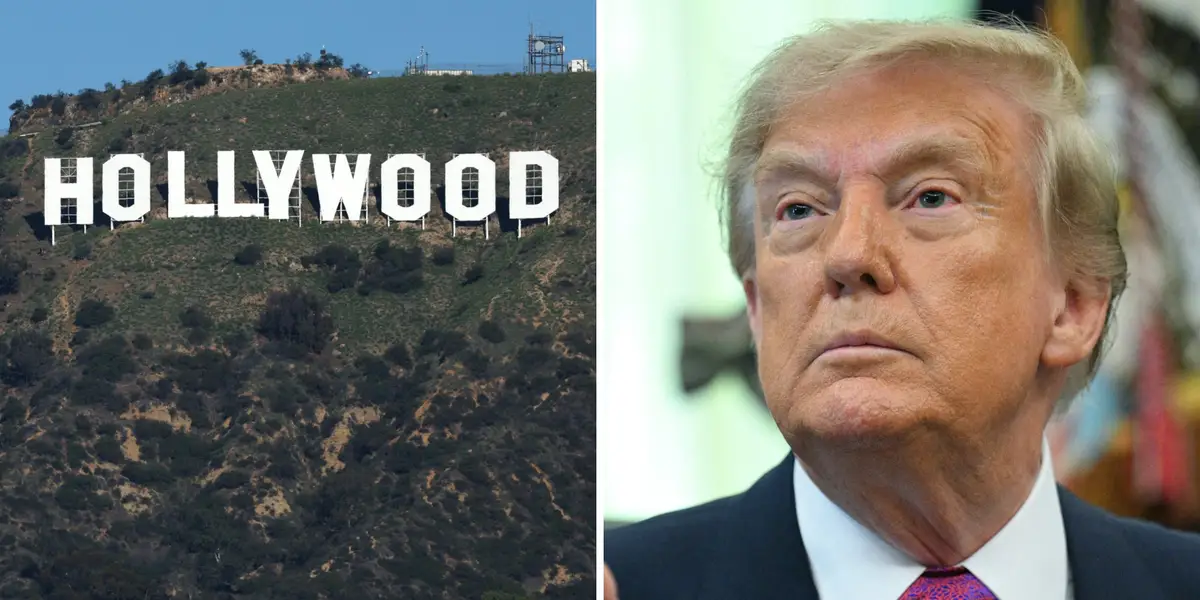
President Donald Trump’s popularity in Hollywood may soon take a turn for the better.
Trump voiced support for a federal tax incentive for movies and TV made in the US. The plan came after conversations with Jon Voight, whom the president appointed as his “Special Ambassador to Hollywood.”
“I am going to suggest that Republicans and Democrats get together, and immediately craft Legislation to save the Movie, Television, and Entertainment Business in America,” Trump wrote on social media on Monday night.
A tax credit for films and TV shows made domestically could give a huge boost to Hollywood, which has been hindered by the pandemic, work stoppages due to labor strikes, and a decline in local production as projects move to countries with more generous incentives.
States like Georgia, Louisiana, and New York already offer production tax credits, and a federal incentive could further sweeten the deal.
“This is great news for people working in the rapidly changing and challenging film production business,” said Paul Hardart, an entertainment industry professor at NYU.
Rewarding studios for shooting in the US could also help support businesses across the country that provide ancillary support to the film industry, like hotels, restaurants, and makeup artists.
“It’s not just about LA,” said Michael J. Wolf, the CEO of media-focused advisory firm Activate Consulting.
Ta-ta to tariffs
Trump’s proposal for production incentives was received by the creative community far better than his idea for “tariffs” on movies made outside of the US, which faced serious logistical questions.
The president called for “a 100% Tariff” on foreign-made movies last May and doubled down in September, saying it would solve the “long time, never ending problem” of production moving out of Hollywood.
But the proposal caused confusion about how an import tax would be enforced on a virtual product. It was also unclear how films and TV would be treated if they were only partially filmed or edited overseas.
Netflix co-CEO Ted Sarandos said in March that he talked Trump out of movie tariffs, given the disruptive impact they could have had.
“Having the incentives versus tariffs is much better,” Sarandos said.
Hardart said a film production incentive “is actually pretty exciting news and makes way more sense than tariffs,” which he said last May would “hit the whole industry.”
“It’s sort of moving from a stick mentality to carrots,” Hardart said.
Selling tax incentives and avoiding loopholes
While Trump’s proposal may win over Hollywood, it could face challenges.
Some Republicans may bristle at the idea of providing production incentives for Hollywood creatives, especially tax rebates for so-called “above-the-line” talent like star actors and directors.
Congresswoman Nicole Malliotakis, a Republican from New York, told Variety in August that “members of Congress want to make sure we’re not covering a multimillion-dollar salary for a celebrity.”
“You’re going to have some Republicans who are going to look at this as a giveaway to liberal Hollywood,” Malliotakis said of film tax credits.
Trump is trying to sell the move by saying in his post that a production incentive “will benefit ALL of America.” The key may be to frame the move as a way to level the playing field in a crucial American industry and to keep jobs from going overseas while supporting blue-collar workers like caterers.
“Tax policy shouldn’t push those jobs out overseas,” Wolf said. “How can you disagree about creating jobs?”
The president is playing up the idea that Hollywood needs his help, saying on Monday that Tinsel Town is “a Complete and Total Disaster” and is “being dissipated in its entirety.”
Hollywood-skeptical Republicans may back a film production incentive to keep tech giants like Google’s YouTube from gaining too much power over the media. Another argument is that studios need these credits to brace for the looming threat of AI-generated content.
Several questions remain with a film and TV production incentive, from timing to details.
Trump said in his post that the legislation would be completed “quickly” and “efficiently,” though he didn’t provide a timeline on when it would be introduced.
A federal production incentive program must also walk a tightrope between being generous enough to attract domestic investment without putting taxpayer money toward projects that would have happened regardless.
“The incentives have to be meaningful enough to change where a production is made, predictable enough that producers can build it into their financing, and structured so that the benefits flow actually to American workers,” Hardart said.
Hardart continued: “If it simply becomes another subsidy without changing production decisions, then it will just give tax dollars to productions that were already planned for the US.”