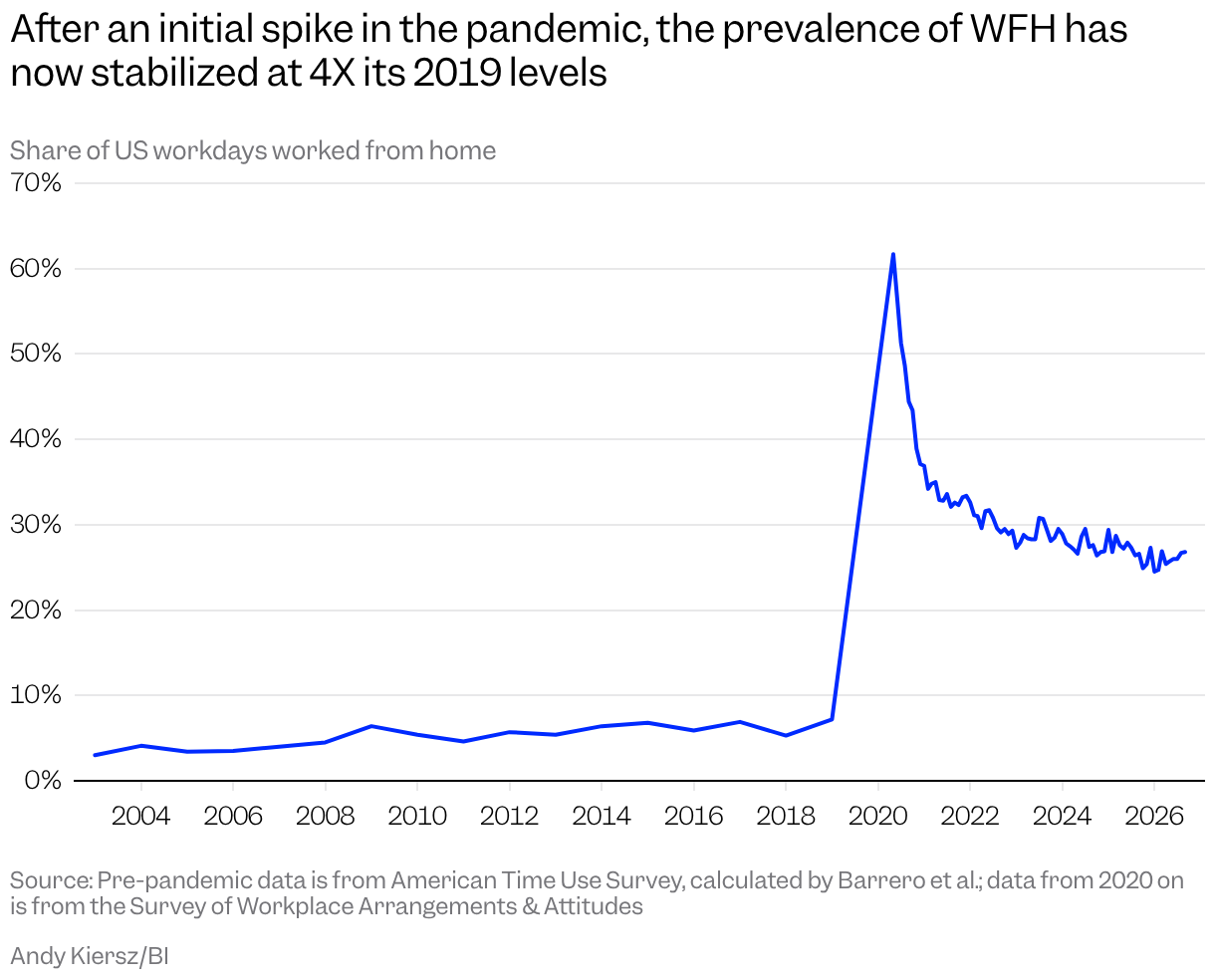
Work from home is dead: You’ve probably heard some version of this declaration from your boss over the past year. But the numbers show that WFH is actually very much here to stay. The prevalence of working from home has barely budged over the last two years, at around 26% of all American work days.
That’s a lot less than the 62% we saw in the early months of the pandemic — but a near quadrupling since 2019, when that share was at a miniscule 7%. Had the pandemic never happened, it probably would have taken us 40 years to get to work from home as much as we do today.
We’ve reached a new normal for the corporate workplace — one where remote jobs have become a bigger minority, and it’s also become totally normal for white-collar professionals to work from home at least a day or two a week.
That shift has brought about all kinds of other changes in American life — some profound, some life-saving, some strange and unexpected. Nobody’s reflected on those changes more than Nick Bloom, an economist at Stanford who’s the world’s leading expert on remote work.
When I first spoke to him in early 2021, Bloom was right in the midst of helping rewrite corporate America’s work policies, presenting his research to managers at companies including Microsoft, Facebook, Google, and Apple. He warned that years of intense turmoil would follow as employees and employers fought over the new terms of where we work — and he couldn’t have been more right. Now that the dust has largely settled, I caught up with him at his house on one of his WFH days to take stock of the most lasting impacts of America’s work-from-home revolution.
1. Saved time
One of the biggest reasons why people love working from home is because it saves them time. The average commute in the US is about 40 minutes each way, and ahead of venturing out into the world, you need to spend a little extra time making yourself presentable to the world by showering and getting dressed. Rolling out of bed and opening your laptop? That takes 30 seconds. By Bloom’s estimates, the typical American worker saves an hour and a half for every day they work from home. For those in WFH-friendly sectors like tech and finance, those time savings average about 3 hours a week.
What have people done with that extra time? They’re getting more sleep and exercise, and they’re cooking — and if they have kids, they’re spending a lot more time on parenting. One study in the Netherlands found that when parents were allowed to work from home, their kids scored higher on an important standardized test that helps determine their high school track. “It’s because you’re home,” Bloom says. “You know that your kid is up there doing their homework and you can smell it if they’re smoking weed.”
2. More workers
In 2020, 77% of Americans without a disability had a job, compared with only 32% for those with a disability. In a lot of cases, disabled people wanted to work but couldn’t in an office-only world. Maybe they couldn’t drive because they were blind, or they had knee and back issues that made navigating the stairs at the office too difficult.
The boom in remote and hybrid jobs in the pandemic changed that, increasing the ranks of disabled people with full-time roles by more than a quarter million people. Add to that all the women who, thanks to the flexibility of working from home, no longer had to quit working to juggle their childcare responsibilities.
That’s been great for those workers, and great for the economy as a whole. “It’s not impossible that hybrid increases labor participation rates by 1 to 2%, which probably increases GDP by about 1 to 2%,” says Bloom. That would amount to an additional $300 billion to $600 billion in economic value. “This is huge.”
3. More babies
From 2023 to 2025, people who worked from home at least one day a week had more babies compared to daily office-goers, Bloom and his cofounders found. They also planned to have more kids in the future. That’s likely because of the increased flexibility of remote work that makes having more kids feel feasible — and also some basic biology. “My friend had this great line,” Bloom tells me. “He said, ‘My wife and I discovered she can’t get pregnant by email.'”
Bloom estimates that working from home is associated with a roughly 5% increase in fertility in the US and Northern Europe — statistically significant, but not huge. Still, any increase is desperately needed in much of the developed world, which is fighting a declining birth rate. The fertility bump, Bloom notes, has been the most pronounced among women 30 and older, who have college degrees, and already have one kid.
4. Saved lives
In the early days of the lockdown, urban dwellers around the world got to enjoy better air quality. Did these improvements continue even once the workplace settled into a new hybrid world? Bloom and his coauthors looked at levels of nitrogen dioxide — which is linked to lung and heart conditions — across US cities to see.
In 2025, the largest city centers had 8% less nitrogen dioxide than in 2019. That translates to between 1,500 and 3,500 fewer deaths every year in the country.
5. Struggling cities
One clear loser of WFH has been city centers. Cities from San Francisco to Washington DC are struggling with budget shortfalls that they’ve attributed to a weaker commercial real estate market (in San Francisco, 29% of office space sat vacant in the second quarter, eight times higher than in 2019). In an even dire state are public transit systems in major cities. BART, which connects San Francisco to its neighboring areas, used to be able to cover about 70% of its operating costs with fares and parking. Now, it’s 23%. Next month, Bay Area residents will vote on a ballot measure that would increase the sales tax to keep BART and other public transit systems afloat.
6. The AI takeover
First, it was work from home; now it’s AI. Is it a coincidence that these two asteroids hurtled into white-collar work within the span of just a few years? Bloom argues that the two are related. The transition to remote and hybrid work, he says, made way for the rapid uptake of AI in the workplace.
For one, the switch to digital communication — Slack, email, Zoom — created an explosion of data for companies to train their AI models on. Before, these conversations were happening in person, disappearing into the ether as soon as they escaped our vocal cords. Now, so many of them are happening on some digital medium, recorded for posterity to fine-tune the machines.
Businesses can’t get enough of this data. That’s why Google recently purchased Spirit Airlines for $10 million in a recent bankruptcy auction. Google’s goal wasn’t to start its own airline, but to get access to Spirit’s 100 million emails, 500 million Microsoft Teams messages, and 30 million lines of code.
Bloom argues that the shift to digital communication also created new norms for the AI era. Imagine your coworker pulling out their phone to record the audio of a meeting so they could send around their AI-transcribed notes to everyone afterwards. That would have been pretty weird, back in 2019. But that’s totally normal now, thanks to the fact that we started using Zoom a lot more in the pandemic, and because Zoom has a record button. “It’s just changed a lot of stuff that’s made it more feasible to use AI,” Bloom says.
Most white-collar workers like that they get to work from home more often than they used to. They see the remote work revolution as largely a positive one. But if it also accelerated AI’s spread in the corporate workplace, that’s more of a mixed bag. Would they go back to the daily slog into the office if it meant not having to worry about losing their job to Claude?
After all, Bloom notes, it’s the fully remote back-office jobs that are probably the easiest to automate. The jobs that still require in-person charm, collaboration, and logistics are the ones the machines still can’t touch.
Business Insider’s Discourse stories provide perspectives on the day’s most pressing issues, informed by analysis, reporting, and expertise.