
The FBI, National Security Agency (NSA), and Cybersecurity and Infrastructure Security Agency (CISA) have warned organizations to urgently patch two critical PHP attack dubbed “PHP2Shell,” which could let hackers take control of vulnerable servers without logging in. With PHP powering websites and web applications worldwide, the warning raises a pressing question for crypto safety: Should you cash out Bitcoin or pull funds from exchanges to protect your crypto?
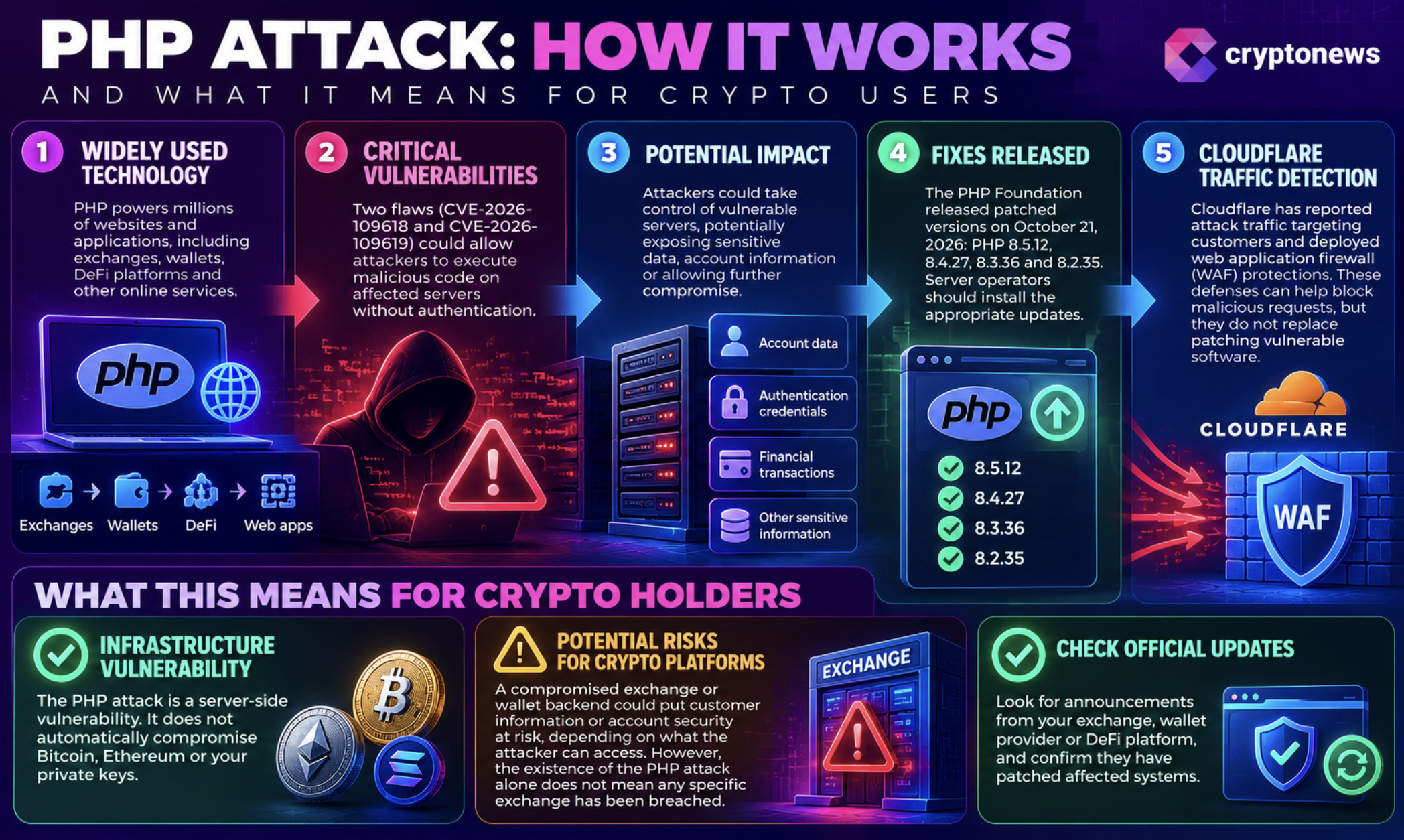
The PHP2Shell vulnerabilities, tracked as CVE-2026-109618 and CVE-2026-109619, could allow attackers to execute malicious code on vulnerable servers without authentication. Both flaws carry a critical CVSS v4.0 score of 9.2, prompting cybersecurity agencies to urge organizations to patch affected systems immediately.
The PHP attack creates a potential risk for crypto exchanges, wallet providers, and decentralized finance (DeFi) platforms that depend on vulnerable web infrastructure. But it does not automatically compromise Bitcoin, Ethereum, or private keys stored securely offline.
Could Hackers Reach Your Crypto in This PHP Attack?
PHP powers websites and applications, including services that may handle account information, authentication, and financial transactions. The newly disclosed vulnerabilities could let attackers execute code on affected servers, potentially exposing sensitive information or allowing further compromise.
The PHP Foundation released fixes on October 21, 2026, including PHP 8.5.12, 8.4.27, 8.3.36, and 8.2.35. Administrators running affected systems should install the appropriate updates, while organizations using managed hosting should confirm that their providers have addressed the vulnerabilities.
Cloudflare has also reported attack traffic targeting customers and deployed web application firewall protections. Those defenses can help block malicious requests, but they do not replace patching vulnerable software.
For us, crypto holders, the key is between an infrastructure vulnerability and a confirmed breach. A compromised exchange backend could create risks for customer information or account security, depending on what the attacker can access. Yet the existence of the PHP attack alone does not establish that any particular exchange has been breached.
Discover: Crypto IPO to Watch This Q4
Should You Withdraw From Exchanges or Cash Out?
The answer is direct, not solely because of PHP2Shell. There is currently no basis for treating every exchange account or self-custody wallet as compromised simply because these vulnerabilities exist.
Withdrawing funds from an exchange may reduce exposure to certain exchange-specific risks, but it also introduces other considerations, including withdrawal fees, network errors, phishing scams, and the security of the destination wallet. Moving crypto to another platform without checking its security could simply exchange one risk for another.
Selling crypto is a different decision. A PHP attack is a cybersecurity event, not direct evidence that Bitcoin or Ethereum prices must fall. Cashing out based on a headline could leave investors reacting to a threat that never affects their own holdings.
For better Crypto safety, we should first determine if the exchange or wallet provider has issued a relevant warning, if their account shows suspicious activity, and whether their credentials or recovery phrase could have been exposed.
If a provider confirms a breach affecting customer assets, follow its official instructions and assess the specific exposure before deciding whether to withdraw or transfer funds.
Ledger Attack Raises Separate Hardware Wallet Concerns
The PHP attack arrives amid separate concerns about hardware wallet security.
In an October 12 report, we covered Ledger’s investigation into a hardware implant found in at least one device associated with the CryptoBilis reseller. The investigation linked affected devices to reported wallet-draining incidents, with estimates reaching $93 million across 311 wallets on five blockchain networks. The total remains an estimate rather than a confirmed final loss figure.
The Ledger incident is separate from PHP2Shell. It highlights a different crypto safety concern: hardware supply-chain tampering rather than a vulnerability in server software. Neither incident establishes that all Ledger devices are compromised.
Hardware wallets can help protect private keys, but Crypto safety still depends on how devices are sourced, how recovery phrases are stored, and whether users verify transaction details before signing.
Read the full report: What Ex Mt.Gox CEO Found, and How to Protect Your Crypto
PHP Attack Crypto Safety Checklist: What We Should Do Now?
We can take several practical steps without making rushed financial decisions. First, update wallet applications and devices through official channels. Second, review recent transactions and token approvals for unfamiliar activity. Third, never enter a recovery phrase into a website or share it with someone claiming to provide technical support.
Hardware wallet owners should follow their manufacturer’s official guidance, particularly if they purchased devices through a reseller associated with a security investigation. Anyone who has credible evidence that a recovery phrase was exposed should create a new wallet with a new seed phrase on a trusted device and transfer remaining assets securely.

Finally, monitor official announcements from exchanges, wallet manufacturers, and relevant security agencies. Organizations operating vulnerable PHP servers need to patch urgently; ordinary investors should focus on their own exposure rather than treating every vulnerability as an instruction to sell.
PHP2Shell is a serious server-security threat, but it is not an automatic crypto wallet drain. For now, we do not need to cash out or withdraw funds solely because of the PHP attack. Checking providers, securing credentials, and responding to confirmed exposure offer a more targeted approach to Crypto safety.
Discover: The Best Token Presales
The post PHP Attack Threatens Crypto Safety: Should You Cash Out or Pull Funds From Exchanges? appeared first on Cryptonews.