
HOA president was not on the list of titles Lana Martin ever planned to hold, but it’s one that’s befallen her.
Martin bought a townhouse in a 13-unit complex in Los Angeles in 2022. She quickly realized that the leaders of her homeowners association were ignoring a number of unaddressed issues, including a leaky decades-old roof that was flooding her neighbors’ living rooms. Martin, who works for the California state government, decided to join her complex’s three-person board to help out.
As the saying goes, no good deed goes unpunished.
The other two board members aren’t very involved, so “everything falls on me,” Martin says. She handles vendor calls, fields resident complaints, and babysits a low-budget property manager. Residents raised hell about the roof replacement project — they didn’t want to stomach the roughly $160,000 cost that meant a painful $13,000 assessment for each unit. Some of them accused the HOA board and management company of acting illegally and threatened to lawyer up. Martin has had to block some of her neighbors’ phone numbers.
“They wanted to second guess everything, Monday-morning quarterback everything, rather than just become involved,” Martin says.
The reluctance to participate is understandable. It’s also part of what’s left Martin holding the bag.
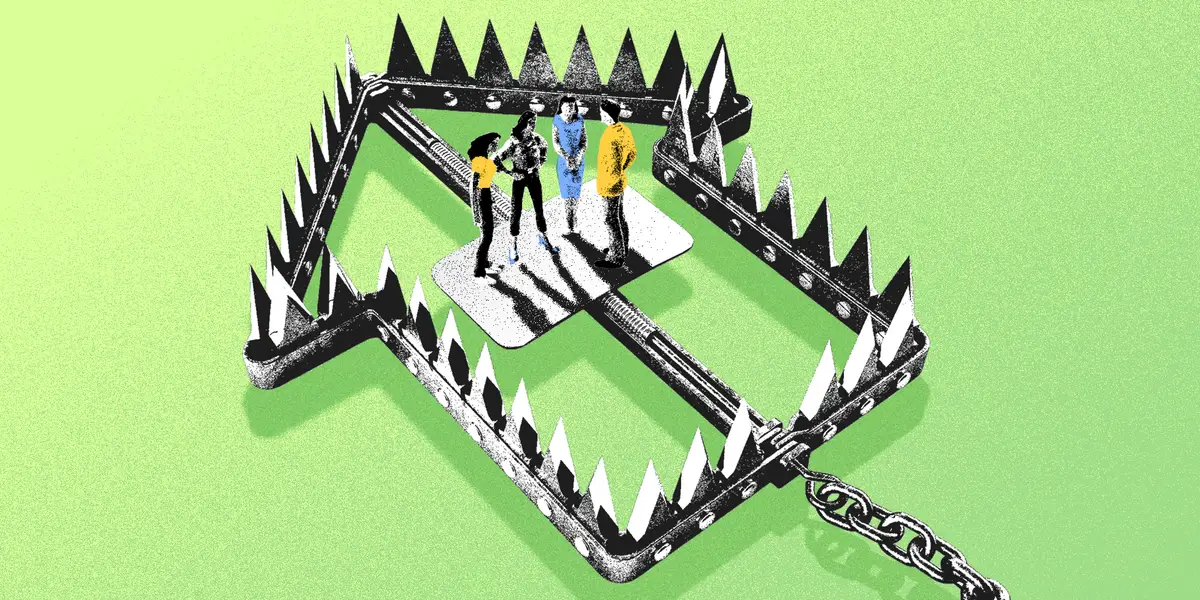
HOAs are easy to hate. They are private mini-governments made up of non-expert volunteers who happen to live in proximity with one another. Across the country, millions of Americans have bought into condos, co-ops, and subdivisions governed by these associations, tethering their largest financial asset to an amateur bureaucracy. Most HOA stories are told from the outside looking in: a beleaguered resident hit with a ridiculous fine over a rogue garden hose or an overgrown lawn. Talk to the people who’ve ventured into the belly of the beast, and the picture gets gnarlier: You give up a ton of time, don’t get paid, and everybody’s always a bit mad at you.
And yet, HOA setups are growing. There were 373,000 community associations in the US in 2025, covering 29.6 million housing units and 78.1 million residents. By comparison, there were 222,500 in 2000. These entities collected $124.2 billion in assessments last year — about 1.5 times New York City’s total tax revenue for the same year. You can see why things get so heated, and not just about money.
“HOAs are the ultimate pressure cooker environment for human interactions,” says A.J. Steigman, a Florida real estate investor who currently sits on two boards. “You can cure cancer, you can pave the place in gold, you can even lower the HOA fees, and yet you’re still going to have some elderly couple constantly complain about their flower patch.”
Why would anyone in their right mind raise their hand for this?
HOAs typically attract two distinct archetypes, says Evan McKenzie, a political science professor at the University of Illinois Chicago and author of “Privatopia: Homeowner Associations and the Rise of Residential Private Government.” On one side are the reluctant pragmatists — people who step up out of civic duty or sheer self-defense. On the other are what McKenzie calls the “condo commando” types who have some pretty strict ideas about how the people next door ought to live. For them, the board is a badge of domestic authority. Once they wind up in the same room, these groups inevitably clash — or, perhaps even worse, they run up against the paralyzing apathy of everyone else.
The paradox of HOA leadership is that the moment an owner displays basic competence, the rest of the community often abdicates. That’s how James, a product designer in LA, landed in his current situation. He asked me to withhold his last name in order to protect his privacy — and keep from ruffling feathers among his neighbors.
HOAs are the ultimate pressure cooker environment for human interactions.
Back in 2021, a couple of people in his complex asked him to help out since he works from home and could keep an eye on things. He officially joined the board in 2023 and now acts as an unwitting customer service desk. Residents email the board about petty issues like intercom numbers and rat spottings. One recent Friday night, someone emailed to report a gas leak. “It’s like, you need to call 911,” James says.
He can’t walk around his residence without risking someone coming up to him to pitch an idea or air a grievance. “You’re never really off the clock,” he says. He wishes he could quit, but no one else will step up.
Olivia Horbowy’s story is one of self-preservation. When she bought an older top-floor condo in LA in 2024, the concept of an HOA was quite foreign to her. There were signs something might be amiss when she informed the building’s then-leadership of her renovation plans for her new place — demands for extra documentation, a denied in-unit washer-dryer — but she brushed them off. She is an attorney, after all. But after moving into the space in the spring of 2025, she received notice of $15,200 in surprise accumulated fines related to the remodel. “They were convinced they were above the law and could make any decision they wanted,” she says. After some legal back-and-forth, she didn’t wind up paying.
As a result of the incident, Horbowy also decided to run for the five-person board herself. Victory wasn’t entirely sweet, because of one preexisting board member’s reaction. In emails, the aggrieved veteran referred to one member as a “kiss ass minion,” accused the board president of taking bribes, and called Horbowy a “Russian whore.” (She’s Polish.) That member eventually resigned.
What makes HOAs and condo boards different from, for example, a corporate board is the question of interest, explains Nadav Shoked, a law professor at Northwestern. In HOA boards, the directors and the people affected by the decisions are often one and the same — and their neighbors. While they all have a common interest — the property — they often have interests that conflict.
People of a certain age, even though they may not be financially insecure, they worry about, will the money run out in my lifetime?
HOA boards contend with all sorts of fault lines. Older residents on fixed incomes tend to prioritize keeping monthly fees lower, while younger families lean toward upping fees for more amenities and construction projects. In situations where some owners live in their residences and others rent them out, boards wind up with a triangle of interests: Landlords want low costs and easy rental terms, full-time residents prioritize day-to-day quality of life, and renters wade through all of it without having a say.
These disconnects are why routine governance so frequently devolves into absurdity.
Andrew Simkovsky just wanted an investment property when he bought a condo in South Florida in 2024, but he wound up orchestrating a “hostile takeover” of the board amid concerns over their stewardship of said investment. He’s since worked to rebuild the condo’s finances and reestablish a budget. Still, the one thing that’s surprised him is the hullabaloo over pets. The building’s original bylaws from the 1970s officially barred them. In the ’80s, there was an amendment allowing pets for owners but not renters, but over the decades, both groups had brought them in. The association’s attorney advised them that enforcing the pet ban for tenants could be legally problematic, so Simkovsky decided to bring the building into the 21st century by officially allowing dogs and cats of up to 50 pounds for owners and instituting rules around leashes and cleanup that hadn’t previously been in place. (Renters are still technically not allowed to have pets, but the board doesn’t enforce that.) Purist residents revolted and wanted pets out. “My response to them was, they’re already here, should I evict them?” he says.
Courtesy of Alice Young
Alice Young, a retiree in suburban Chicago, says she’s fine to serve on her board as long as it doesn’t cut into her pickleball time, even though “everything takes so goldarn long to resolve.” Among the lengthy items on her agenda are finding a new property management company and convincing a fellow board member to personally confirm a single extension cord has been removed from the basement in order to close out another board member’s violation.
The true crisis inside the HOA machine is money. Many boards have kept dues artificially low for decades in order to appease residents and put off pricey updates. Now, aging housing stock is colliding with surging insurance premiums, stricter reserve laws, and tighter safety regulations, and the bill is coming due.
Florida is an especially stark example. It has the second-most community associations of any state, behind only California, with 50,600 such groups covering 4.5 million housing units and 10.9 million residents. Neighbors who live under Florida HOAs kick in over $20 billion to their associations annually. A 2023 Florida Senate analysis found that 912,000 of the state’s 1.5 million condo units were at least 30 years old. After the 2021 collapse of the Surfside condominiums that left 98 people dead, the state required qualifying buildings to undergo “milestone” structural inspections after a certain age and changed the rules so owners can’t simply vote to underfund reserves for major structural repairs. In 2024, Redfin found double-digit annual increases in condo dues in Tampa, Orlando, Fort Lauderdale, and West Palm Beach.
Courtesy of Paul Vesely
This creates a brutal fiduciary burden. When Paul Vesely joined the board for his Florida second-home condo in 2009, the complex’s on-site managers warned him against commissioning an engineering inspection, because “they might find something.” The association has since taken out over $2 million in loans to pay for various updates and renovations, which translates to thousands of dollars a year for each unit. One owner, who has cancer, is currently delinquent on her payments, and the board will send her to collections if she doesn’t pay. “As badly as we may feel about a certain individual, we have to be consistent,” he says.
Not everyone shares the same economic clock. Bill Masterson recalls attending a condo meeting in Chicago years ago in which an elderly man pushed back against a $225,000 assessment to put in a parking lot. “Why can’t you wait until I die?” the man asked. The board went ahead anyway, and the man lived for another several years. “People of a certain age, even though they may not be financially insecure, they worry about, will the money run out in my lifetime?” he says.
Masterson swore off condo boards when he moved from Chicago to Florida in 2016 and then signed right back up. He admits he’s a stickler for the rules, but he’s also aware of how silly disputes can break down relationships. One of his neighbors doesn’t speak to him because of a long-past disagreement over a speed bump.
“That’s OK, because the work gets done,” he says. “You never know in a given moment what pressure people are under.”
Lana Martin, back in LA, says contending with everything has been a “wild ride.” She spoke to me the day roof construction on her complex had finally begun. She’s relieved, but there’s more work to be done. Next up: writing up a towing policy. “People won’t voluntarily just agree, ‘Oh yeah, I shouldn’t block driveways,'” she says.
Emily Stewart is a senior correspondent at Business Insider, writing about business and the economy.
Business Insider’s Discourse stories provide perspectives on the day’s most pressing issues, informed by analysis, reporting, and expertise.