
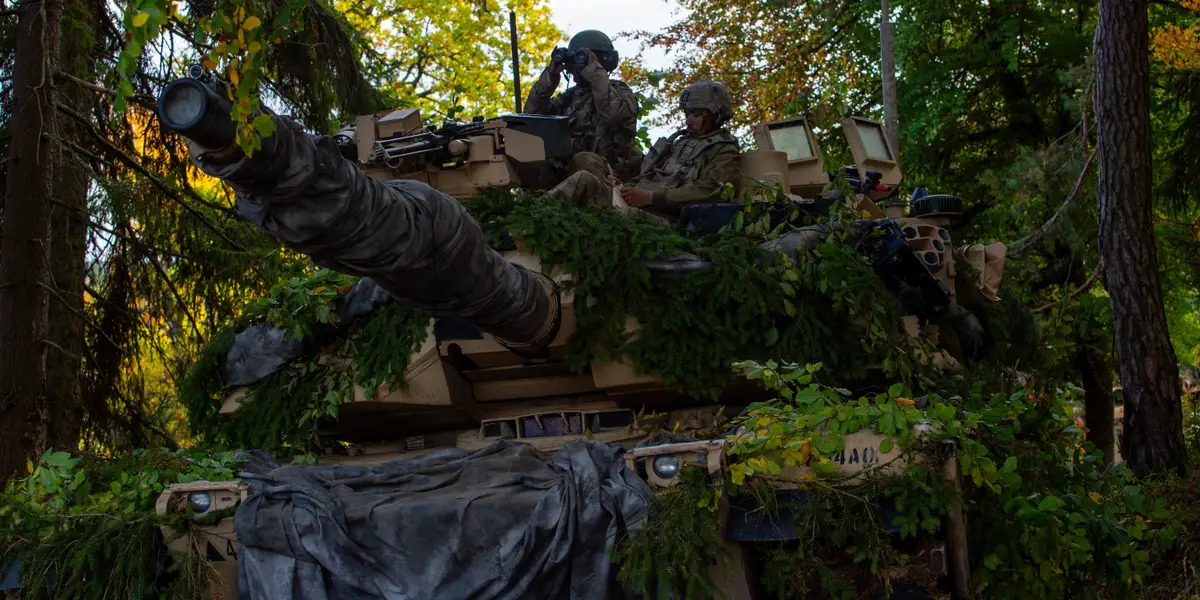
HOHENFELS, Germany — The US Army’s Abrams tanks are built to charge into battle, using their heavy armor and powerful cannon to break through enemy defenses. But at a major training exercise in Germany, they were doing everything they could to stay out of sight.
Driving through the Joint Multinational Readiness Center, the Army’s main overseas training facility, the presence of the 1st Armored Division’s Abrams tanks was hard to miss. Mud tracks crisscrossed and meandered through the grassy hills, scarred by the treads of the heavy armored vehicles.
However, the tanks themselves were nowhere in sight. They were hidden along the treelines and deeper in the forest, careful not to reveal their positions to enemy reconnaissance drones.
For a vehicle built to deliver overwhelming firepower on the battlefield, concealment has become a matter of survival.
Drones filled the sky when Business Insider visited the Hohenfels training grounds in late October to observe Combined Resolve, a recurring exercise that pitted a rotational armor brigade against an opposition force simulating a US adversary.
The training environment was designed to resemble the battlefields in Ukraine, where heavy drone proliferation has made it extremely difficult for tanks and infantry fighting vehicles to move freely without being detected. Armored assets have taken heavy losses in the war, raising questions among some warfare experts about their continued relevance on a modern battlefield dominated by constant overhead surveillance and cheap precision strikes.
At the JMRC in Germany, Army officers insisted that tanks aren’t dead. However, effectively keeping them in the fight means changing how armored formations operate, from the way tanks move and conceal themselves to how they refuel, communicate, and prepare for an attack.
Jake Epstein/Business Insider
“I don’t see armor disappearing,” said Sgt. Sean Brenna, an M1A2 Abrams tank gunner with the 1st Armored Division’s 1st Armored Brigade Combat Team (1/1 ABCT).
“A lot of people are like, ‘Drones are the death of the tank,'” he said. “I don’t see that. I see tanks evolving.”
What Ukraine taught the US Army
Russia’s full-scale invasion has dramatically upended perceptions of armored vehicles on the modern battlefield.
Tanks and infantry fighting vehicles were once seen as pillars of Ukraine’s defense; in the early stages of the war, for instance, some of these systems — like the M1 Abrams and German-made Leopard tanks— were considered priority acquisitions for Kyiv.
But drones have made it much harder for armor to operate effectively.
Ukraine and Russia have lost multimillion-dollar armored vehicles to drones that cost a few hundred dollars. Both sides have tried to mitigate the risk by equipping tanks with added protection, such as cage armor, but it’s far from a perfect solution.
Across much of the sprawling front line, dense minefields, entrenched defenses, artillery, and widespread drone surveillance have made large-scale maneuver increasingly difficult. Drones in particular have expanded the danger, creating a miles-wide “kill zone” where soldiers and their vehicles risk being spotted and targeted whenever they move.
Alexander Ermochenko/REUTERS
At the Army’s training grounds in the Bavarian hills outside Munich, the drone threat was impossible to ignore.
At one point during the exercise, soldiers clad in black, wearing baseball hats and camouflage vests, rushed out of a command post and across an uneven field to deploy a spy drone.
As they worked, a sudden buzz filled the air. Another drone, a small quadcopter, appeared almost out of nowhere and flew toward the team. A soldier raised his rifle and pulled the trigger. Jamming, it produced an impotent click.
The drone hovered briefly before flying off. It turned out to be a friendly asset, but had it belonged to the enemy, the soldiers could have found themselves facing an attack.
The US Army has increasingly been confronting these threats and related vulnerabilities in training, with Ukrainian soldiers helping expose just how dangerous the battlefield has become for American armored formations.
Like other NATO militaries, the US has leveraged Ukraine’s experience and included its soldiers in major exercises across Europe.
During an iteration of Combined Resolve held earlier this year, Ukrainian soldiers from the 412th Unmanned Systems Brigade, an elite unit known as “Nemesis,” served as an opposing force, challenging US armor. Nemesis helped to cause roughly 70% of the casualties suffered by a US armored brigade in the opening two days.
Jake Epstein/Business Insider
The Americans eventually improved, changing tactics, and the share of drone-related casualties dropped.
A source with knowledge of the exercise said the Ukrainian soldiers had the entire training area covered by their sensing and strike capabilities, turning practices considered safe in previous US military campaigns, such as clustering vehicles in rear areas to refuel, into large targets.
It was particularly eye-opening for soldiers to see that logistics and maintenance could no longer be done in the open, the source said, adding that the purpose of the exercise is to use these hard-learned lessons to inform future tactics.
Brig. Gen. Terry Tillis, the commander of the 7th Army Training Command, which operates under US Army Europe and Africa, said the April exercise raised a key question for officers and soldiers: how can they better protect armor from drones?
The answer, at least in part, is to rethink some of the most basic practices of armored warfare.
Reinventing the armored fight
For starters, it means decentralized logistics and using the terrain to avoid massive clusters. In the October iteration of Combined Resolve, this proved to be a work in progress.
In the middle of a field, an M1 Abrams sat powered down, its crew resting on top. Hours earlier, the tank had tried to refuel but was targeted by indirect fire, forcing it to disperse. The tank was eventually struck — what the crew called a mobility-firepower kill — and had to remain in position until it was allowed to rejoin the exercise.
The incident underscored how even routine tasks, such as refueling a tank, have become dangerous operations when enemy drones and other sensors can expose vehicles to attack.
Brenna, the Abrams gunner, said one of the biggest challenges of the exercise was learning how to handle drones as an armor crew. Reports of overhead activity were near-constant, and his crew spotted countless drones.
He and the rest of his crew have learned to adapt, he said. In some ways, the methods are rather basic, like using camouflage nets to cover their tank, but they are also overhauling how they maneuver, handle logistics, and communicate with the brigade.
It’s an ongoing effort that involves experimenting with new tactics to gauge their effectiveness, such as hiding along the treelines and resupplying at night rather than during the day.
Brenna said that the crew is mainly trying to avoid remaining in the same place for too long because, during the exercise, the opposition force taught them that “hiding in a treeline might protect you from being spotted from a drone, but not forever. And the moment you do get spotted, it is best to relocate quickly.”
The Army is working through those challenges while recognizing that survival is only one part of the equation in battle. Armored forces must also be able to maneuver, attack, and seize territory.
Jake Epstein/Business Insider
The Ukrainians recently demonstrated what that looks like in practice.
Ukraine’s Third Army Corps, which has led a major counteroffensive in the embattled eastern Donetsk region, disclosed recently that it had executed two successful mechanized assaults behind Russian lines. Gen. Andrii Biletskyi, the corps’ commander, said that he was initially skeptical it could be done.
While details remain limited, the general has revealed that armored crews had to undergo special training and that their vehicles were outfitted with additional equipment to support their push. Other armored endeavors have involved support drones operating in both surveillance and attack roles.
“Today, the use of armored vehicles is effectively a special operation. It requires extremely detailed planning and the coordination of a huge number of assets,” Biletskyi recently told Militarnyi, a Ukrainian military news site.
Recent successes suggest that mechanized maneuver isn’t necessarily a thing of the past, even if carrying it out on a drone-saturated battlefield has become far more difficult.
Why the tank still matters
The challenges that armored vehicles and mechanized infantry formations have faced in Ukraine “prompted some to prematurely declare the death of ground maneuver, claiming that a transparent battlefield defined by persistent observation, unmanned system proliferation, AI-driven targeting, and long-range strike made offensive ground movement obsolete,” wrote Gen. Christopher LaNeve, the acting Army chief of staff, in an October document outlining how the service will fight its next war.
Jake Epstein/Business Insider
“These claims mistake tactical destruction for operational and strategic success,” LaNeve said. “Long-range fires degrade enemy networks at range, but standoff alone rarely compels the enemy to surrender. Only ground maneuver can seize what the enemy holds and secure it against the enemy’s will.”
The argument is that while drones and long-range weapons can help destroy enemy forces, they cannot replace the ground troops needed to capture and hold territory. The Army sees armor as an essential part of that effort, even as the way it operates changes.
“Armor will always be present. It’s always a necessity, right?” said Capt. Kevin Rincon, the troop commander of the multifunctional reconnaissance company, the brigade’s action arm. “It’s kind of like that shock force — the combination of the duo of infantry and armor.”
To that end, the October exercise was designed to stress-test how the rotating armored brigade could use drones, electronic warfare, and other counter-drone technology to sense, track, and engage attacks from the opposing force. By the time Business Insider visited Hohenfels, near the end of the multi-day-long scenario, 1/1 ABCT was on the counteroffensive.
Tillis, the 7th ATC commander, said drones can help control terrain, but actually holding ground requires integrating emerging technologies with traditional armor.
Technologies like drones, counter-drone systems, and electronic warfare “are all enablers designed to facilitate combined arms maneuver,” Tillis said. “We’ve got to be able to attack, seize, retain terrain, hold, and then, if need be, defend and do it again. You cannot take an objective without putting boots on the ground.”
The challenge is figuring out how to make that kind of maneuver possible against an enemy that can watch and strike from overhead.
Brenna said he can envision a situation where armor plays a more “precise role” in the next US war.
For now, the American tank crews in Germany are learning that surviving long enough to fight may require staying hidden, moving carefully, and abandoning some of the practices that once defined armored warfare.
One thing is certain, Brenna said. “The army is definitely not giving up on tanks. That’s for sure.”