
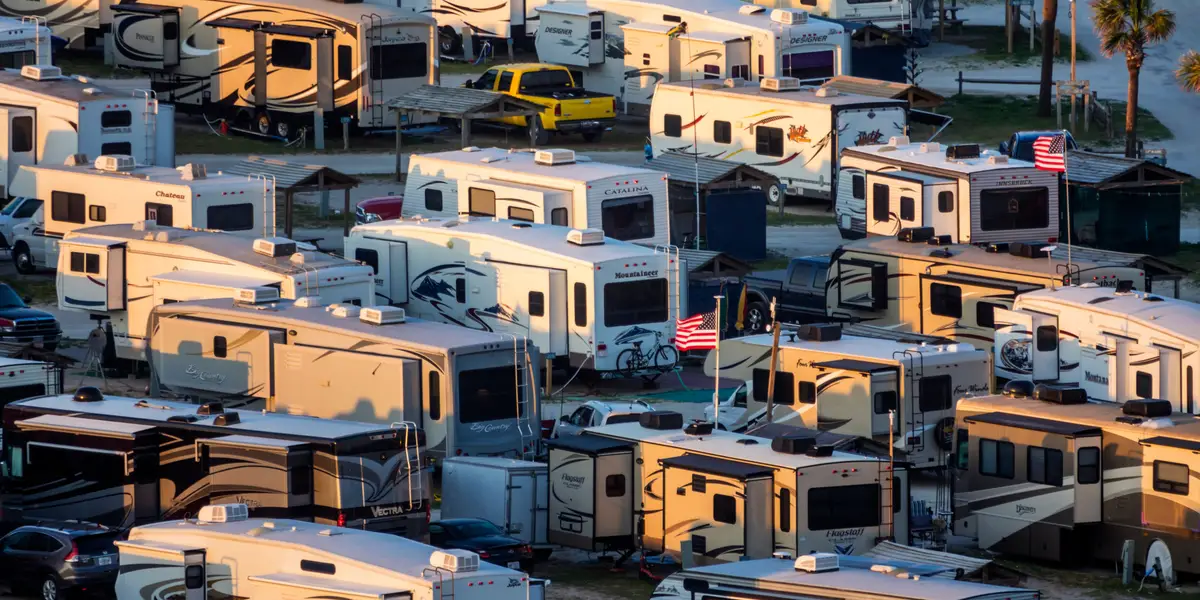
Seventy Amazon packages were piled up at an RV park near Cedar Rapids, Iowa.
They weren’t for the tourists passing through to attend an antique show or see the nearby historic German villages, says Jamie Wolter, the manager of Amana RV Park & Event Center. They’re for the hundreds of data center workers now living at the park.
Typically, the 450-campsite park hosts up to 60 long-term campers, but now that Google and QTS are both building data centers in the area, workers have come from as far away as Oregon and Washington. Some bring spouses and children they homeschool. Staff who used to field complaints about missing fire rings now have to decide whether to ask someone who’s behind on rent to move their home.
“It’s like you’re a landlord now, and you never used to be,” Wolter says.
Still, she credits the data center workers with helping mitigate a decline in RV tourists due to gas prices. “Without these long-term guests, it would have been terrible.”
As construction workers crisscross the country for high-paying data center jobs, some are putting their per diem toward an RV. While working on one of the biggest infrastructure buildouts in US history, they could be at a site anywhere from a few months to a few years, often in places where hotels and short-term rentals are scarce or expensive. If they find a spot in packed campsites, a travel trailer can stretch their housing allowance further, shorten their commute, and make room for family and pets — all while “chasing that data center money”. It can also go with them to the next job when construction ends.
The trend is a much-needed boost for the RV industry, which has tumbled from its pandemic high. US wholesale RV shipments fell 13.7% through September compared with the same period last year; sales to data center workers are helping some dealers weather the slump. Meanwhile, campgrounds built for tourists are filling up with data center workers — and their operators are learning what it means to be flooded with long-term tenants.
At ATC RV Center in Cedar Rapids, Iowa, data center workers helped keep unit sales roughly flat from a year earlier. “Without them, it would have been really slow for us,” manager Joel Philipp says.
Because RVs are largely a leisure purchase, sales are especially exposed when households cut back. “It’s usually the first into a recession and the last out,” he says of the industry. “You don’t need it, you want it.”
His dealership used geofencing to target ads to people using their phones around data center construction sites. The idea was to reach workers interested in RVs on their breaks, when they browse Facebook or ESPN on their phones — and it worked. A number of those people turned up to buy RVs, he says.
In Louisiana, Bayou Outdoor Supercenter offers workers on Meta’s Hyperion project a calculator that compares the cost of staying in a hotel with the cost of buying an RV they can take to their next job.
At Clear Creek RVs in Abilene, marketing director Shannon Calkins estimates about half the dealership’s business now comes from data center workers. Before the buildout, workers buying RVs for housing, including people on pipeline and solar projects, accounted for about 15% to 20% of its business. Calkins credits new customers with helping Clear Creek continue to grow in a difficult market.
Most data center buyers opt for smaller, cheaper travel trailers, Calkins says. Her finance team has seen per diems ranging from about $100 to $300 a day. A smaller trailer can cost around $20,000, and depending on the loan, payments can come in at $400 a month or less. A $400 trailer paired with a $600 campsite would put the cost at $1,000 a month before electricity, insurance, or food.
Calkins says some buyers have limited credit histories, which can make loans harder to get and more expensive when they do qualify. But a worker who would otherwise spend that money on hotel rooms can put some of it toward a trailer they’ll still own when the job is over. In Cedar Rapids, Philipp did see some demand for larger fifth-wheel RVs, which he says could run $60,000 to $70,000, but those typically came from coworkers looking for bunkhouse models they could share or tradespeople bringing their families.
At Abilene RV Park in Texas, all the weekly and monthly spaces and long-term cabins were full when I spoke with manager Debbie Coffey. Data center workers make up most of her long-term guests, and she says there’s continually a waitlist of 20 to 30 people.
Coffey spends so much time handling deliveries that she feels “like a mail lady about half the day every day.” There’s more work keeping up the showers, restrooms, and laundry room, too. The park recently increased its monthly rate by $50, to $600 plus electricity, to help cover higher property taxes and upkeep costs.
She keeps about five of the park’s 66 spaces open for people passing through, the guests she’s counting on to come back when data center construction winds down.
Near Meta’s sprawling data center campus in Richland Parish, Louisiana, Corporate Mobile Housing’s Dunn Village provides construction workers with rooms in mobile homes as well as 170 spaces for them to bring their own RVs. Heather Kleinpeter, the company’s director of strategic growth, says data centers have given a new life to a business whose owners had been considering retirement. Founded after Hurricane Katrina in 2005 to house workers pumping water out of New Orleans, the business later pivoted to accommodating oil and gas workers. Prior to Meta’s Louisiana data center announcement in late 2024, Corporate Mobile Housing provided 300 beds. It’s now at 1,500, and Kleinpeter expects that number to double next year.
Two of Kleinpeter’s sons work in data centers and have both lived in modular housing at Dunn Village. In her parks and around Richland Parish, she sees all kinds of workers living in RVs, from younger ones who don’t need much space to retirees picking up work again to people traveling with kids or dogs. That means campers with little fences, swings, and kids’ bikes out front. At some parks, food trucks have set up shop to sell breakfast.
“People are just taking advantage of the opportunity on every level,” she says.
The opportunity comes with an end date. Meta says its expanded Richland Parish campus will support more than 7,500 jobs at peak construction and 1,000 once it’s operating. When data construction projects finish, the traveling crews will need another job — and somewhere else to park their RVs.
Kleinpeter says Corporate Mobile Housing is planning five to seven years out. Afterward, the company could move some of the modular homes to another job or find a new use for land it has already equipped with water, sewer, and electricity. It depends on what the parish looks like then.
“It’s going to be a collective like, ‘What does the municipality want?'” Kleinpeter says.
Future data center projects also face a tougher political climate. In this month’s midterms, Texas elected Gina Hinojosa, who backs a statewide moratorium on new data center approvals, as governor. Texas accounts for about one in five US data center buildings that are planned or under construction, according to industry tracker Cleanview. Michigan backed Abdul El-Sayed, who has called for a pause on new developments, for the Senate. Voters in several towns across the country also approved measures to restrict or ban new data centers.
Around Abilene, Calkins has watched new RV parks pop up in fields, some little more than crushed gravel and utility hookups. Some of these parks have plenty of space, she says, even while established parks are turning away monthly renters. When the work dries up, she figures the crews will hitch up their trailers and take them to the next job.
It’s the parks they leave behind that she thinks will sell for “pennies on the dollar.”
Business Insider’s Discourse stories provide perspectives on the day’s most pressing issues, informed by analysis, reporting, and expertise.