
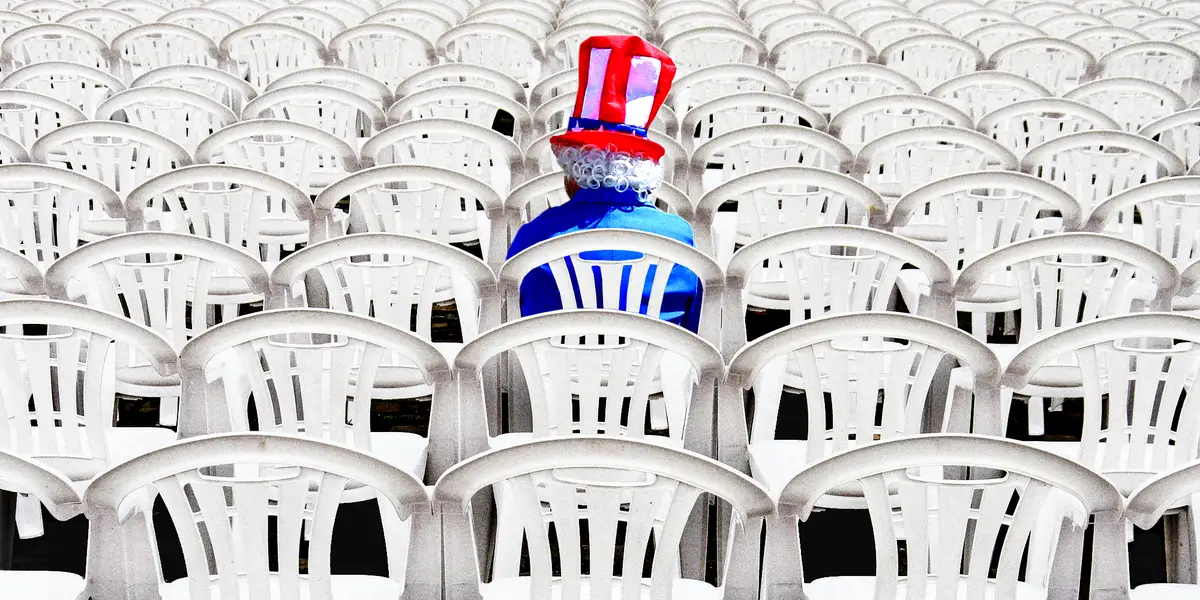
America isn’t empty empty. Its population is still growing. Its cities remain raucous and crowded. Its suburbs are buzzing. But the country is starting to feel a little less full.
For years, economists and demographers have warned about the coming “Great People Shortage,” a time when the US population would begin to decline thanks to lower birth rates and aging baby boomers. While the current situation is not yet as dire as those predictions, the ground is shifting in ways likely to reshape the American economy. The decrease in babies born years ago is now becoming more perceptible, as fewer people are reaching adulthood and joining the labor force. Plus, the Trump administration is giving America’s ongoing demographic shifts a shove by making it harder for foreigners to enter the US, closing off one of the country’s main buffers against a workforce that’s getting smaller and older. Tourism is weakening, too, amid rising prices and hesitant international visitors.
The effects may not show up in the national head count yet. But the slowdown will start to appear in the places and industries that depend on a churn of newcomers.
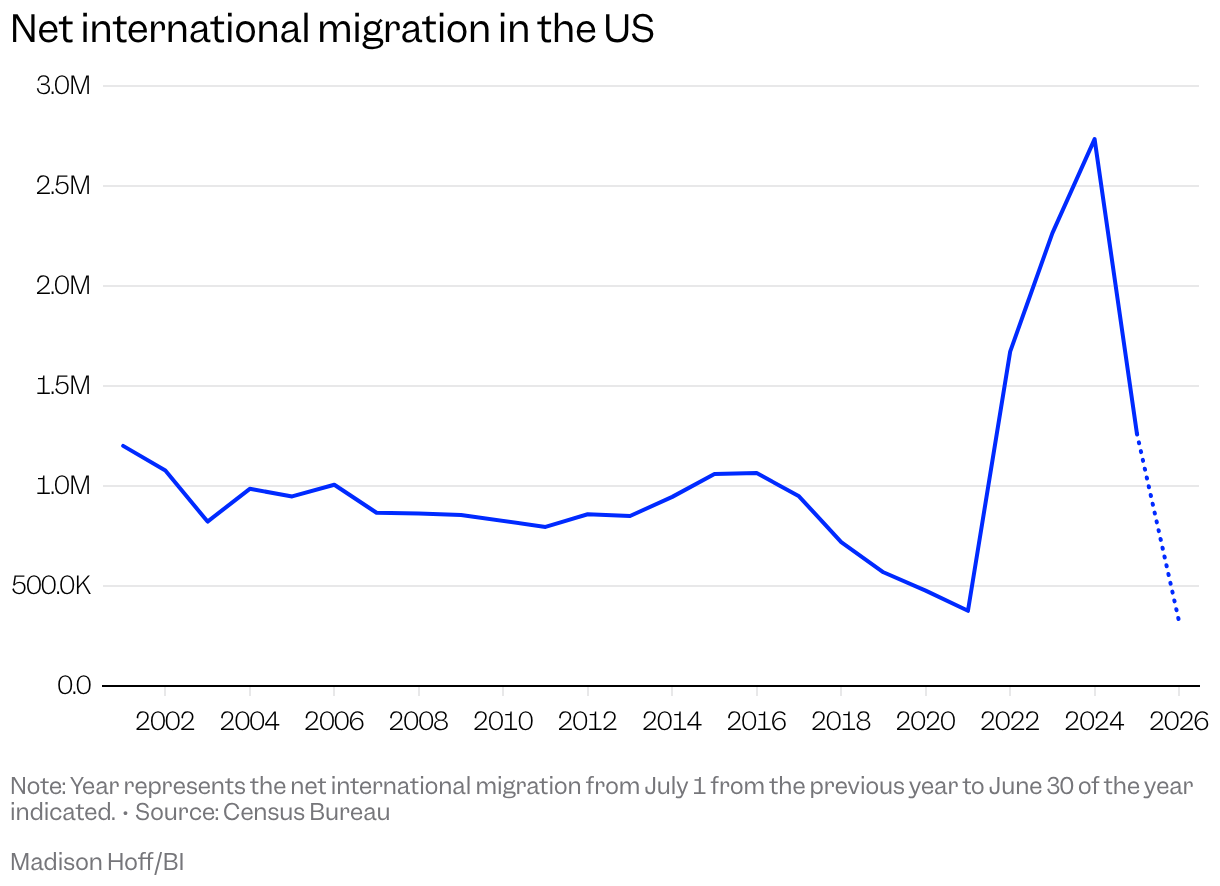
The US population isn’t expected to fall off a cliff soon: The Congressional Budget Office expects the number of people living in America to peak at 364 million in 2056 before it starts to decline. But in a country where the fertility rate crested in 2007 and isn’t likely to go back up anytime soon, there are a lot of unanswered questions lurking underneath that topline number — namely, will there be enough working-age people in the places that need them to power the economy?
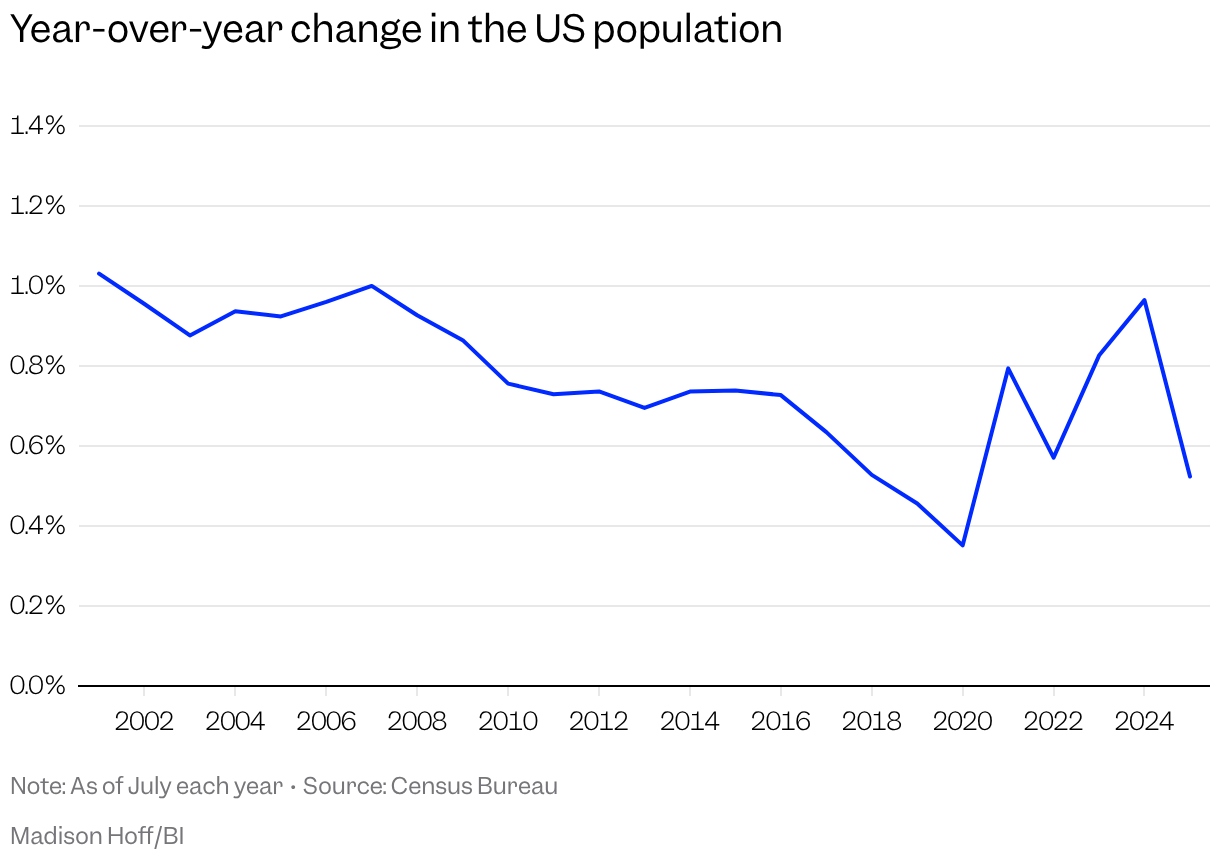
Immigration has historically been a crucial part of the answer. The last few years have seen some wild swings in the country’s net international migration. Under the Biden administration, it ballooned to 2.7 million in 2024, per the Census Bureau. It fell to 1.3 million in 2025 and is expected to decline to 321,000 in 2026. In terms of the workforce, that’s a big deal.
“Immigration is usually about half our job growth,” says Pia Orrenius, a labor economist at the Federal Reserve Bank of Dallas. When fewer immigrants arrive, it becomes harder for employers to fill jobs, especially in regions that need workers. That means lower output, slower growth, and less demand, because immigrants aren’t just workers, they’re also consumers. Orrenius points to Texas, which is in the midst of a manufacturing boom and building out data centers. “If you have a stagnant economy anyway that doesn’t really grow much or really generate a lot of new jobs anyway, you’re not really going to feel it as much,” she says. In Texas, however, “we grow fast, and we depend on immigrants and migrants from other states to fuel that growth.”
While incoming immigration numbers have waxed and waned over the decades, America is in novel territory regarding its broader attitude toward foreigners already in the country. Not only has the White House undertaken mass deportation efforts and cracked down severely on entrances at the border, but it has also revoked thousands of visas for students and workers and ended protections for hundreds of thousands of people living in the US from countries such as Venezuela and Haiti. Whether they’re a white-collar tech engineer or a blue-collar roofer, non-natives across the economic spectrum are less welcome in the US.
Immigrants don’t simply take jobs that would otherwise go to US-born workers. The two groups often do different, complementary work. Immigrants also create demand — they buy groceries, rent apartments, and start businesses that fuel local economies.
Fewer tourists from abroad impact economies, too. Many foreigners have decided to avoid Stateside visits under the Trump administration. The president’s antagonistic stance toward Canada and ongoing tensions with our neighbors to the north has resulted in a steep decline in visitors from there. Tourism from Europe and Asia has fallen.
People are just a little less footloose.
Leigh Barnes, the North America president of Intrepid Travel, an international travel company, tells me they’ve seen a 67% decline in Canadians traveling to the US from 2025 to 2026, a 30% decline in inbound visitors from Australia and New Zealand, and a 24% decrease from Europe, the Middle East, and Africa. He attributes the drop-offs to a mix of politics and economics. Canadians have had a “visceral” response to Trump’s stance toward their home country, while visitors from Australia and the United Kingdom, for example, are more put off by financial pressures at home and increased costs in the US. Once tourists arrive in the US, he says they often discover “everyone’s bloody lovely,” but the problem is that they’re nervous about getting here. “It’s that trepidation and concern coming into the border,” he says.
The cumulative effect is an uneven demographic era. There will be some places with fewer workers and some places that continue to grow. Attractions and cities that depend on international tourism will take a hit, whereas others that don’t get many visitors won’t see a difference. Some colleges will survive the drop in international students, navigate a world with lower attendance, or successfully entice enough young people to enroll. Others will struggle to weather the storm.
The competition for an increasingly scarce number of young people is also complicated by the fact that Americans are moving less than they once did, says William Frey, a demographer and senior fellow at Brookings Metro. “People are just a little less footloose,” he says.
The result will be more parts of the country emptying out, especially rural areas that don’t have the same kinds of job opportunities they used to have. They can’t offer the jobs and amenities more populated areas do.
One thing that is true across the country: the population is aging. “That’s probably a bigger, broader concern,” Frey says. Baby boomers are exiting the workforce, and there aren’t enough young workers to backfill them, take their jobs, and replace their tax dollars. This is also changing the nature of jobs the country needs — someone has to care for these older people.
For up-and-coming American workers, this setting isn’t necessarily terrible news, says Steven Ruggles, a regents professor of history at the University of Minnesota. Workers entering the workforce in 2040 — about 15 years down the road — will have a “pretty darn good” labor market, he says.
Companies will have to compete for the available workforce, which will mean greater leverage, stronger job prospects, and higher pay. “When the baby boomers entered the labor market, the labor unions disintegrated because they no longer had any bargaining power because workers were a dime a dozen,” he says. On the flip side, it also means companies will try to squeeze more out of every worker they can hire. “If there’s a shortage of workers, you expect there to be a lot of incentive for companies to adopt labor-saving devices like AI and other things that increase productivity,” Ruggles says.
One thing that’s hard to know is how sticky current conditions are. The slowing of immigration under Trump isn’t permanent, just like the explosion under Biden wasn’t. Once America’s political winds change, policies around green cards, student visas, and immigration enforcement are likely to change. Tourism may bounce back. Low birth rates and an aging population are less likely to change.
America’s future depends on how and whether the country adjusts to an older, less mobile population — and how leaders think about filling the gaps.
Emily Stewart is a senior correspondent at Business Insider, writing about business and the economy.
Business Insider’s Discourse stories provide perspectives on the day’s most pressing issues, informed by analysis, reporting, and expertise.