
Ethereum co-founder Vitalik Buterin believes younger generations investing in stocks and digital assets instead of housing could help ease pressure on property prices. However, he says crypto still needs something that makes housing attractive: stability.
Buterin thinks that housing creates incentives for owners to keep property prices high, even when cheaper homes would benefit society. Digital assets could offer an alternative, but today’s platforms often encourage excessive speculation.
“We need the equivalent of those good properties that housing investment has, for modern digital assets,” Buterin wrote on X
His comments raise a question for Ethereum. Can the network evolve beyond speculative trading and become dependable infrastructure for people building long-term digital wealth?
Ethereum Roadmap Targets the Stability Vitalik Buterin Wants
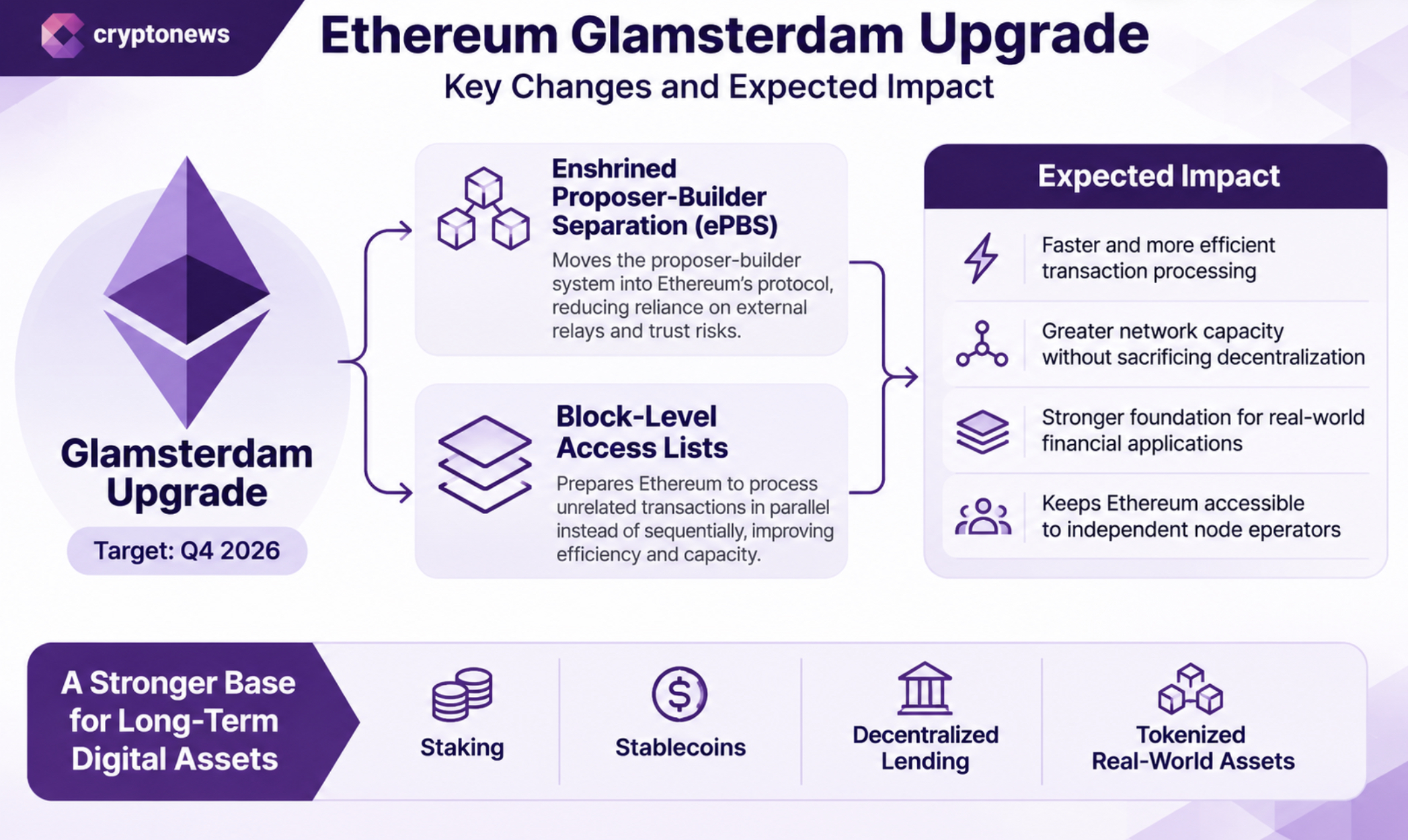
Ethereum’s development roadmap increasingly focuses on making the network faster, more efficient, and harder to disrupt. Its next major upgrade, Glamsterdam, is currently undergoing devnet testing, with a mainnet launch expected in Q4 2026. The upgrade introduces several changes designed to improve Ethereum’s capacity without sacrificing decentralization.
One major feature is Enshrined Proposer-Builder Separation (ePBS). It moves the relationship between block proposers and builders directly into Ethereum’s protocol, reducing reliance on external relays and additional trust assumptions.
Another important development is Block-Level Access Lists. The feature prepares Ethereum to process unrelated transactions in parallel rather than handling everything sequentially.
These improvements could help Ethereum support more financial applications while keeping its infrastructure accessible to independent node operators. So, if digital assets are expected to become long-term financial instruments rather than vehicles for short-term speculation, this is very much needed.
Ethereum also provides an established foundation for staking, stablecoins, decentralized lending, and tokenized real-world assets. These applications could give investors more ways to hold and use digital wealth without constantly trading volatile tokens.
Yet, security, reliable applications, and responsible financial products must develop alongside network capacity.
Discover: The Crypto Presales This Q4 2026
ETH Price Struggles to Reflect Ethereum’s Long-Term Ambitions

Ethereum’s market performance presents a contrasting picture. ETH is trading just a notch above $1,800. This leaves the coin 63% below its all-time high of $4,946. The decline highlights the gap between Ethereum’s technological ambitions and its current market valuation.
Ethereum’s network utility and ETH’s investment performance are also not interchangeable. More applications and transactions can strengthen the ecosystem, but they do not create proportional demand for ETH.
The token still plays an important role as Ethereum’s native transaction currency, staking asset, and collateral across decentralized finance. For this reason, continued growth in staking, stablecoins, and tokenized assets could strengthen ETH’s underlying investment narrative.
Buterin’s comments are bigger than a debate about housing affordability. He is effectively challenging the crypto industry to build assets and platforms that encourage long-term ownership rather than constant speculation.
Ethereum has several pieces of that foundation already, including proof-of-stake security, smart contracts, and an expanding financial ecosystem.
Its upcoming upgrades aim to improve the infrastructure supporting those applications. But the network still needs to prove that its technology can deliver dependable financial products at scale.
Discover: The Best Token Presales
The post Vitalik Buterin Wants Crypto to Have Housing’s Stability, But Can Ethereum Deliver? appeared first on Cryptonews.