
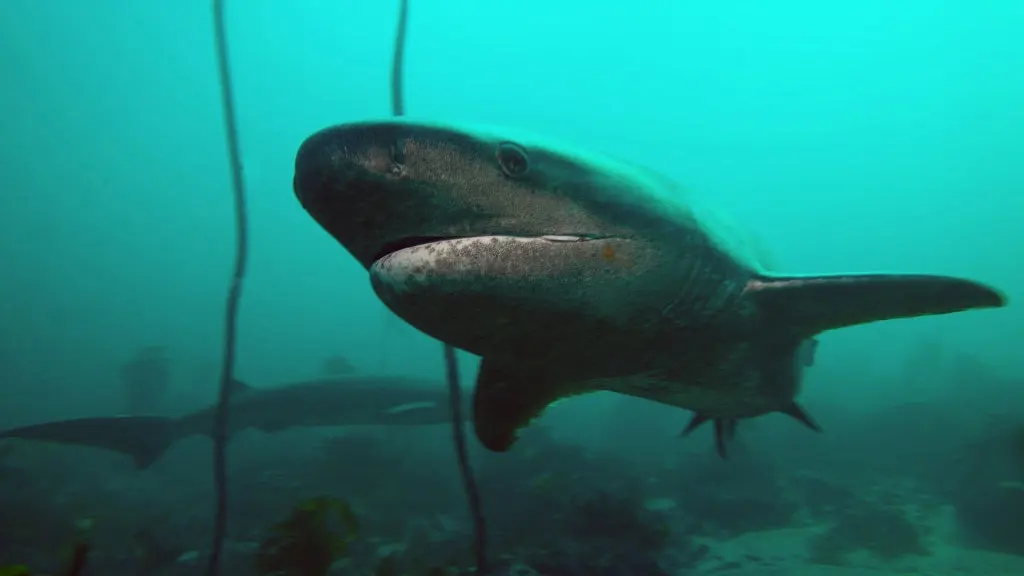
A video making the rounds on social media Sunday shows a massive deep-water shark getting up close and personal with a group of scientists inside a submersible.
And when I say up close and personal, I mean it.
This page may contain affiliate links to legal sports betting partners. If you sign up or place a wager, FOX News may be compensated. This content was created by a team that works independently from the FOX newsroom.
CLICK HERE FOR MORE COVERAGE FROM OUTKICK OUTDOORS
In the footage, the shark slowly circles the vessel, seemingly just as curious about its human visitors as they are about her. At one point, she swims right up to the viewing window and presses her snout against the glass.

A Broadnose sevengill sharks is photographed near Durban, South Africa. (Anadolu via Getty Images)
The video is spectacular, but it isn’t new. The encounter actually happened back in June 2019, roughly 1,700 feet beneath the surface of the Atlantic Ocean near the Bahamas.
Check out the piercing blue eye at the 52-second mark.
The shark is a bluntnose sixgill, a deep-water species that can grow up to 20 feet long. Researchers estimated that the particularly inquisitive female in the video measured about 16-17 feet.
And as incredible as the footage is, the story behind it might be even cooler.
Scientists got more than they bargained for during deep-sea shark expedition
The encounter occurred during an expedition by OceanX, an ocean exploration organization working alongside marine scientists to study the bluntnose sixgill shark.
The team traveled to the deep waters of Exuma Sound aboard the research vessel Alucia, hoping to accomplish something that had never been done before: attach a satellite tracking tag to a sixgill shark without bringing it to the surface.
THE BIGGEST NAMES AND WILDEST STORIES IN THE GREAT OUTDOORS. WATCH ‘OPEN SEASON’ ON YOUTUBE!
Previously, researchers studying these animals had to capture them and haul them up from the depths. But that process can stress the sharks and disrupt their natural behavior, making it difficult to collect reliable data about how they actually live.
Using OceanX’s three-person submersible, Nadir, the team descended into the darkness with roughly 100 pounds of bait to attract the sharks.

A submersible is lowered by crane from the OceanXplorer, a research vessel operated by the marine non-profit OceanX, for a deep-sea mission in the waters off Sulawesi island, Indonesia, on Jan. 12, 2026. (AFP via Getty Images)
After several unsuccessful attempts involving bad weather, equipment problems and even a grouper that interfered with the tagging process, the researchers finally got their chance on June 29.
According to the Florida Museum of Natural History, scientist Gavin Naylor successfully attached a satellite tag to a male sixgill shark more than 1,700 feet underwater.
It was the first time scientists had successfully tagged one at depth in its natural habitat.
But the team also encountered several other sharks during the dive, including the enormous female that stars in the viral video.
FORREST GALANTE SAYS MOST SHARK BITES ARE A CASE OF MISTAKEN IDENTITY AS FLORIDA ATTACKS LEAD THE US
“She was studying us,” Naylor told the Florida Museum. “It was delightful for me to see a shark being curious. We’d be arrogant to think we were the only ones doing the evaluating.”
Prehistoric giants are just casually lurking in the deep
Bluntnose sixgill sharks are among the largest predatory sharks in the ocean, although most people will never see one. That’s because these animals spend much of their lives hundreds or even thousands of feet below the surface. Some have been documented at depths approaching 6,500 feet.

The viral shark encounter happened off the coast of Exuma in The Bahamas. (iStock)
They’re also pretty much living fossils. According to the Florida Museum, sixgills closely resemble sharks that swam the oceans roughly 200 million years ago.
Way down there, sixgills aren’t generally a threat to humans. They spend their days hunting fish, squid and other marine life, occasionally scavenging larger carcasses.
SIGN UP FOR THE DAILY OUTKICK NEWSLETTER
And considering how little we still know about what goes on in the depths of our oceans, it’s pretty fascinating to think about what else might be lurking down there.
Fascinating and utterly terrifying.
Love all things fishing and outdoors? Follow OutKick OutDoors on Instagram, TikTok and YouTube!