

Two of my pals — Andrew Biggs (“No, Social Security Isn’t Earned”) and Gene Steuerle (“Lifetime Social Security Benefits and Taxes”) — are making my mind ache. They are each arguing that individuals will get lifetime Social Security advantages far in extra of lifetime contributions, and the “unearned” portion of future advantages ought to be on the chopping block.
Read: This is the scariest quantity for Social Security
Let me make three feedback after which handle the underlying problem.
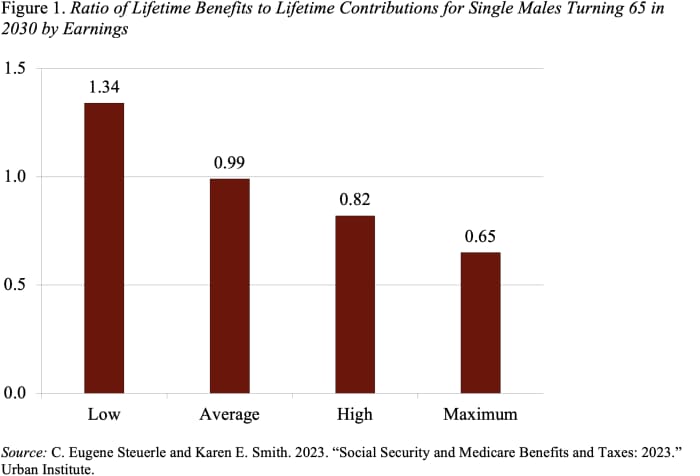
First, the individuals who obtain advantages in extra of contributions will not be the group that anybody would goal for cuts (see Figure 1).
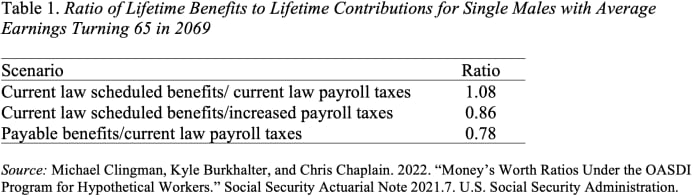
Second, any train that appears at scheduled advantages and present taxes after 2030 is deceptive, because the program can’t pay scheduled advantages with out new income. Hence, the Social Security actuaries embody “increased-tax” and “reduced-benefit” eventualities, which completely change the story (see Table 1).
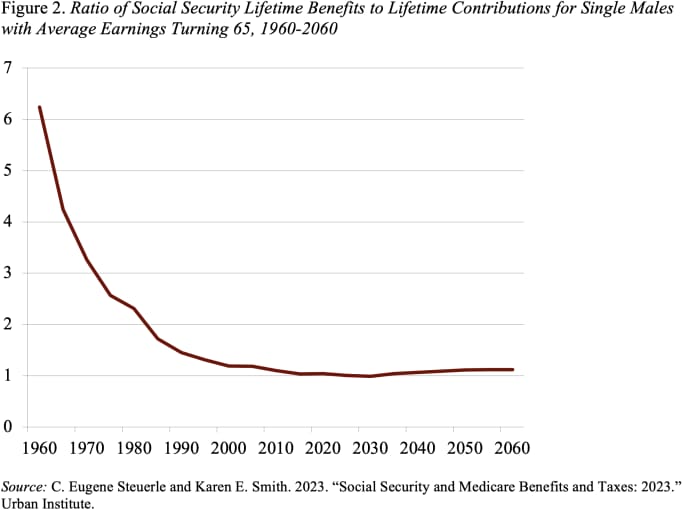
Third, the common male employee did obtain advantages in extra of contributions for many years. But, the scenario has improved dramatically (see Figure 2).
The larger query is why the profit/contribution ratio was so excessive traditionally and what that suggests about Social Security’s funds going ahead.
Read: As you close to retirement, scrutinize your Social Security assertion. Here’s what catches an adviser’s eye.
With the exception of the buildup of reserves within the wake of the 1983 amendments and the upcoming depletion of those reserves, Social Security has usually been financed on a pay-as-you-go foundation. This funding technique differs sharply from the unique 1935 laws, which envisioned the buildup of belief fund belongings like personal insurance coverage. The 1939 amendments, nevertheless, essentially modified the character of this system and resulted in payroll tax receipts getting used to pay advantages to retirees far in extra of their contributions. In essence, we gave away the belief fund.
The value to Social Security of giving freely the belief fund is the distinction within the required contribution charge to finance advantages beneath a funded retirement plan in contrast with a pay-as-you-go system. Under a funded system, the mixed employer-employee contribution charge for a typical employee can be 11.2% of earnings to attain a current-law scheduled profit equal to 36% of common listed earnings. Under our pay-as-you-go system, the whole value is 14.9%. The ensuing distinction — 3.7% of payroll — is as a result of presence of a belief fund that may pay curiosity in a funded system however is lacking within the pay-as-you-go system (see Figure 3).
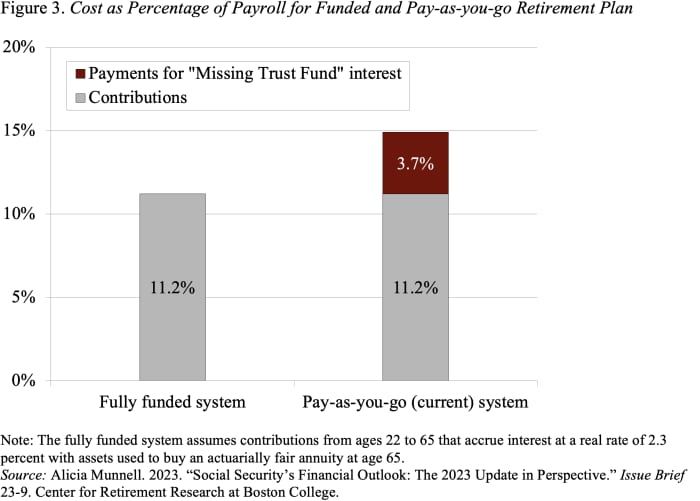
How this extra value related to the lacking belief fund ought to be financed is an actual problem. Should staff be requested to pay greater than the “normal cost” related to a funded plan or ought to among the financing come from basic revenues?
In no case, nevertheless, do disparities between lifetime contributions and lifelong advantages present any steerage on how the shortfall in Social Security’s 75-year financing ought to be resolved.