
Hacks have always been part of crypto, but in 2026, it does look like we are noticing more and more of them, especially on custodial platforms. This year alone there has been hundreds of millions of dollars drained from exchanges, bridges, and protocols that hold user funds in centralized wallets.
As crypto news “scream” about the latest hacks, a quieter, more resilient model continues to operate without making the news: non-custodial swaps.
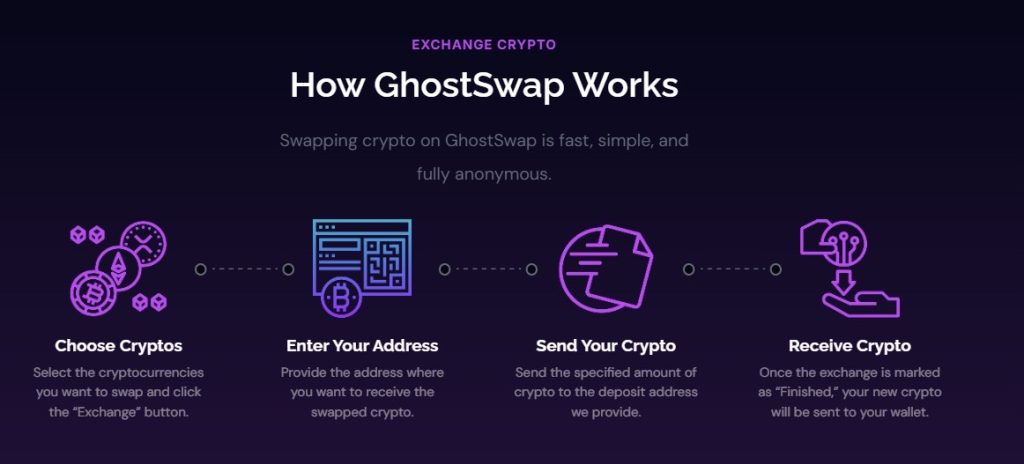
GhostSwap is a non-custodial crypto exchange where funds are never in a shared pool waiting to be drained. Instead, assets route directly from the user’s wallet to the destination address, which drastically reduces the attack surface compared to traditional custodial platforms.
Curious to understand what this actually means? Bear with us, please.
The 2026 Custodial Hack Wave
The numbers regarding crypto hacks this year are worrying, to say the least. In the first four months of 2026 alone, custodial platforms lost over $670 million to hacks and exploits. Here are some of the most biggest incidents:
KelpDAO suffered a $292 million loss on April 18, 2026, through an infrastructure attack via the LayerZero bridge. The custodial bridge/L2 platform proved vulnerable to a single point of failure in its cross-chain infrastructure.
Drift Protocol (which is basically a custodial perpetuals exchange on Solana) lost $285 million on April 1, 2026, through a combination of smart contract vulnerability and compromised admin keys. The attack exposed the risks of relying on centralized administrative controls.
Grinex, a custodial CEX operating in Kyrgyzstan with Russian links, had $13.7 million in USDT drained from 54 wallets on April 15, 2026. The attack showed that even smaller exchanges with less visibility are prime targets.
Step Finance lost $28.9 million between January and February 2026 through compromised executive email accounts and private keys. That breach is particularly interesting since it shows how even human factors (such as email access, or credential management) remain critical vulnerabilities.
Truebit Protocol suffered a $26.4 million exploit on January 9, 2026, through “zombie code” in its smart contracts; a reminder that legacy code can become a ticking time bomb.
ResolvLabs, a custodial stablecoin issuer, lost $25 million in March 2026 through an AWS KMS key management vulnerability. Even infrastructure giants like Amazon aren’t immune to configuration errors.
If a series of news about hundreds of millions in losses doesn’t make you think twice about keeping your assets on a custodial exchange, then honestly, what will?
This is where GhostSwap comes into play.
Why the Attack Surface Is Smaller with GhostSwap
GhostSwap’s non-custodial model doesn’t claim to be unhackable. To be completely honest, no system is in crypto. However, it drastically reduces the attack surface by eliminating several high-value targets that attackers typically go after.
In a custodial exchange, users deposit assets into exchange-controlled wallets. This creates large, tempting pools of customer funds. GhostSwap operates differently: funds move through the swap process and are delivered directly to the destination wallet rather than being stored as long-term customer balances.
No Accounts Means No Account Database to Breach
There’s no honey pot waiting to be drained.
Traditional exchanges maintain extensive databases of user accounts, login credentials, and often identity records. This creates multiple attack vectors: credential stuffing, password theft, and account takeovers.
GhostSwap’s no-account approach removes entire categories of risk. There is no user database to breach, no login system to compromise, and no credentials to steal.
Minimal Personal Data Reduces Exposure
Because GhostSwap doesn’t require routine account creation or standard KYC processes for most swaps, there is far less sensitive user information available to steal. The platform follows a data-minimization strategy, which collects only what’s necessary to complete a swap.
This means even if an attacker were to breach GhostSwap’s systems, there would be little valuable personal data to exfiltrate.
No Large Customer-Fund Pool to Drain
Perhaps the biggest and most significant difference is the absence of a centralized pool of customer assets. GhostSwap’s wallet-to-wallet swap model avoids maintaining a shared pool that could be drained in a single compromise.
When you compare this to custodial platforms, it’s pretty clear even to a newbie that a single successful attack can empty millions from a single wallet. GhostSwap’s model distributes risk across individual transactions, and eliminates the giant target.
The Refund-Address Safety Mechanism
A key operational safeguard in GhostSwap’s model is the refund address. During a swap, users provide both:
- A destination address where they want to receive the output asset
- A refund address where the original funds can be returned if the swap cannot be completed
This dual-address system provides a critical safety net. If a transaction encounters a problem (such as a routing issue, liquidity problem, or another failure condition) the refund address gives GhostSwap a predefined destination for returning funds when possible. This reduces the risk of assets becoming stranded during an incomplete swap and provides a clear recovery path.

It’s a simple but very effective mechanism. Rather than user funds remaining in limbo while support teams investigate, the refund address enables automated recovery. The asset has a defined path home.
GhostSwap Offers High-Standard Security
So, let’s conclude with this – Imagine waking up to check your portfolio, only to discover that the exchange where you kept your funds has been drained overnight. This happened to thousands of traders in 2026, so it’s not hypothetical.
When Drift Protocol lost $285 million on April 1, traders who had funds on the platform couldn’t access their assets for days. When KelpDAO lost $293 million just weeks later, many users watched their holdings vanish with no clear path to recovery.
Traders who use GhostSwap avoid this entire category of risk. Your funds move directly from your wallet to the swap route and land in your destination wallet; never held in a GhostSwap-controlled pool where they could be swept away in a single attack.
When you hear about the next custodial breach, and there will be a next one, you won’t have to panic about whether your funds were caught in the crossfire.
This peace of mind isn’t just theoretical anymore. In a year where over $670 million has been stolen from custodial platforms in the first four months alone, GhostSwap’s non-custodial model has proven its value by simply not appearing in the hack news.
Traders who value their assets and their sleep are increasingly turning to non-custodial swaps, not just for privacy, but for the security of knowing their funds are never held by the platform they’re trading on.
GhostSwap’s non-custodial model doesn’t eliminate all risk, but it does reduce the chance for the hack to happen. When there’s no honey pot, there’s less honey to steal.
The post Funds Never Held: GhostSwap’s Non-Custodial Model vs the 2026 Hack Wave appeared first on Cryptonews.