
What's Hot

    Andy Ogles targets ‘chain migration’ in huge authorized immigration overhaul | Invesloan.com

    March 13, 2026

    ‘Healthcare is important to me’: I’m apprehensive about relocating to Florida from New Jersey. Are hospitals there underneath stress? | Invesloan.com

    March 13, 2026

    Amazon Data Scientist Lives a 7-Minute Walk Away From Office | Invesloan.com

    March 13, 2026
    Facebook Twitter Instagram
    Finance Pro
    Facebook Twitter Instagram
    invesloan.cominvesloan.com
    Subscribe for Alerts
    • Home
    • News
    • Politics
    • Money
    • Personal Finance
    • Business
    • Economy
    • Investing
    • Markets
      • Stocks
      • Futures & Commodities
      • Crypto
      • Forex
    • Technology
    invesloan.cominvesloan.com
    Home » Old Bug May Have Cost Balancer DeFi Protocol Over $100M | Invesloan.com
    Crypto

    Old Bug May Have Cost Balancer DeFi Protocol Over $100M | Invesloan.com

    November 4, 2025
    Share
    Facebook Twitter LinkedIn Pinterest Email

    Key Takeaways:

    • Balancer DeFi protocol suffered an exploit on Nov. 3, with estimated losses between $100 million and $120 million.
    • The attack targeted V2 Composable Stable Pools, while V3 remained unaffected. Early analysis links the vulnerability to a similar bug first identified in 2023.
    • Researchers found that parts of the exploit code contained AI-generated traces, suggesting possible use of large language models.
    • Analysts traced the root cause to rounding and batch swap calculation errors in the Balancer Vault.

    The week started badly for the Balancer DeFi protocol, with yet another exploit shaking one of DeFi’s oldest projects. Early estimates put the losses between $100 million and $120 million, making it one of the biggest hacks of the year. What makes it worse is the familiarity of it all.

    The vulnerability behind this attack traces back to a bug first spotted in 2023, now resurfacing in a more complex form. We looked into what happened, why it matters, and what this says about the current state of DeFi security.

    You might also like
    Balancer DeFi Protocol Recovers $19.3M Hours After Multi-Million Hack

    Audits Didn’t Save Balancer DeFi Protocol

    Balancer DeFi protocol is one of the projects in decentralized finance, operating as an automated market maker (AMM) that provides liquidity across multiple pools. The protocol has been active for several years in DeFi. Many in the crypto community pointed out that Balancer DeFi protocol had passed several security audits — something usually seen as a mark of reliability.

    balancer went through 10+ audits. the vault was audited 3 separate times by different firms

    still got hacked for $110M

    this space needs to accept that 'audited by X' means almost nothing. code is hard, defi is harder

    it is unfortunate but hope the team recovers pic.twitter.com/nZzVzCdqDO

    — Suhail Kakar (@SuhailKakar) November 3, 2025

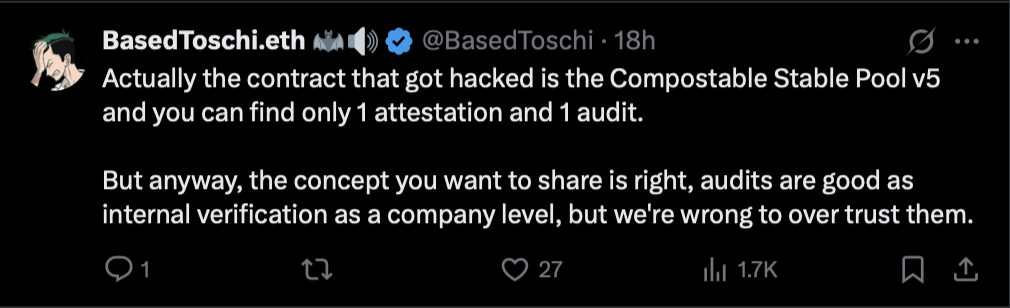
    However, that raised even more questions when the protocol was exploited again this November. How could Balancer DeFi protocol, with so many audits behind it, still fall victim to a hack? One user on X (formerly Twitter) noted that the vault affected this time had been audited only once.

    Source: X

    Old Bugs, New Faces

    The exploit appears to have targeted the same V2 Composable Stable Pools that were previously involved in a vulnerability back in August 2023. At that time, the project also faced a serious technical issue, but the team managed the situation effectively. Developers praised how quickly Balancer DeFi protocol reacted and openly communicated with the community.

    In August 2023, Balancer’s cooperation with a white-hat hacker known as GothicShanon89238 through Immunefi played a crucial role. The hacker discovered a flaw and responsibly disclosed it, receiving a $130,000 bounty. The vulnerability was found in linear pools (ERC4626).

    NOTE:

    The majority of funds on Balancer are safe.

    Only 1.4% of the total TVL is at risk, and only boosted pools are affected.

    Several pools are paused to mitigate risks and will remain so, with users advised to withdraw liquidity as soon as possible.https://t.co/xcT1OfALs2

    — Balancer (@Balancer) August 22, 2023

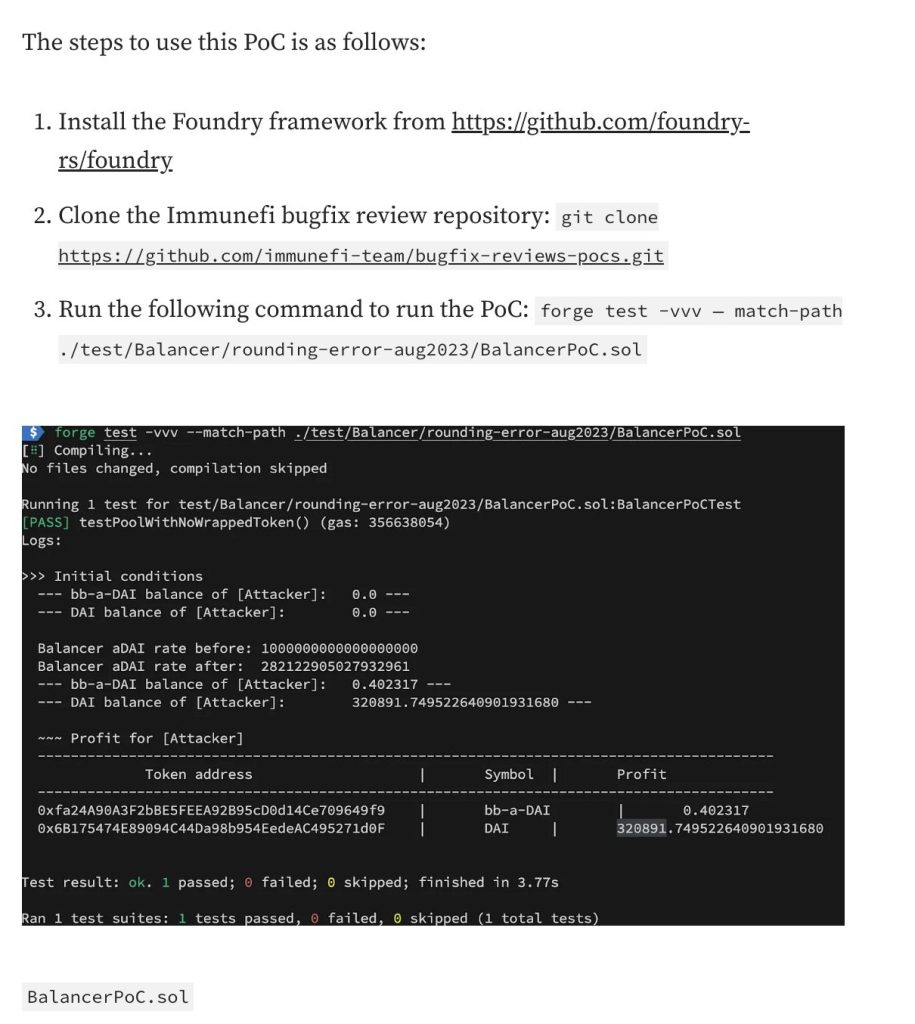
    During token swaps of very small wrapped-asset volumes, a rounding error caused the pool to withdraw an equivalent amount of base tokens at a 1:1 ratio, even though the wrapped token had a higher value. Under specific conditions, this allowed users to gradually extract value from the pool, threatening a large portion of its liquidity.
    Source: Immunefi’s Medium page

    Immunefi later praised the protocol in a Medium post, noting that “Balancer also did an amazing job identifying the best mitigation plan, even with limited admin access to affected pools.”

    In October 2023, Balancer DeFi protocol released a detailed report explaining the incident and the steps the team took to mitigate the issue. Ironically, that transparency earned Balancer recognition across DeFi circles and strengthened its reputation for openness.

    History Repeats Itself in 2025

    On Nov. 3, 2025, Balancer DeFi Protocol returned to the spotlight after another exploit. The official team has not yet published a post-mortem, but early reports indicate that the incident once again involved V2 Composable Stable Pools, while V3 pools appear unaffected.

    The researcher Adi conducted an initial investigation and suggested that the attacker used a specially designed contract that, during pool initialization, managed to manipulate internal calls within the Balancer Vault. The vulnerability in authorization handling and callback logic allowed the attacker to bypass protections and perform unauthorized swaps, draining several interconnected pools.

    Here's everything you need to know about the Balancer Hack:

    1. The attack targeted Balancer's V2 vaults and liquidity pools, exploiting a vulnerability in smart contract interactions. Preliminary analysis from on-chain investigators points to a maliciously deployed contract that… pic.twitter.com/udAM4hB0OD

    — Adi (@AdiFlips) November 3, 2025

    At first glance, the mechanism of the attack resembles the 2023 issue with ERC4626 rounding. However, the 2025 exploit appears to go deeper. It was not a calculation flaw but an architectural one. While the 2023 bug was a singular error, this time the exploit exposed potential weaknesses in the very structure of Balancer V2 under certain conditions.

    Later researchers discovered that the attacker’s contract still contained console.log statements, typical debug traces that are usually removed before deployment. These logs are often found in code generated by AI tools such as ChatGPT or other large language models. This led to speculation that the exploit might have been at least partially written with AI assistance.

    Balancer hacker just left console logs on-chain.

    might sound small, but it’s actually wild

    real hackers never leave console.log in production code.

    When you see something like that, it usually means one thing the exploit was AI-generated or copy-pasted.

    LLMs always sprinkle… pic.twitter.com/nBG3VZobBZ

    — RayRay (@rayray_1_) November 4, 2025

    If this version is confirmed, it could become one of the first recorded cases of an AI-assisted hack in the DeFi sector.

    Lessons for DeFi

    Security analysts from GoPlus Security believe that the root cause of the new exploit lies in the same kind of rounding issue previously found in Balancer Vault. Their analysis suggests that the vulnerability involved rounding-down precision losses within swap calculations. Each swap slightly mispriced the pool’s internal ratios, and when combined into a batchSwap, the losses compounded.

    This allowed the attacker to manipulate pool prices and withdraw funds at a profit. The 2025 Balancer DeFi protocol attack can therefore be seen as an evolved version of the 2023 rounding bug — more complex, more damaging, and highlighting once again how mathematical precision can make or break a DeFi protocol.

    The batchSwap function amplified the issue, just as it did in the previous vulnerability.

    This incident demonstrates that even long-standing DeFi protocols with multiple audits are not immune to fundamental design flaws. Balancer DeFi protocol became another reminder of how technical debt in decentralized systems can accumulate quietly and reappear years later in new forms.

    The post Old Bug May Have Cost Balancer DeFi Protocol Over $100M appeared first on Cryptonews.

    Share. Facebook Twitter Pinterest LinkedIn Tumblr Email

    Keep Reading

    Bitcoin Price Prediction: Major Miner Just Expanded in Texas: Is a Massive BTC Production Surge Coming? | Invesloan.com

    Crypto Price Prediction Today 25 February: XRP, Solana, Bitcoin | Invesloan.com

    Hong Kong to Link New Digital Bond Platform With Regional Crypto Tokenization Hubs | Invesloan.com

    An AI Crypto Agent Sent a ‘Beggar’ Six Figures, Then He Lost It All This Way | Invesloan.com

    Ethereum Locks In FOCIL for 2026 as Foundation Moves $6.8M ETH to Staking | Invesloan.com

    Bitcoin Price Prediction: $400 Million Suddenly Pulled From ETFs — Is Smart Money Quietly Exiting BTC? | Invesloan.com

    Crypto Price Prediction Today 24 February – XRP, Bitcoin, Ethereum | Invesloan.com

    XRP Price Prediction: Arizona Just Named XRP in a State Crypto Reserve Bill — Is Government Adoption Beginning? | Invesloan.com

    Bitpanda Offers €15 in Silver to New Users Trading €50 in Metals | Invesloan.com

    LATEST NEWS

    Andy Ogles targets ‘chain migration’ in huge authorized immigration overhaul | Invesloan.com

    March 13, 2026

    ‘Healthcare is important to me’: I’m apprehensive about relocating to Florida from New Jersey. Are hospitals there underneath stress? | Invesloan.com

    March 13, 2026

    Amazon Data Scientist Lives a 7-Minute Walk Away From Office | Invesloan.com

    March 13, 2026

    Seeking Alpha interview: Andri Fauzan Adziima sees Bitcoin at $85K–$100K in 2026 | Invesloan.com

    March 13, 2026
    POPULAR

    China’s first passenger jet completes maiden commercial flight

    May 28, 2023

    Numbers taking US accountancy exams drop to lowest level in 17 years

    May 29, 2023

    Toyota chair faces removal vote over governance issues

    May 29, 2023
    Advertisement
    Load WordPress Sites in as fast as 37ms!
    Facebook Twitter Pinterest WhatsApp Instagram
    © 2007-2023 Invesloan.com All Rights Reserved.
    • Privacy
    • Terms
    • Press Release
    • Advertise
    • Contact

    Type above and press Enter to search. Press Esc to cancel.

    invesloan.com
    Manage Cookie Consent
    To provide the best experiences, we use technologies like cookies to store and/or access device information. Consenting to these technologies will allow us to process data such as browsing behavior or unique IDs on this site. Not consenting or withdrawing consent, may adversely affect certain features and functions.
    Functional Always active
    The technical storage or access is strictly necessary for the legitimate purpose of enabling the use of a specific service explicitly requested by the subscriber or user, or for the sole purpose of carrying out the transmission of a communication over an electronic communications network.
    Preferences
    The technical storage or access is necessary for the legitimate purpose of storing preferences that are not requested by the subscriber or user.
    Statistics
    The technical storage or access that is used exclusively for statistical purposes. The technical storage or access that is used exclusively for anonymous statistical purposes. Without a subpoena, voluntary compliance on the part of your Internet Service Provider, or additional records from a third party, information stored or retrieved for this purpose alone cannot usually be used to identify you.
    Marketing
    The technical storage or access is required to create user profiles to send advertising, or to track the user on a website or across several websites for similar marketing purposes.
    • Manage options
    • Manage services
    • Manage {vendor_count} vendors
    • Read more about these purposes
    View preferences
    • {title}
    • {title}
    • {title}